Speak with a licensed insurance agent

1-855-454-9051

TTY user 711 Mon-Fri : 8am-9pm EST

Medicare Advantage PPO Plans 2027: Networks, Costs and Out-of-Network Coverage

Reviewed by Russell Noga, Licensed Medicare Insurance Broker (all 50 states) — Last updated September 18, 2026

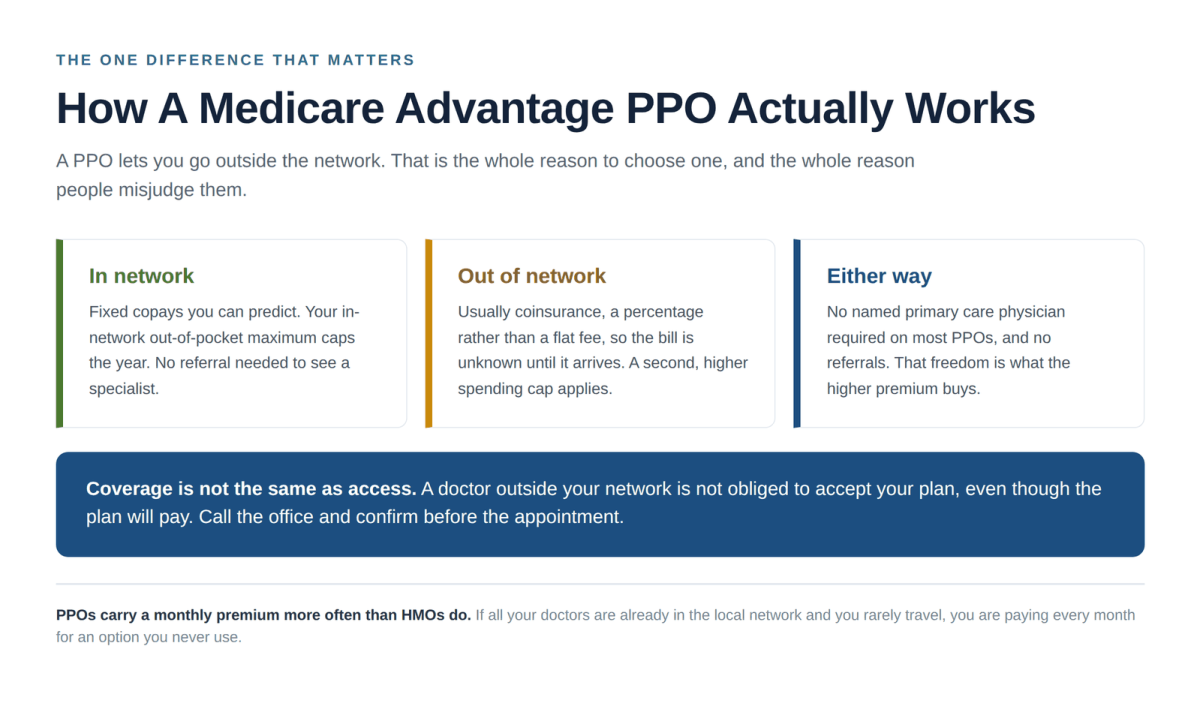
A Medicare Advantage PPO is the plan type that lets you see doctors outside the plan’s network. That single difference is why people choose one, and it is also the thing most often misunderstood, because out-of-network coverage is not the same as out-of-network affordability.

PPOs generally cost more each month than other Medicare Advantage plans and rarely require referrals. Whether that trade is worth it depends almost entirely on how settled your care is.

How Medicare Advantage PPO plans work with in network and out of network coverage in 2027

Compare Medicare Advantage PPO plans and enroll online

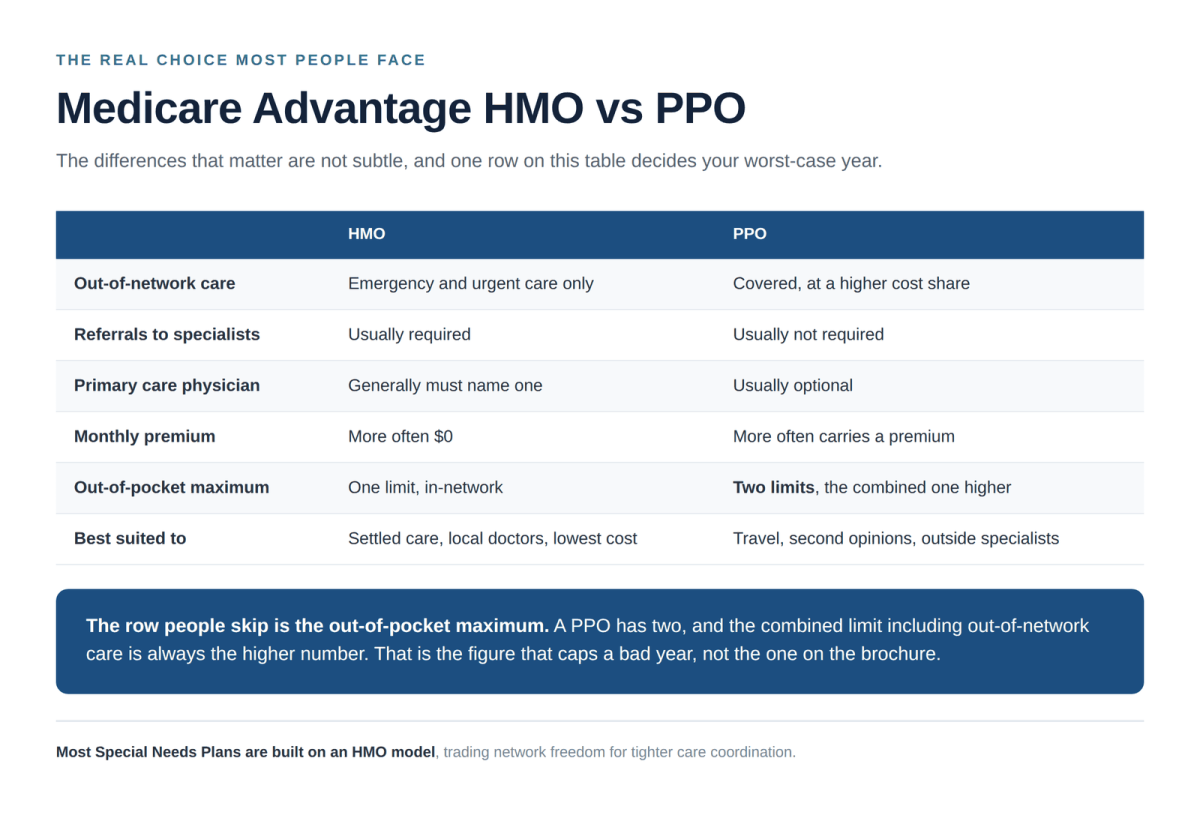
Medicare Advantage HMO vs PPO

Medicare Advantage HMO vs PPO compared on referrals networks premiums and out of pocket maximums

These are the two plan types most people are actually choosing between. The differences that matter are not subtle.

HMO PPO
Out-of-network care Emergency and urgent care only Covered, at a higher cost share
Referrals to specialists Usually required Usually not required
Primary care physician Generally must name one Usually optional
Monthly premium More often $0 More often carries a premium
Out-of-pocket maximum One limit, in-network Two limits: one in-network, a higher combined one
Best suited to Settled care, local doctors, lowest monthly cost Travel, second opinions, specialists outside the network

The row people skip is the last-but-one. A PPO has two out-of-pocket maximums, and the combined one that includes out-of-network care is always the higher number. If you plan to use the out-of-network freedom, that is the figure that determines your worst-case year, not the in-network one on the front of the brochure.

What Out-of-Network Actually Costs

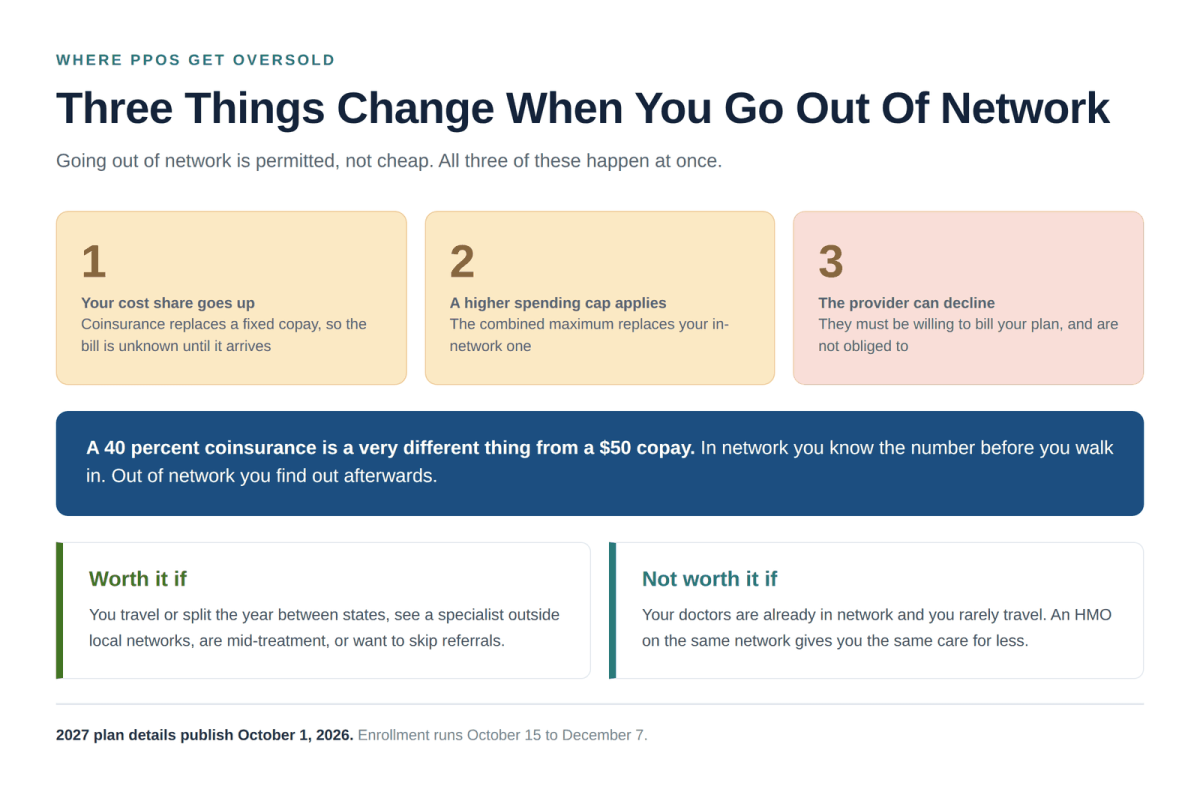
What out of network care costs on a Medicare Advantage PPO plan including coinsurance and the combined out of pocket maximum

This is where PPOs are oversold. Going out of network is permitted, not cheap, and three things change at once when you do.

Your cost share goes up

In-network you typically pay a fixed copay. Out-of-network you usually pay coinsurance, a percentage of the cost, which means you do not know the bill until it arrives. A 40 percent coinsurance on a procedure is a very different thing from a $50 copay.

A second, higher spending cap applies

Your in-network out-of-pocket maximum no longer protects you on its own. The combined maximum, covering in and out-of-network together, is the one that caps your year, and it is materially higher on every PPO.

The provider can decline

A doctor outside the network is not obliged to accept your plan, even though the plan will pay. They must be willing to bill it. Call and confirm before the appointment rather than assuming coverage equals access.

A PPO Does Not Mean No Prior Authorization

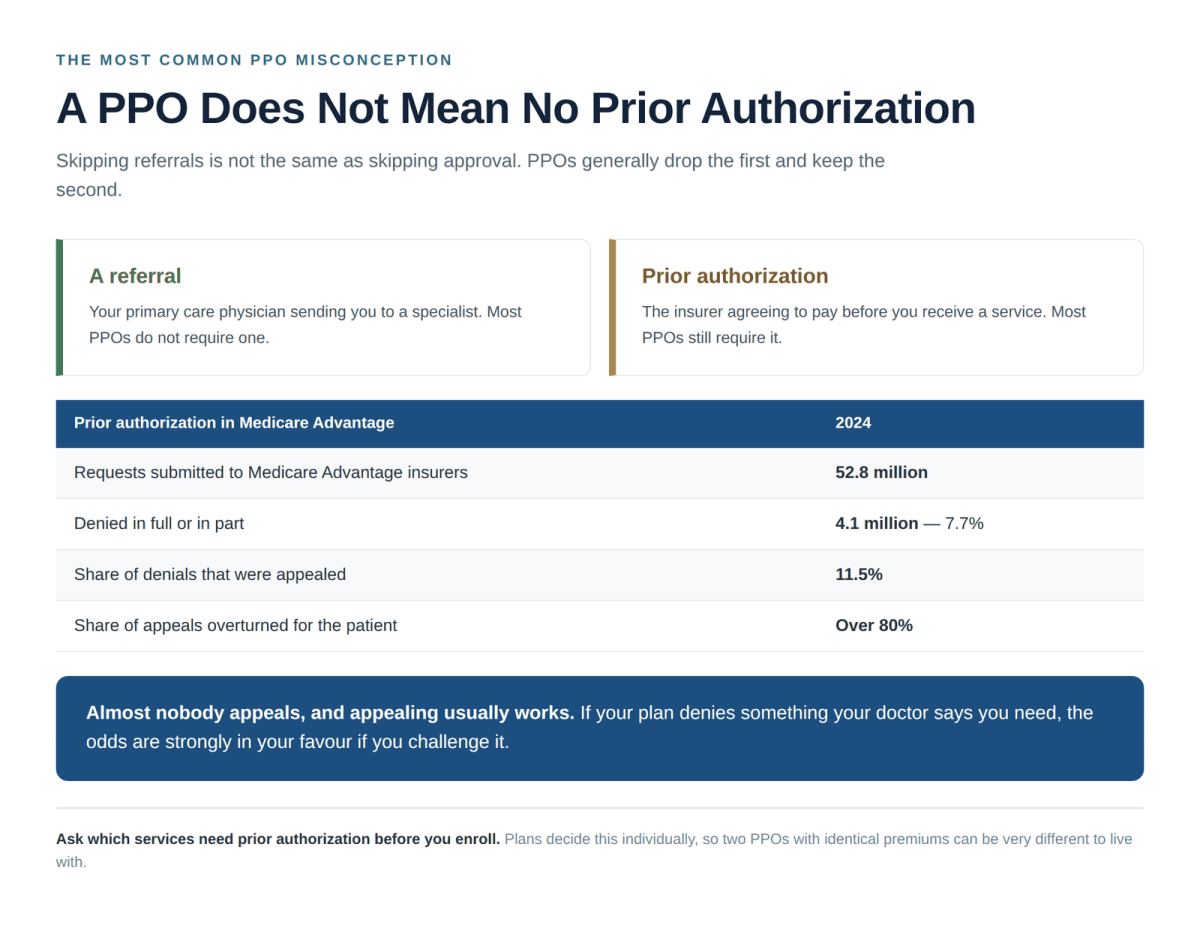
Medicare Advantage PPO prior authorization requirements and 2024 denial and appeal rates

This is the most common misunderstanding about PPOs. Skipping referrals is not the same as skipping approval. A referral is your primary care physician sending you to a specialist. Prior authorization is the insurer agreeing to pay before you receive a service. PPOs generally drop the first and keep the second.

Most Medicare Advantage plans, PPOs included, require prior authorization for higher cost services: hospital stays, skilled nursing facility care, advanced imaging such as MRI and CT, many outpatient procedures, and durable medical equipment. Routine office visits usually do not need it.

Prior authorization in Medicare Advantage 2024 figure
Requests submitted to Medicare Advantage insurers 52.8 million
Denied in full or in part 4.1 million, or 7.7 percent
Share of denials that were appealed 11.5 percent
Share of appeals overturned in the patient’s favour More than 80 percent

Two things follow from that table. Denials are uncommon but not rare, and almost nobody appeals them even though appealing works most of the time. If your PPO denies something your doctor says you need, the odds are strongly in your favour if you challenge it.

Before you enrol, ask the plan which services require prior authorization. Plans decide this individually, so two PPOs with identical premiums can be very different to live with.

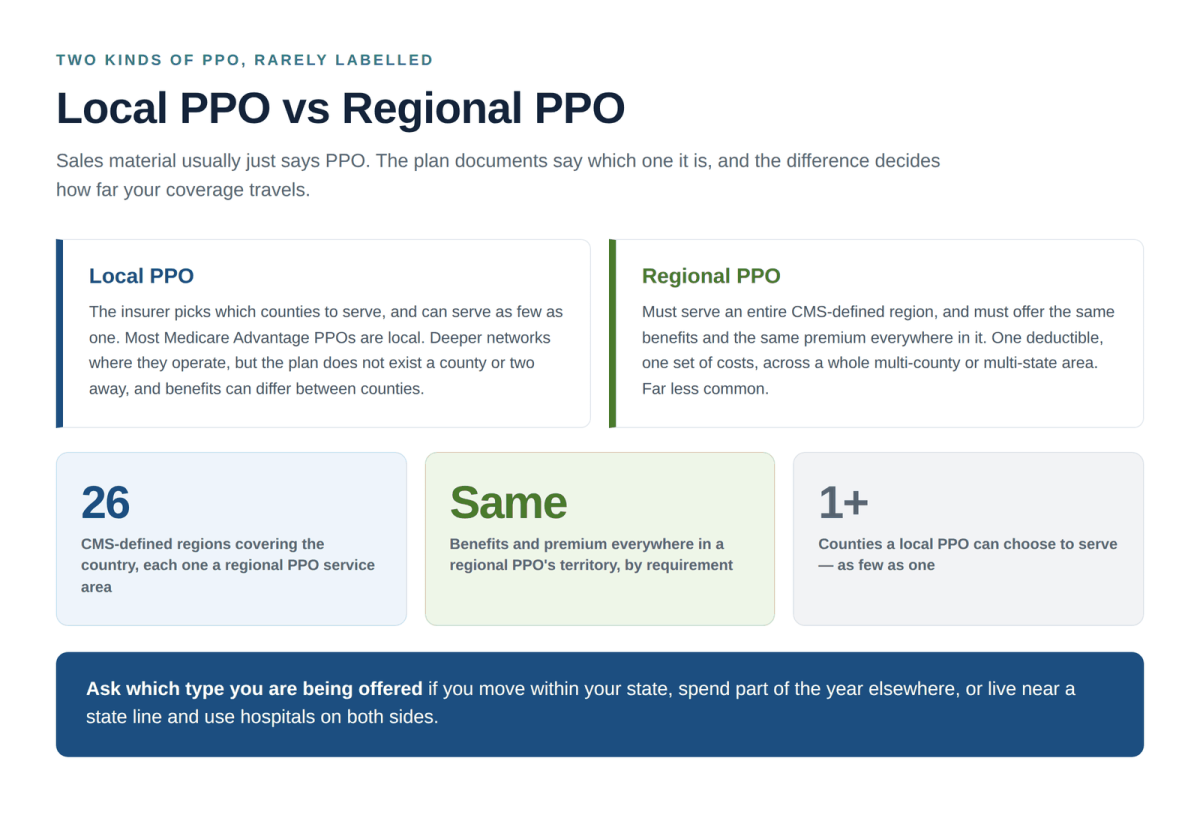
Local PPO vs Regional PPO

Local PPO vs Regional PPO Medicare Advantage plans compared on service area benefits and premiums

There are two kinds of Medicare Advantage PPO and they are not labelled clearly in most plan listings. The difference decides how far your coverage travels.

Local PPO

The insurer picks which counties to serve, and can serve as few as one. Most Medicare Advantage PPOs are local PPOs. Networks tend to be deeper where they operate, but the plan simply does not exist a county or two away, and benefits can differ between the counties one insurer serves.

Regional PPO

Must serve an entire CMS-defined region, of which there are 26 covering the country, and must offer the same benefits and the same premium everywhere in that region. That uniformity is the point: one deductible, one set of costs, across a whole multi-county or multi-state area. Regional PPOs are far less common than local ones.

If you move within your state, spend part of the year elsewhere, or live near a state line and use hospitals on both sides, it is worth asking which type you are being offered. Plan documents use the terms Local PPO and Regional PPO, but sales material usually just says PPO.

Find & Compare Plans Online

Speak with a licensed insurance agent

1-855-454-9051TTY 711

Mon-Fri: 8am-9pm ET

What You Will Pay in 2027

PPO premiums for 2027 publish on October 1, 2026 along with every other plan. The figures below are set by CMS and apply regardless of plan type.

Cost 2026 2027
Medicare Part B premium $202.90 $209.50 projected
Part D drug deductible $615 $700
Drug out-of-pocket cap $2,100 $2,400

You pay the Part B premium on top of any PPO premium. For what else CMS confirmed for next year, see Medicare Advantage plan changes for 2027.

Who a PPO Suits, and Who It Does Not

A PPO is usually worth it if

You split the year between two states or travel often. You see a specialist who is not in most local networks. You are mid-treatment and will not change doctors. You want to avoid referrals. Or you simply value the option and can afford the premium for it.

A PPO is usually not worth it if

All your doctors are already in the local network and you rarely travel. In that case you pay a higher premium every month for an option you never use, and an HMO with the same network gives you the same care for less. Paying for freedom you do not exercise is the most common mistake in this choice.

If you have VA health care, the calculation changes. A plan may be a backstop rather than your main coverage, which usually points the other way. See Medicare Advantage plans for veterans for how the PPO and HMO choice works alongside VA benefits.

Which Carriers Offer PPOs

Most large national carriers offer both HMO and PPO versions in the counties they serve, though availability varies. Detail on each:

If you qualify for a Special Needs Plan, note that most are built on an HMO model rather than a PPO, so that route generally trades network freedom for tighter care coordination.

When You Can Enroll

  • October 1, 2026 — 2027 plan details publish for every county
  • October 15 to December 7, 2026 — Annual Enrollment Period, for coverage from January 1, 2027
  • January 1 to March 31, 2027 — one switch allowed if you are already in an Advantage plan, which is when most HMO to PPO moves happen

Full detail on each window is in our guide to Medicare open enrollment for 2027.

Compare Medicare Advantage PPO plans and enroll online

Medicare Advantage PPO FAQ

  What is a Medicare Advantage PPO plan?

A PPO is a Medicare Advantage plan with a preferred provider network that also covers care outside that network at a higher cost share. You generally do not need referrals to see specialists and usually do not have to name a primary care physician. The trade is cost: PPOs more often carry a monthly premium than HMOs do.

  What is the difference between a Medicare Advantage HMO and PPO?

An HMO covers out-of-network care only for emergencies and urgent care, usually requires referrals to see specialists, and generally asks you to name a primary care physician. A PPO covers out-of-network care at a higher cost share, usually does not require referrals, and usually does not require a named primary care physician.

HMOs more often carry a $0 premium. PPOs more often carry one, and have two out-of-pocket maximums rather than one, with the combined limit that includes out-of-network care always being higher.

  Can I see any doctor with a Medicare Advantage PPO?

Any doctor who accepts Medicare and is willing to bill your plan. That last part matters, because a provider outside your network is not obliged to accept the plan even though the plan will pay. Confirm with the office before the appointment. You will also pay more, usually coinsurance rather than a fixed copay, so the bill is less predictable than an in-network visit.

  Do Medicare Advantage PPO plans cost more?

Usually, yes. PPOs carry a monthly premium more often than HMOs do, and their out-of-network cost sharing is higher. Whether that is worth paying depends on whether you will actually use the out-of-network freedom. If all your doctors are in the local network and you rarely travel, you are paying every month for an option you never exercise.

  Can I switch from an HMO to a PPO?

Yes, during the Annual Enrollment Period from October 15 to December 7, for coverage starting January 1. You can also make one switch between January 1 and March 31 if you are already in a Medicare Advantage plan, which is when most people move to a PPO after finding their HMO network too restrictive in practice.

Have Questions?

Speak with a licensed insurance agent

1-855-454-9051

TTY users 711

Mon-Fri: 8am-9pm ET

Find & Compare Plans Online

Speak with a licensed insurance agent

1-855-454-9051TTY 711

Mon-Fri: 8am-9pm ET

ZRN Health & Financial Services, LLC, a Texas limited liability company