





Speak with a licensed insurance agent

1-855-454-9051

TTY user 711 Mon-Fri : 8am-9pm EST

Medicare Advantage Plans for Veterans 2027: Using VA Benefits and Medicare Together

Reviewed by Russell Noga, Licensed Medicare Insurance Broker (all 50 states) — Last updated September 19, 2026

VA health care and Medicare are two separate systems that do not talk to each other. Neither replaces the other, and having VA benefits does not exempt you from Medicare’s rules. Most veterans end up better off holding both, but there is one decision that costs real money if you get it wrong, and it comes up at 65.

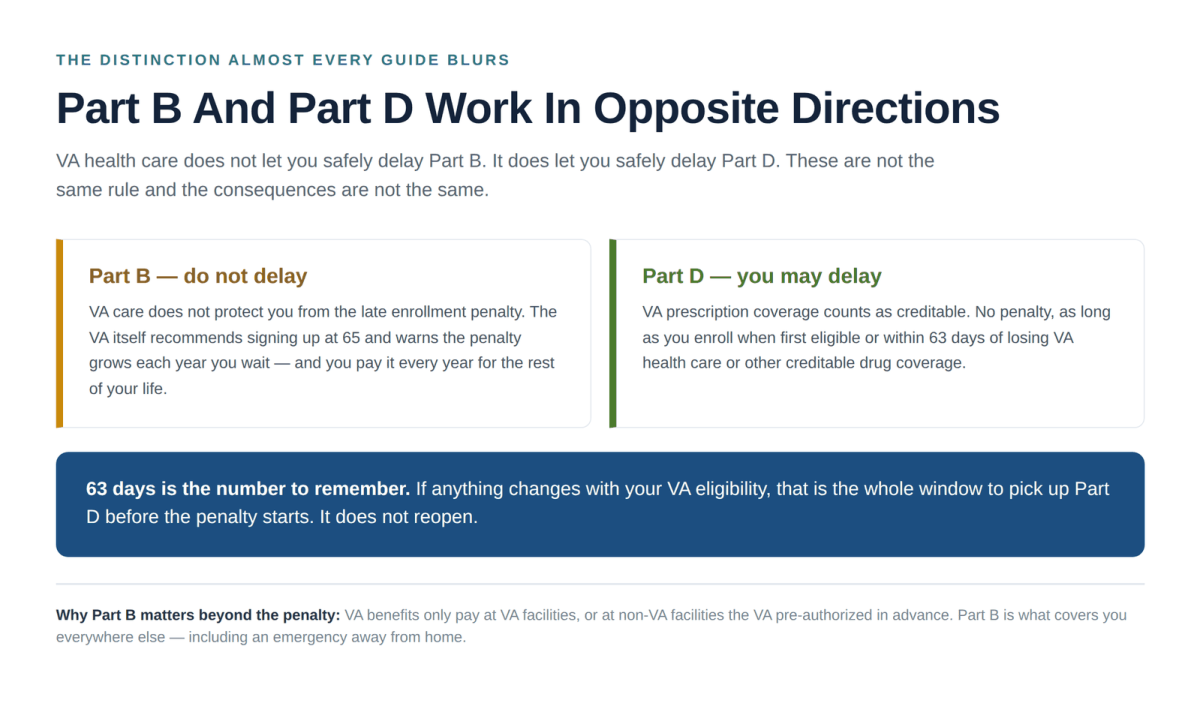
The short version: VA health care does not let you safely delay Medicare Part B, but it does let you safely delay Part D. Almost every guide on this subject blurs those two together. They are not the same, and the consequences are not the same.
How VA health care and Medicare Advantage work together for veterans in 2027 and who pays for care where

Compare plans and enroll online

The Part B Mistake That Follows You Forever

Why VA health care does not let veterans delay Medicare Part B without a lifetime late enrollment penalty

Plenty of veterans reach 65, look at their VA card, and decide they do not need Medicare Part B. It is an understandable conclusion and it is an expensive one.

The VA itself is direct about this. It recommends signing up for Part B when you first become eligible, and warns that if you delay and later need it, you will pay a penalty that grows for every year you waited and that you keep paying every year for the rest of your life. It does not go away once you enroll.

Why VA care is not enough on its own

VA benefits only pay for care you receive at a VA facility, or at a non-VA facility the VA has pre-authorized in advance. If you have a heart attack away from home, walk into a hospital that is not VA, or want to see a specialist the VA has not authorized, VA coverage does not follow you there.

Part B is what covers you in those situations. Veterans who skipped it have found out during the emergency rather than before it.

Part D Works the Opposite Way

Here is where the two parts split, and where most guidance gets it wrong.

VA prescription coverage counts as creditable drug coverage. The VA states there is no penalty for delaying Part D as long as you enroll when first eligible, or within 63 days of losing VA health care or other creditable drug coverage. So unlike Part B, you genuinely can leave Part D alone while your VA drug benefit is intact.

The 63 day clock is the thing to remember

If you lose VA health care for any reason, you have 63 days to pick up Part D coverage before the penalty starts accruing. Diarize it the day anything changes with your VA eligibility. That window is short and it does not reopen.

There is also a practical reason veterans take Part D anyway, even while VA coverage is fine: it lets you fill prescriptions at a local pharmacy rather than waiting on VA mail order. If you split your time between two states or travel, that convenience is often worth the premium on its own.

Find & Compare Plans Online

Speak with a licensed insurance agent

1-855-454-9051TTY 711

Mon-Fri: 8am-9pm ET

What a Medicare Advantage plan adds for veterans who already have VA health care in 2027

Can You Have VA Care and a Medicare Advantage Plan?

Yes. Nothing stops you holding both, and enrolling in Medicare does not affect your VA health care eligibility. The VA is explicit that whether or not you have other health insurance does not change the VA benefits you can get.

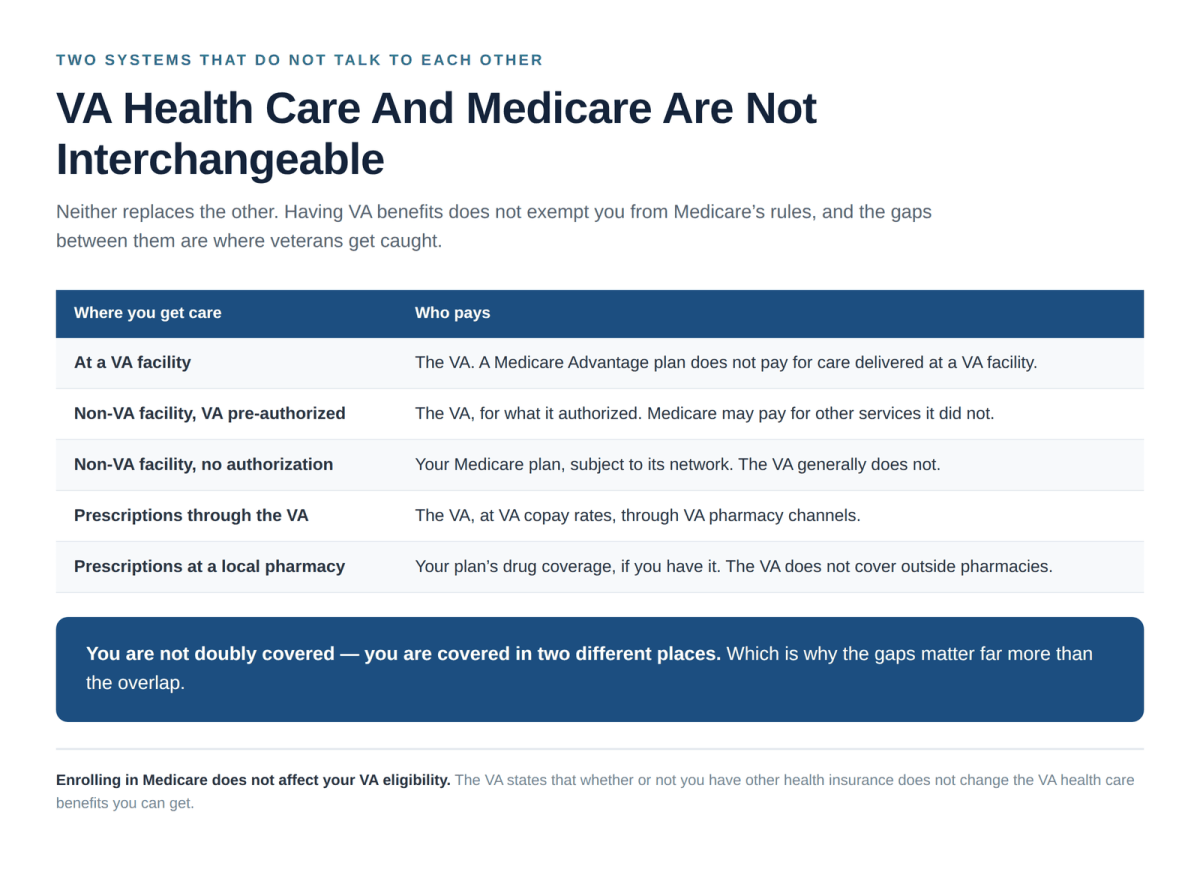
What changes is that you choose which system to use each time you need care, and the two do not pay each other’s bills.

Where you get care Who pays
At a VA facility The VA. Your Medicare Advantage plan does not pay for care delivered at a VA facility.
At a non-VA facility the VA pre-authorized The VA, for the services it authorized. Medicare may pay for other services it did not.
At a non-VA facility with no VA authorization Your Medicare Advantage plan, subject to its network and cost sharing. The VA generally does not.
Prescriptions through the VA The VA, at VA copay rates, through VA pharmacy channels.
Prescriptions at a local pharmacy Your plan’s drug coverage, if you have it. The VA does not cover outside pharmacies.

The practical consequence: you are not double covered, you are covered in two different places. Which is exactly why the gaps matter more than the overlap.

What a Medicare Advantage Plan Actually Adds

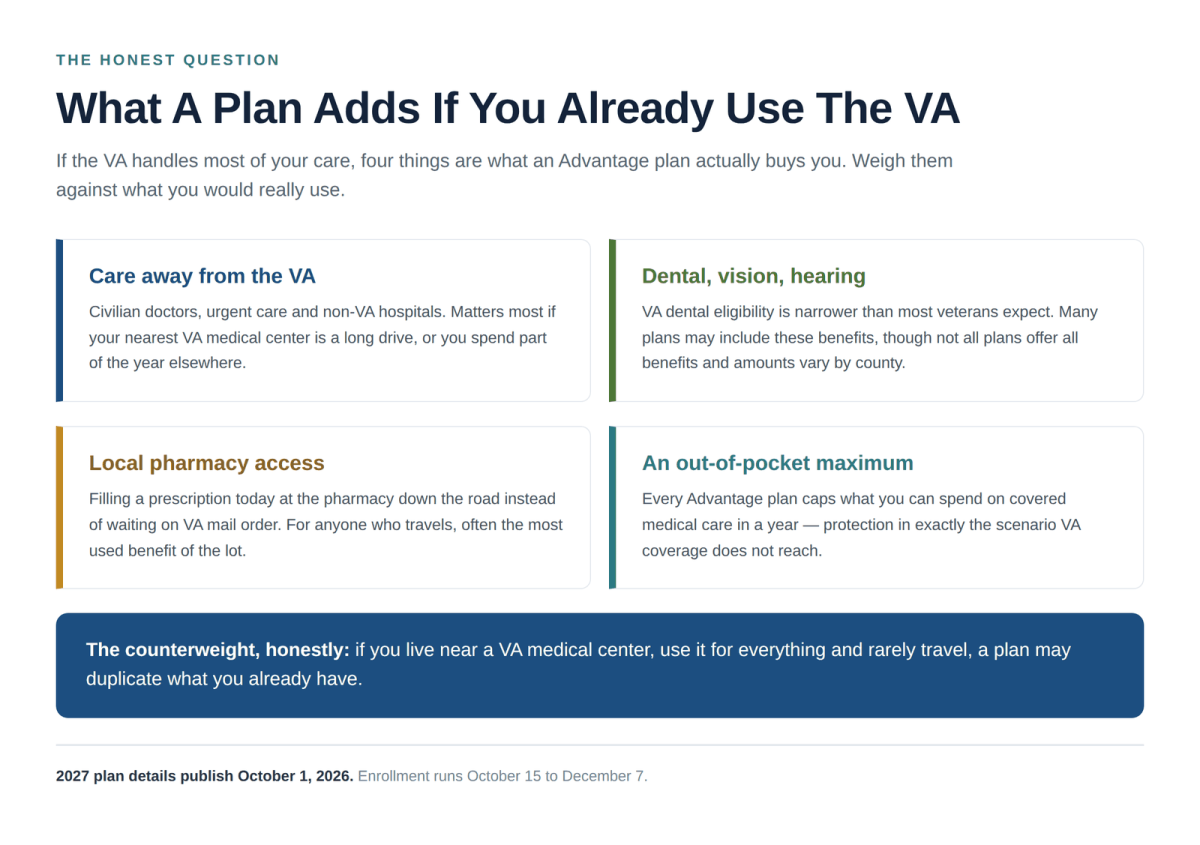
If you use the VA for most of your care, the honest question is what a plan adds beyond what you already have. Four things, usually.

Care away from the VA

Civilian doctors, urgent care, and hospitals that are not VA facilities. This matters most if your nearest VA medical center is a long drive, or if you spend part of the year elsewhere.

Dental, vision and hearing

VA dental eligibility is narrower than most veterans expect and depends on your rating and circumstances. Many Medicare Advantage plans may include dental, vision and hearing benefits, though not all plans offer all benefits and the amounts vary by plan and county.

Local pharmacy access

Filling a prescription today at the pharmacy down the road rather than waiting on VA mail order. For anyone who travels, this is often the single most used benefit.

An out-of-pocket maximum

Every Medicare Advantage plan caps what you can spend on covered medical care in a year. That cap protects you in exactly the scenario VA coverage does not reach: a serious illness handled outside the VA system.

The counterweight is honest too. If you live near a VA medical center, use it for everything, and rarely travel, a plan may duplicate what you already have. Compare what it adds against what you would actually use before paying a premium for it. For how the plan types differ, see our guides to Medicare Advantage PPO plans and Medicare Advantage plans for 2027.

PPO or HMO: The Choice Is Different for Veterans

For most people this comes down to premium against network freedom. For a veteran it depends on something else first: whether the plan is your main coverage or a backstop behind the VA.

If the VA handles most of your care

The plan is a safety net rather than your day to day coverage. You are buying it for emergencies, urgent care and the occasional civilian appointment. In that case the lowest premium usually wins, which more often means an HMO. Paying extra every month for out-of-network freedom you will rarely use is money spent on an option you do not exercise.

If you travel or split the year between states

VA coverage does not follow you, and neither does an HMO network. This is the situation a PPO exists for. If you winter somewhere else, spend months near family in another state, or drive long distances regularly, the out-of-network coverage stops being a luxury and starts being the reason you bought the plan.

If your nearest VA medical center is a long drive

Then the plan is effectively your primary coverage whatever you intended, because you will use civilian care for anything that is not worth the journey. Network depth matters more than premium here. Check your actual local doctors and hospital by name before you choose, and weight that above the monthly cost.

One more route worth knowing: if you qualify for Medicaid as well as Medicare, a Special Needs Plan may be available to you, and those are built around care coordination rather than network breadth. For the general differences between the plan types, see our guide to Medicare Advantage PPO plans.

What You Will Pay in 2027

Cost 2026 2027
Medicare Part B premium $202.90 $209.50 projected
Part D drug deductible $615 $700
Drug out-of-pocket cap $2,100 $2,400

You pay the Part B premium whether or not you use it, and whether or not you have VA care. Many Medicare Advantage plans carry a $0 premium on top of it. Plan-level costs for 2027 publish October 1, 2026, and for what else is changing next year see Medicare Advantage plan changes for 2027.

TRICARE and CHAMPVA

If you have TRICARE or CHAMPVA rather than, or alongside, VA health care, different rules apply and they are stricter than most people expect. Both programmes have their own Medicare enrolment conditions, and failing to meet them can cost you the coverage entirely rather than just adding a penalty.

Because those rules are specific and change independently of Medicare, confirm your own situation directly with TRICARE at tricare.mil or with the VA for CHAMPVA before making any enrolment decision. This is not an area to rely on general guidance, including ours.

When You Can Enroll

  • Your Initial Enrollment Period — the seven months around your 65th birthday. This is when to take Part B, VA card or not
  • October 15 to December 7, 2026 — Annual Enrollment Period, for coverage from January 1, 2027
  • January 1 to March 31, 2027 — one switch allowed if you are already in a Medicare Advantage plan
  • Within 63 days of losing VA drug coverage — to pick up Part D without a penalty

Full detail on each window is in our guide to Medicare open enrollment for 2027.

What to Do When You Turn 65

Step 1

Take Part B, VA card or not

This is the one decision with a permanent consequence. Enroll during your Initial Enrollment Period, the seven months around your 65th birthday. Everything else on this list can be changed later. This one follows you.

Step 2

Leave Part D alone, but write down the 63 day rule

While your VA drug coverage is intact you do not need Part D and will not be penalised for skipping it. What you do need is to know that if your VA eligibility ever changes, you have 63 days to act. Put it somewhere you will find it.

Step 3

Work out honestly how much you use the VA

Not how much you intend to. How far away is the medical center, how long are the waits for what you need, and how often do you end up going elsewhere anyway. That answer decides whether a plan is a backstop or your real coverage, and the two lead to different plans.

Step 4

Check the plan against the doctors you would actually use

Not the VA ones, the civilian ones. The whole point of the plan is the care the VA does not cover, so the network has to contain the people you would go to when you are not going to the VA. Check them by name before you enrol, not after.

Compare plans and enroll online

Veterans and Medicare Advantage FAQ

  Do veterans need Medicare Part B if they have VA health care?

The VA recommends signing up for Part B when you first become eligible, and the reason is the penalty. VA health care does not let you delay Part B without one. If you skip it and later need it, the penalty grows for every year you waited and you pay it every year for the rest of your life.

The coverage reason matters as much as the cost reason. VA benefits only pay at VA facilities or at non-VA facilities the VA pre-authorized. Part B is what covers you everywhere else, including emergencies away from home.

  Is VA prescription coverage creditable for Part D?

Yes, and this is where Part D differs from Part B. The VA states there is no penalty for delaying Part D as long as you enroll when first eligible, or within 63 days of when you no longer have VA health care or other creditable prescription drug coverage. So you can leave Part D alone while your VA drug benefit is intact, provided you act inside that 63 day window if anything changes.

  Can I have VA benefits and a Medicare Advantage plan at the same time?

Yes. Nothing prevents holding both, and the VA states that having other health insurance does not affect the VA health care benefits you can get. What you do is choose which system to use each time you need care.

The one thing to understand is that a Medicare Advantage plan will not pay for care you receive at a VA facility, and the VA will not pay for care at a non-VA facility it has not pre-authorized. You are not doubly covered in one place, you are covered in two different places.

  Does enrolling in Medicare affect my VA benefits?

The VA is clear that whether or not you have health insurance coverage does not affect the VA health care benefits you can get. Enrolling in Medicare or a Medicare Advantage plan does not remove your VA eligibility. If you have questions about how it interacts with your specific priority group or any VA benefit beyond health care, confirm directly with the VA rather than relying on general guidance.

  Will the VA pay if I go to a non-VA hospital?

Generally only if the VA pre-authorized it, meaning it gave permission ahead of time for you to be seen at a non-VA hospital or other care setting. Where the VA authorizes only some services at a non-VA site, Medicare may pay for the others. Emergency care has its own rules and they are more complicated than this page can usefully cover, so if you have been billed for emergency care at a non-VA hospital, take it up with the VA directly.

Have Questions?

Speak with a licensed insurance agent

1-855-454-9051

TTY users 711

Mon-Fri: 8am-9pm ET

Find & Compare Plans Online

Speak with a licensed insurance agent

1-855-454-9051TTY 711

Mon-Fri: 8am-9pm ET

ZRN Health & Financial Services, LLC, a Texas limited liability company