Reviewed by Russell Noga, Licensed Medicare Insurance Broker (all 50 states) — Last updated September 2, 2026






Aetna Medicare Advantage PPO 2027: Out-of-Network Costs Explained
This page covers Aetna's PPO plans specifically. For the full picture across every Aetna plan type, costs and the 2027 changes, start with Aetna Medicare Advantage plans 2027.
An Aetna Medicare Advantage PPO is the plan type you pick when you do not want a network telling you where to go. No referral to see a specialist.
Coverage that follows you to doctors outside the network. For a lot of people, that flexibility is the whole reason they choose Aetna over a cheaper HMO sitting right next to it on the same comparison page.
What almost nobody explains is what that flexibility costs when you actually use it.
A PPO does not have one annual spending limit — it has two, and the second one is roughly 50% higher than the first. Most people shopping these plans never see the second number until they need it.
This page covers what Aetna’s PPO plans are, what CMS has locked in for the 2027 plan year, how Aetna’s PPO business is actually rated, and the specific questions worth asking before you sign anything during the enrollment window that opens October 15, 2026.
For Aetna’s full lineup, including HMO plans, start with our main Aetna Medicare Advantage plans guide.
Compare 2027 Aetna plans and enroll online
What an Aetna Medicare Advantage PPO Actually Is
PPO stands for Preferred Provider Organization. The word that matters is preferred, not required. Aetna builds a network of doctors and hospitals it has negotiated rates with, and you pay the lowest cost share when you use them. Step outside that network and the plan still pays — it just pays less, and you pick up the difference.
That single design choice creates every other difference between a PPO and an HMO.
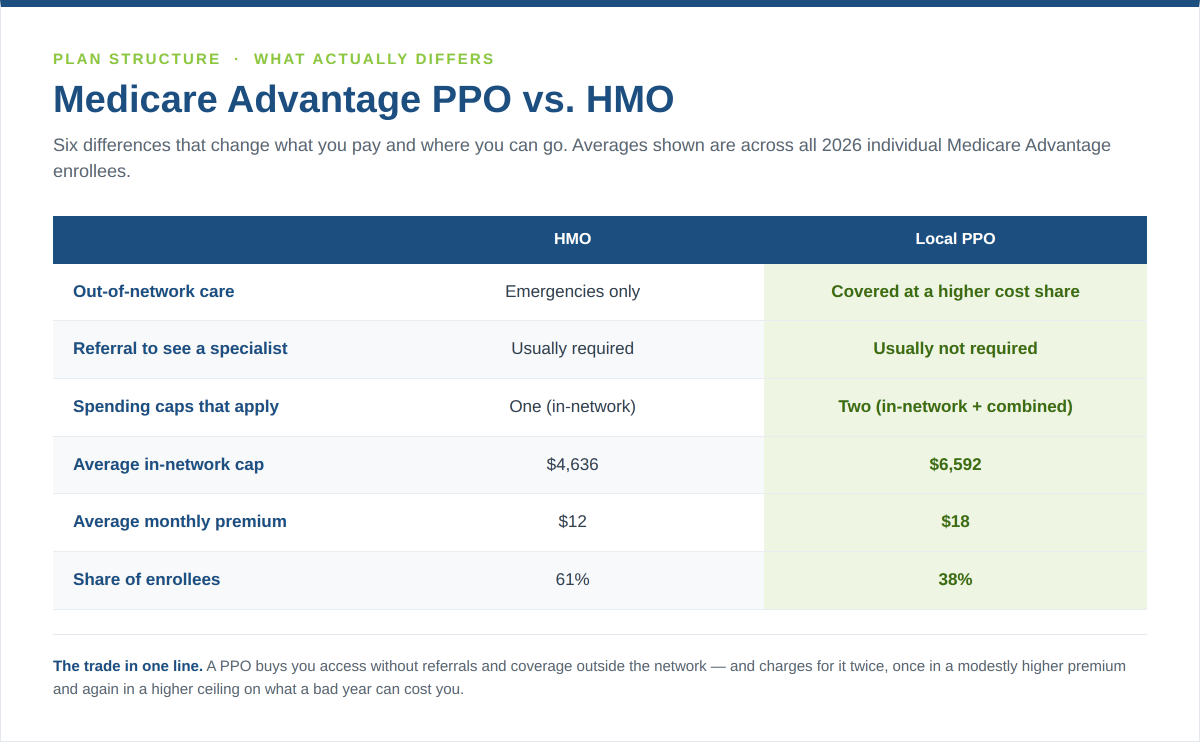
No referrals. You can book a cardiologist, a dermatologist, or an orthopedist directly. With most HMOs you need your primary care doctor to send you first, which adds an appointment and a delay before you get to the specialist.
Out-of-network coverage is real, not theoretical. If you travel, split the year between two states, or want a second opinion at a hospital your plan does not contract with, a PPO covers it. An HMO generally covers out-of-network care only in a true emergency.
You still need a network check. Flexibility is not the same as universal acceptance. Out-of-network providers are not obligated to take your plan, and some will decline. Confirm before the appointment, not after.
You pay for it in two places. PPO premiums run modestly higher than HMO premiums — an $18 average versus $12 across 2026 enrollees — and the annual spending ceiling is meaningfully higher. The premium gap is small. The ceiling gap is not.
The Two Spending Caps — The Part Most Pages Skip
Every Aetna Medicare Advantage plan in 2027 has a maximum out-of-pocket limit, or MOOP. Once you hit it, the plan pays 100% of covered services for the rest of the year.
It is the single most important number on a Medicare Advantage plan, because it is the answer to “what is the worst this can cost me?”
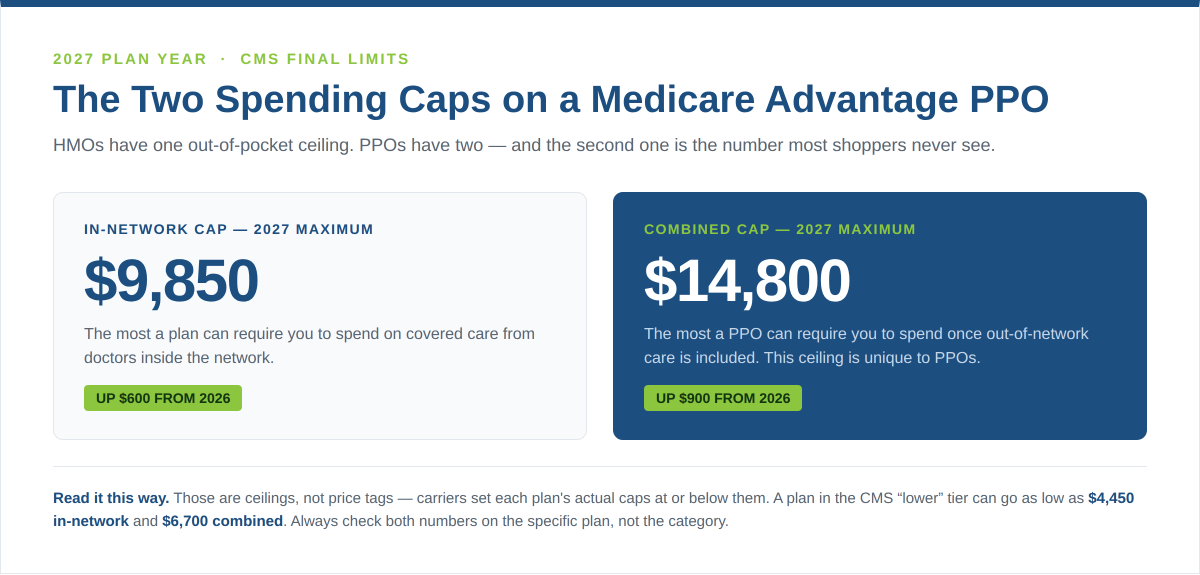
An HMO has one MOOP. A PPO has two: an in-network limit and a combined limit that counts in-network and out-of-network spending together. CMS has finalized both ceilings for 2027.
Here is what that means in practice. Say you have a PPO with a $5,500 in-network cap and a $11,000 combined cap. You have a bad year, and a meaningful share of your care happens out of network.
You do not stop paying at $5,500. You keep paying — at the higher out-of-network cost share — until your total spending reaches $11,000.
Neither number is a prediction. Most PPO members never come close to either one. But the combined cap is the honest measure of your downside, and it is the number to write down when you compare two plans against each other.
| CMS MOOP Tier (2027) | In-Network Limit | Combined Limit (PPO) |
|---|---|---|
| Lower | $0 – $4,450 | $0 – $6,700 |
| Intermediate | $4,451 – $7,150 | $4,451 – $10,750 |
| Mandatory (highest allowed) | $7,151 – $9,850 | $7,151 – $14,800 |
Carriers choose which tier each plan falls into. A plan advertising a low premium often sits in the mandatory tier, and a plan with a small monthly premium often buys you a lower ceiling. That trade is the actual decision.
Where Aetna's PPO Business Stands
Aetna is the third-largest for-profit Medicare Advantage carrier in the country, covering roughly 4.2 million members across 43 states and Washington, D.C. Its quality scores are the strongest argument in its favor.
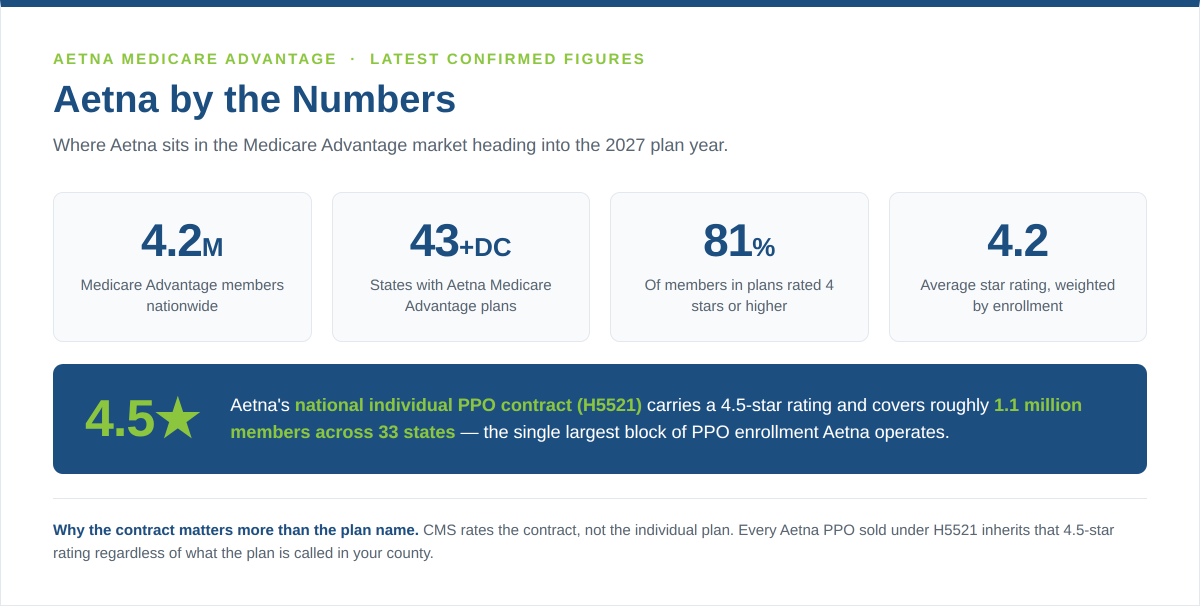
The detail that matters for PPO shoppers specifically is contract H5521. CMS rates Medicare Advantage at the contract level, not the plan level, and H5521 is Aetna’s national individual PPO contract — about 1.1 million members across 33 states, rated 4.5 stars for 2026.
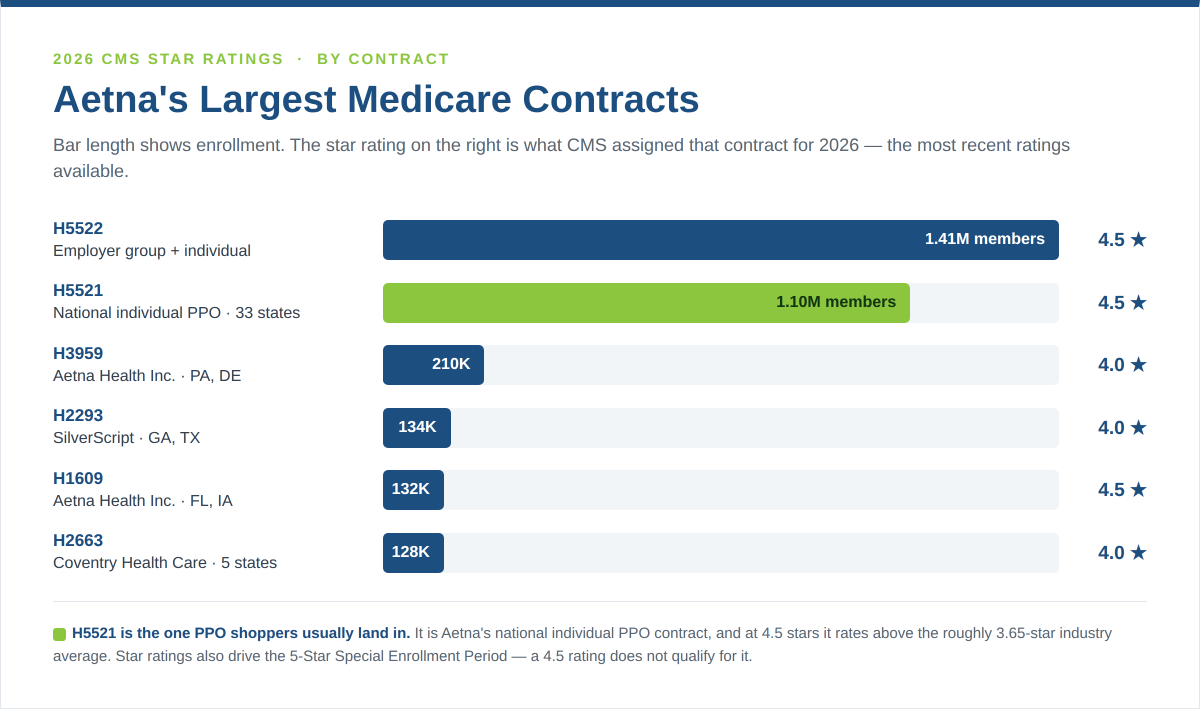
The detail that matters for PPO shoppers specifically is contract H5521. CMS rates Medicare Advantage at the contract level, not the plan level, and H5521 is Aetna’s national individual PPO contract — about 1.1 million members across 33 states, rated 4.5 stars for 2026.
If you enroll in an Aetna PPO in most of the country, that is the contract you land in, whatever the plan is named locally.
For context, the industry average across all Medicare Advantage contracts sits near 3.65 stars.
Aetna reports that more than 81% of its members are in plans rated 4 stars or higher and more than 63% are in 4.5-star plans.
One caveat worth stating plainly: 4.5 stars is very good, but it is not 5. Only a 5-star contract triggers the 5-Star Special Enrollment Period, which lets you switch into that plan once outside the normal windows. Aetna’s PPO contract does not currently offer that door.
Aetna PPO Plan Names You'll See
Aetna sells its PPO plans under a handful of recurring names. The same name can carry different benefits and different costs depending on your county, so treat these as families rather than fixed products. Aetna has said its 2027 lineup will use simplified plan naming, so expect some of these labels to shift when plan details are published.
Aetna Medicare Signature (PPO). The core PPO offering in most markets. Typically the widest availability under contract H5521.
Aetna Medicare Signature Plus / Extra (PPO). Step-up versions with richer supplemental benefits, usually at a higher premium.
Aetna Medicare Premier (PPO). Higher-benefit tier in select markets. Often the strongest dental and OTC allowances.
Aetna Medicare Enhanced (PPO). Mid-tier option positioned between the base and premier plans.
Aetna Medicare Eagle (PPO). Built without prescription drug coverage, aimed at veterans who already get medications through the VA. Do not enroll in this one unless you have creditable drug coverage elsewhere.
Compare Plans in your zip code
What's Confirmed for the 2027 Plan Year
What’s Confirmed for the 2027 Plan Year
CMS finalized the 2027 Medicare Advantage and Part D rule on April 2, 2026. Plan-level details — your county’s premiums, networks, and caps — do not publish until October 1, 2026. But the framework every Aetna PPO has to operate inside is already set. We break these figures down across every major carrier in our 2027 Medicare Advantage costs and benefits by carrier guide.
| What Changes | 2026 | 2027 |
|---|---|---|
| Part D out-of-pocket cap | $2,100 | $2,400 |
| Maximum Part D deductible | $615 | $700 |
| Highest allowed in-network MOOP | $9,250 | $9,850 |
| Highest allowed combined MOOP (PPO) | $13,900 | $14,800 |
Two changes are worth understanding beyond the numbers.
The drug cap protects you; the medical cap did not move in your favor. The $2,400 Part D ceiling is a real backstop on prescription costs, and it applies to the drug portion of your PPO. But the medical ceilings rose — $600 higher in network, $900 higher combined. Both ceilings apply separately. Your drug spending does not count toward your medical cap, and vice versa.
Supplemental benefit debit cards no longer roll over. Starting in 2027, allowances loaded onto a plan-issued card for things like groceries or over-the-counter items do not carry across plan years, and the card must verify your eligibility electronically at the point of sale. If your plan gives you a quarterly allowance, use it inside the period it was issued.
The PPO Market Is Shrinking — Check Your Plan Exists Next Year
This is the context nobody selling you a plan brings up. Going into 2026, the three largest Medicare Advantage carriers all pulled back, and PPO products absorbed a disproportionate share of the cuts.
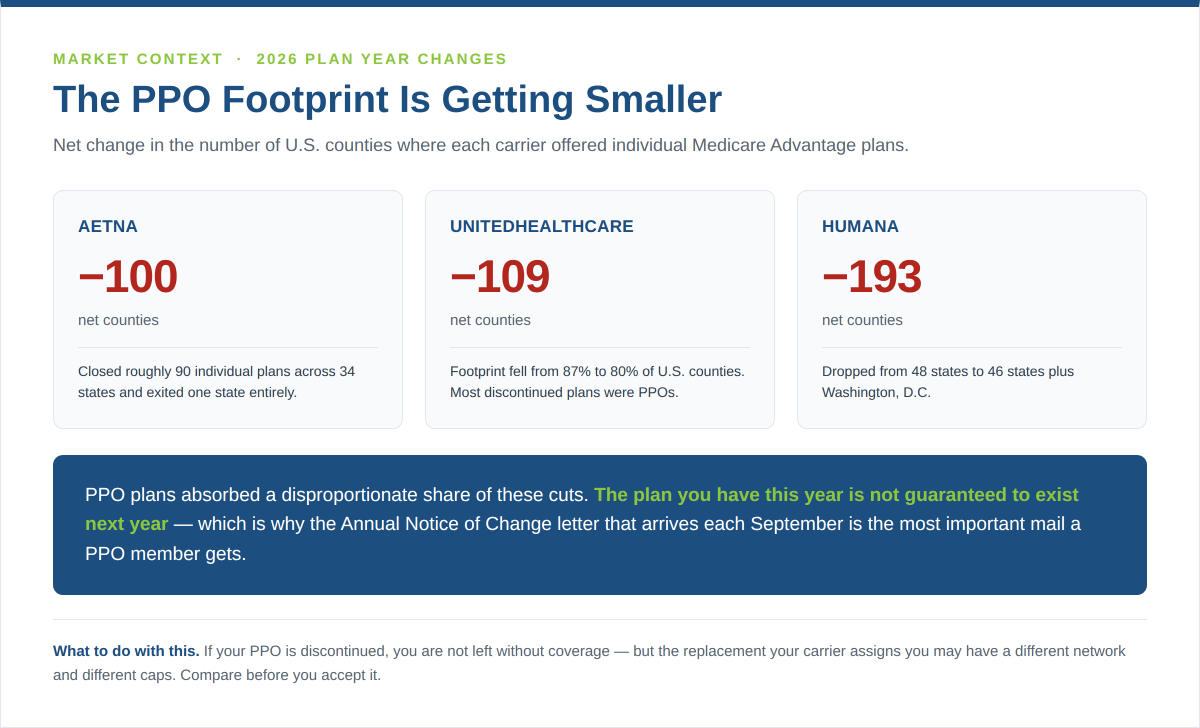
This is the context nobody selling you a plan brings up. Going into 2026, the three largest Medicare Advantage carriers all pulled back, and PPO products absorbed a disproportionate share of the cuts.
Aetna closed roughly 90 individual Medicare Advantage plans across 34 states and exited one state entirely, a net reduction of about 100 counties. UnitedHealthcare’s footprint fell from 87% to 80% of U.S. counties, and most of its discontinued plans were PPOs. Humana went from 48 states to 46 plus Washington, D.C.
If your plan is discontinued you are not left uncovered — but you may be moved into a replacement with a different network and different caps. The Annual Notice of Change letter that arrives each September is where that shows up. Read it before you decide to stay put, because staying put is also a decision.
What Aetna PPO Plans Typically Include
What Aetna PPO Plans Typically Include
Benefits vary by county, and 2027 specifics publish October 1, 2026. Based on Aetna’s 2026 lineup, here is what has been standard.
Monthly premium. Roughly 60% of Aetna plans carry a $0 premium. Plans that do charge one averaged about $33 per month.
Prescription drug coverage. Included on about 94% of plans. Tier 1 generics carry a $0 copay on nearly all of them.
Dental, vision, hearing. Routine coverage on most plans, with allowance amounts that vary widely by county and plan tier.
Fitness. SilverSneakers membership is included on all Aetna Medicare Advantage plans.
Preventive care. $0 copay for annual physicals and covered screenings on many plans.
Prior authorization. Aetna reports 95%+ of eligible requests approved within 24 hours and 83% handled in real time.
Something You Should Know Before You Shop
In August 2026, Aetna notified marketing organizations that it will not pay broker compensation on 123 Medicare Advantage plans across 33 states — nearly 780 counties — for new enrollments in the 2027 plan year. Roughly a fifth of those are in Georgia. Aetna did not state a public reason.
Those plans still exist and you can still enroll in them. But an agent has no financial reason to bring them up, which means they can quietly vanish from the menu a shopper gets shown. That is worth knowing regardless of who you work with.
We tell you this because you should be checking the full plan list in your ZIP code on Medicare’s own Plan Finder alongside anything an agent shows you — including us. No broker represents every plan, and CMS requires us to say so.
Compare 2027 Aetna plans and enroll online
Who an Aetna PPO Fits — and Who It Doesn't
Who an Aetna PPO Fits — and Who It Doesn’t
Good fit: you travel or live in two places. Out-of-network coverage means a winter in Arizona or a summer near the grandkids does not leave you paying full freight for routine care.
Good fit: you see specialists regularly. Skipping the referral step matters more than it sounds like it does when you are managing several conditions across several doctors.
Good fit: you are attached to a specific doctor or hospital. If the provider you refuse to give up is out of network, a PPO is often the only Medicare Advantage structure that keeps them reachable.
Weaker fit: all your doctors are already in network. You would be paying a higher premium and accepting a higher ceiling for flexibility you will never use. An HMO with the same network is usually the better buy.
Weaker fit: your budget cannot absorb a bad year. The combined cap is the number that matters here. If $10,000 or more of exposure is not survivable, look hard at plans in the lower MOOP tier, or compare against Medicare Supplement coverage, which works on an entirely different cost structure.
Weaker fit: you want predictable costs above all. Medicare Advantage trades a low premium for variable cost sharing. If you want to know your yearly number in advance, that is a different product.
When You Can Enroll for 2027
When You Can Enroll for 2027
Annual Enrollment Period: October 15 – December 7, 2026. This is the main window. Anything you choose takes effect January 1, 2027. Plan details for 2027 become public October 1, 2026, so you have two weeks to compare before the window opens — start with our overview of 2027 Medicare Advantage plans.
Medicare Advantage Open Enrollment: January 1 – March 31, 2027. If you are already in a Medicare Advantage plan and it is not working, you get one switch here — to another Medicare Advantage plan, or back to Original Medicare.
Initial Enrollment Period. If you are turning 65, your seven-month window runs from three months before your birthday month through three months after.
One marketing rule changed on October 1, 2026: the 48-hour waiting period between signing a scope of appointment and meeting with an agent was eliminated. You can now sign and talk the same day, which speeds things up considerably during a compressed AEP.
Aetna Medicare Advantage PPO 2027 — Frequently Asked Questions
➤ What is an Aetna Medicare Advantage PPO plan?
It is a Medicare Advantage plan that uses a preferred provider network but still covers care outside that network at a higher cost share. You do not need a referral to see a specialist, and you can use out-of-network doctors who accept the plan. Aetna sells PPO plans in most of the 43 states plus Washington, D.C. where it offers Medicare Advantage.
➤ What is the maximum an Aetna PPO can cost me in 2027?
For 2027, CMS caps in-network out-of-pocket spending at $9,850 and combined in-network plus out-of-network spending at $14,800. Those are the highest limits any Medicare Advantage PPO is allowed to set. Most plans set theirs lower — the lowest tier permits caps as low as $4,450 in network and $6,700 combined. Prescription drug spending is capped separately at $2,400 in 2027.
➤ How is a PPO different from an HMO?
A PPO covers out-of-network care and generally does not require referrals to specialists. An HMO usually covers out-of-network care only in emergencies and often requires a referral. PPOs cost more in both places that matter: an $18 average monthly premium versus $12 for HMOs, and an average in-network spending cap of $6,592 versus $4,636.
➤ What star rating do Aetna's PPO plans have?
Aetna’s national individual PPO contract, H5521, is rated 4.5 out of 5 stars for 2026 and covers roughly 1.1 million members across 33 states. Across all of Aetna’s Medicare Advantage business, more than 81% of members are in plans rated 4 stars or higher and more than 63% are in 4.5-star plans. The industry average is roughly 3.65 stars.
➤ Does an Aetna PPO include prescription drug coverage?
Most do — about 94% of Aetna’s Medicare Advantage plans include Part D coverage. The main exception is Aetna Medicare Eagle (PPO), which is built without drug coverage for veterans who get medications through the VA. Do not enroll in a plan without drug coverage unless you have creditable coverage elsewhere, or you may face a late enrollment penalty.
➤ Are there $0 premium Aetna PPO plans in 2027?
Aetna offered $0 premium plans on roughly 60% of its 2026 lineup, though $0 options are more common among HMOs than PPOs. Availability depends entirely on your county, and 2027 plan pricing does not publish until October 1, 2026. Remember that a $0 premium plan still requires you to keep paying your Medicare Part B premium.
➤ Can I keep my doctor with an Aetna PPO?
Usually, but confirm before enrolling. If your doctor is in Aetna’s network you pay the lower in-network cost share. If they are out of network, a PPO still covers the visit at a higher cost share — but out-of-network providers are not required to accept the plan, so call the office and ask specifically whether they accept the Aetna Medicare Advantage PPO you are considering.
➤ Will my Aetna PPO plan still exist in 2027?
Not guaranteed. For 2026, Aetna closed roughly 90 individual Medicare Advantage plans across 34 states, a net reduction of about 100 counties, and PPO products absorbed a large share of industry-wide cuts. Your Annual Notice of Change letter arrives each September and tells you whether your specific plan is continuing, changing, or ending.
➤ Does Aetna require prior authorization on PPO plans?
Yes, for certain services — as every Medicare Advantage carrier does. Aetna reports that more than 95% of eligible prior authorization requests are approved within 24 hours and 83% are handled in real time, and says it requires prior authorization on fewer medical services than other national plans. Ask about prior authorization for any procedure you already know you will need.
➤ When can I enroll in an Aetna Medicare Advantage PPO for 2027?
The Annual Enrollment Period runs October 15 through December 7, 2026, with coverage starting January 1, 2027. If you are already in a Medicare Advantage plan, the Medicare Advantage Open Enrollment Period from January 1 to March 31, 2027 gives you one additional switch. If you are new to Medicare, your Initial Enrollment Period spans the three months before through three months after your 65th birthday month.
Have Questions?
Speak with a licensed insurance agent
1-855-454-9051
TTY users 711
Mon-Fri: 8am-9pm ET
Find & Compare Plans Online
ZRN Health & Financial Services, LLC, a Texas limited liability company

Russell Noga is the founder of CompareMedicareAdvantage.org, and is a Medicare insurance broker licensed in all 50 states. He works with other licensed insurance agents and partners to keep plan information accurate and current for the 2027 Medicare Advantage enrollment season and beyond.