Speak with a licensed insurance agent

1-855-454-9051

TTY user 711 Mon-Fri : 8am-9pm EST

Medicare Advantage Special Needs Plans 2027: C-SNP, D-SNP and I-SNP Explained

Reviewed by Russell Noga, Licensed Medicare Insurance Broker (all 50 states) — Last updated September 18, 2026

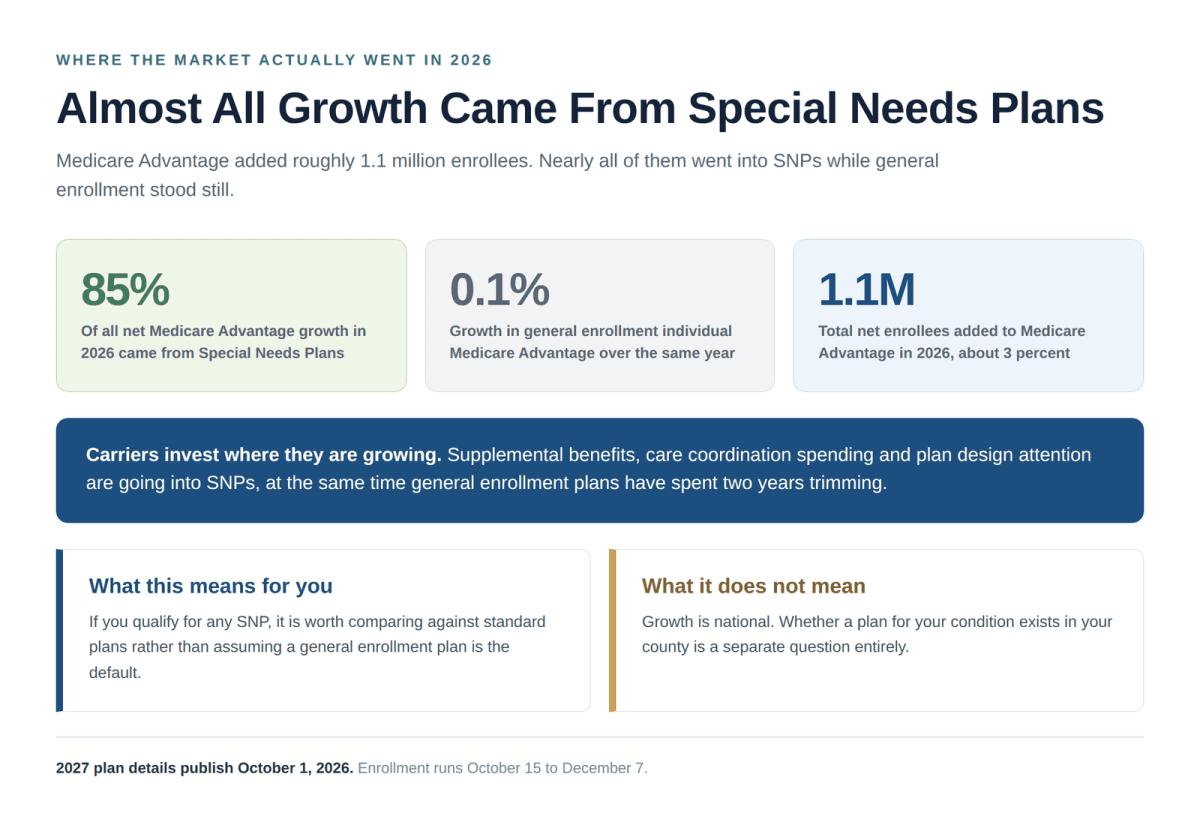
Special Needs Plans are a type of Medicare Advantage plan restricted to people who meet specific eligibility criteria. They are not a niche product any more. In 2026, roughly 85 percent of all net growth in Medicare Advantage enrollment came from Special Needs Plans, while general enrollment Medicare Advantage grew by 0.1 percent. The market is moving into SNPs, and the rules governing them are changing faster than the rest of Medicare Advantage.

There are three types, and they have almost nothing in common except the letters. Which one applies to you depends on your health, your income, or where you live — not on preference.

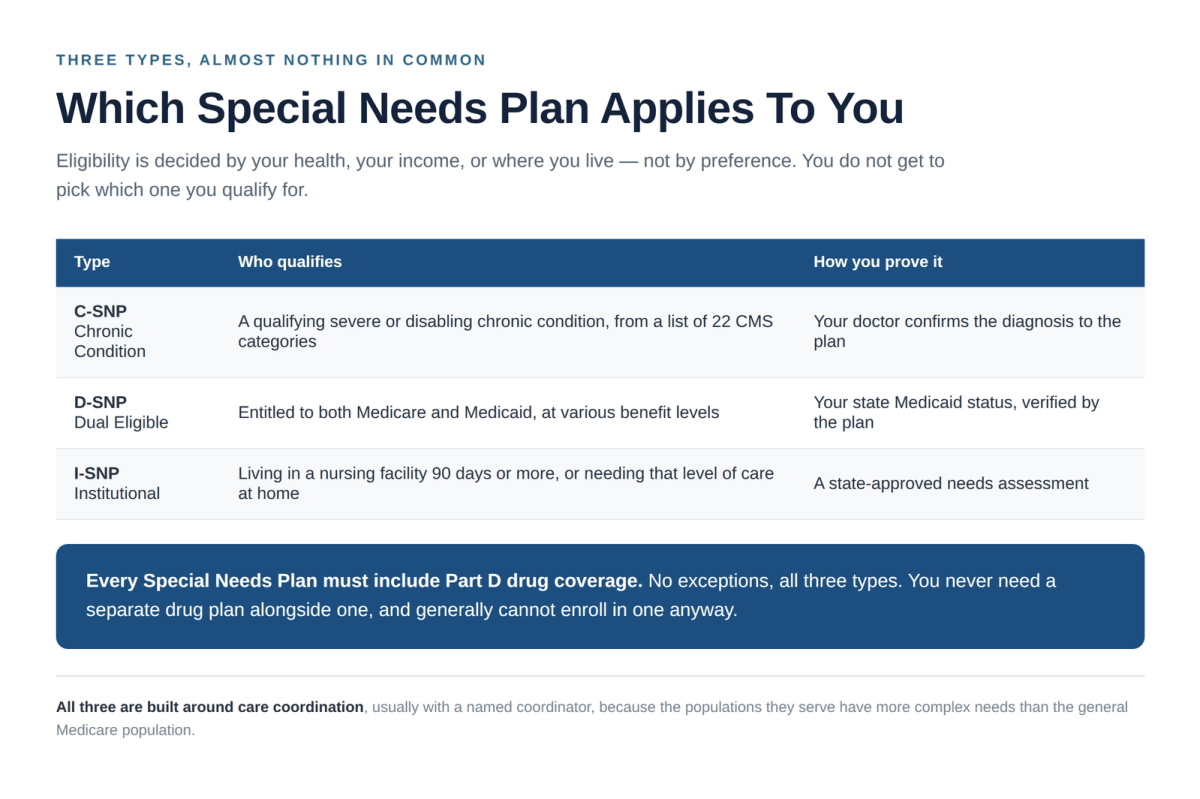
Medicare Advantage Special Needs Plan types C-SNP D-SNP and I-SNP compared with eligibility and proof required

Compare 2027 SNP plans in your area

The Three Types of Special Needs Plan

Type Who qualifies How you prove it
C-SNP
Chronic Condition
People with a qualifying severe or disabling chronic condition, such as diabetes, chronic heart failure, or chronic lung disorders Your doctor confirms the diagnosis to the plan
D-SNP
Dual Eligible
People entitled to both Medicare and Medicaid, at various benefit levels Your state Medicaid status, verified by the plan
I-SNP
Institutional
People living in a nursing facility for 90 days or more, or needing that level of care while living at home A state-approved needs assessment

All three share two features. Every Special Needs Plan is required to include Part D prescription coverage, without exception, so you never need a separate drug plan alongside one. And every SNP is built around a care coordination model, usually with a named coordinator, because the populations they serve tend to have more complex care needs than the general Medicare population.

Most Special Needs Plans use an HMO structure with a defined network. If network freedom matters more to you than care coordination, compare against Medicare Advantage PPO plans, which cover out-of-network care at a higher cost share.

Which Conditions Qualify for a C-SNP

CMS defines exactly which conditions count as severe or disabling. The list was expanded in April 2025 and now runs to 22 categories, up from 15. Many guides still show the old list, so if you were told you did not qualify before 2025 it is worth checking again.

Condition category What CMS includes
Diabetes mellitus The single most common basis for a C-SNP
Chronic heart failure Listed separately from other cardiovascular disorders
Cardiovascular disorders Cardiac arrhythmias, coronary artery disease, peripheral vascular disease, valvular heart disease
Chronic lung disorders COPD, emphysema, asthma, chronic bronchitis, cystic fibrosis, pulmonary fibrosis, pulmonary hypertension
Chronic kidney disease Both CKD requiring dialysis and CKD not requiring dialysis. Broader than the old rule, which covered dialysis only
Neurologic disorders ALS, epilepsy, multiple sclerosis, Parkinson’s disease, Huntington’s disease, extensive paralysis, polyneuropathy, fibromyalgia, chronic fatigue syndrome, spinal cord injuries, spinal stenosis, stroke-related deficit
Stroke Listed in its own right as well as within neurologic disorders
Dementia Separate from the cognitive impairment category below
Conditions associated with cognitive impairment Alzheimer’s disease, traumatic brain injury, mild cognitive impairment, intellectual and developmental disabilities
Cancer Listed without qualification in the current regulation
Autoimmune disorders Rheumatoid arthritis, systemic lupus erythematosus, psoriatic arthritis, scleroderma, polymyalgia rheumatica, polymyositis, dermatomyositis, polyarteritis nodosa
Severe hematologic disorders Sickle-cell disease excluding sickle-cell trait, hemophilia, aplastic anemia, myelodysplastic syndrome, immune thrombocytopenic purpura, chronic venous thromboembolic disorder
Chronic gastrointestinal disease Chronic liver disease, non-alcoholic fatty liver disease, hepatitis B and C, pancreatitis, irritable bowel syndrome, inflammatory bowel disease. Replaces the old end-stage liver disease entry
Overweight, obesity and metabolic syndrome Added in the 2025 expansion
HIV and AIDS Long-standing qualifying condition
Chronic and disabling mental health conditions Major depressive disorders, bipolar disorders, schizophrenia, schizoaffective disorder, paranoid disorder, post-traumatic stress disorder, anxiety disorders, eating disorders
Chronic alcohol and other substance use disorders Now written as chronic alcohol use disorder and other substance use disorders
Post-organ transplantation care Added in the 2025 expansion
Immunodeficiency and immunosuppressive disorders Added in the 2025 expansion
Conditions that impair the senses Chronic conditions affecting vision, hearing including deafness, taste, touch and smell
Conditions with functional challenges Spinal cord injuries, paralysis, limb loss, stroke, arthritis
Conditions requiring continued therapy services Where ongoing therapy is needed to maintain or retain functioning

A C-SNP can be built around a single condition or a grouping of related ones. CMS approves eight groupings of commonly co-occurring conditions:

  • Diabetes and chronic heart failure
  • Chronic heart failure and cardiovascular disorders
  • Diabetes and cardiovascular disorders
  • Diabetes, chronic heart failure and cardiovascular disorders
  • Stroke and cardiovascular disorders
  • Anxiety associated with COPD
  • Chronic kidney disease and post-renal transplantation care
  • Substance use disorders and chronic mental health disorders

Being on the list does not mean a plan exists for your condition where you live. Carriers choose which conditions to build plans around, and diabetes and cardiovascular groupings are by far the most common. Check what is actually offered in your county.

Veterans who qualify for Medicaid as well as Medicare may have a D-SNP available alongside their VA benefits. How the two systems interact is covered in our guide to Medicare Advantage plans for veterans.

Why SNP Enrollment Is Growing While The Rest Is Flat

Medicare Advantage added roughly 1.1 million enrollees in 2026, about 3 percent. Almost all of that came from Special Needs Plans. Individual general enrollment Medicare Advantage was essentially flat.

That matters to you for a practical reason rather than an academic one. Carriers invest where they are growing. SNPs are where the supplemental benefits, the care coordination spending and the plan design attention are going, at the same time as general enrollment plans have spent two years trimming. For the wider picture on what carriers are doing next year, see Medicare Advantage plan changes for 2027.

Special Needs Plans drove 85 percent of Medicare Advantage enrollment growth in 2026

What Changes for Special Needs Plans in 2027

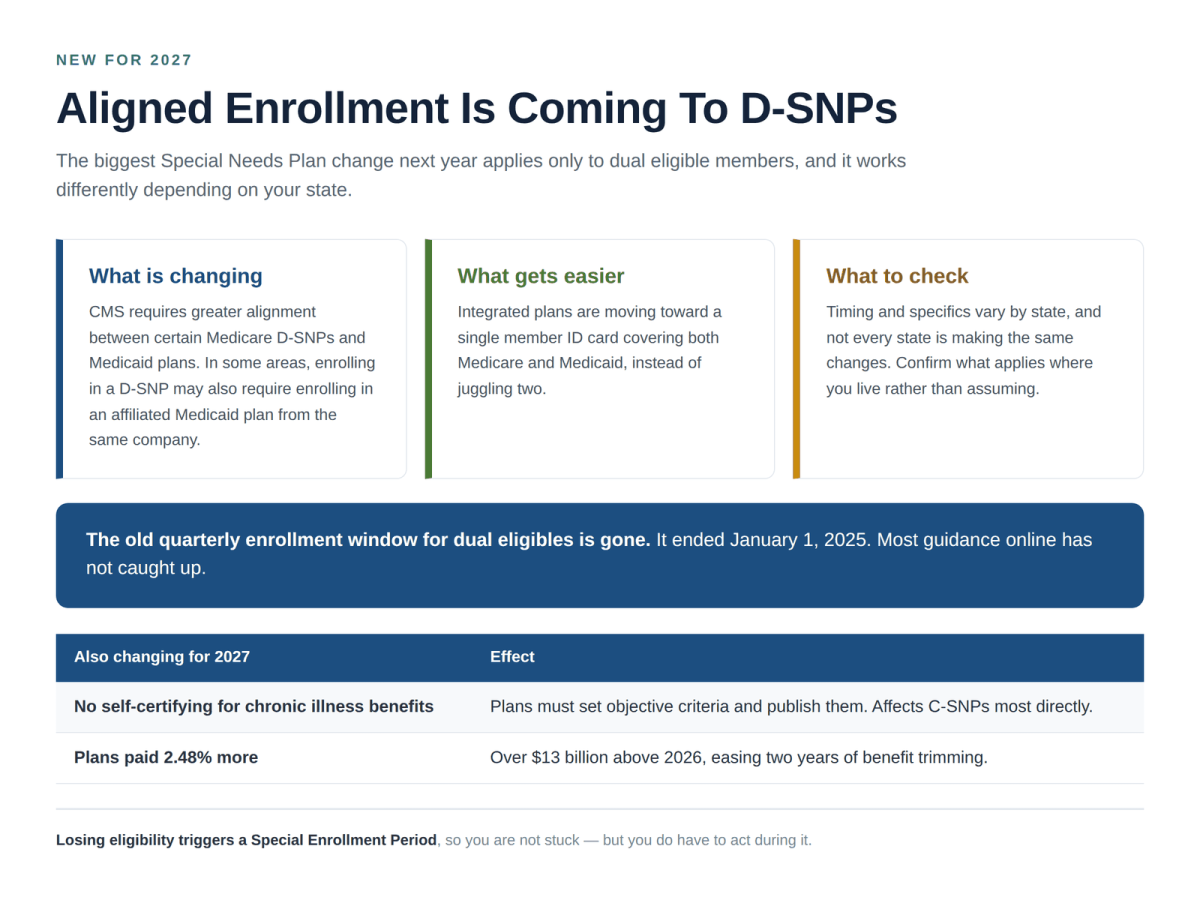
D-SNP aligned enrollment requirements and other Medicare Advantage Special Needs Plan changes for 2027

Aligned enrollment for D-SNPs

From 2027, CMS requires greater alignment between certain Medicare D-SNPs and Medicaid plans. In some areas this means that enrolling in a D-SNP may also require being enrolled in an affiliated Medicaid plan from the same company. Integrated plans are also moving toward a single member ID card covering both. Timing and specifics vary by state, and not every state is making the same changes, so check what applies where you live rather than assuming.

No more self-certifying for chronic illness benefits

CMS has ended self-attestation for special supplemental benefits for the chronically ill. Plans must now set objective eligibility criteria and publish them publicly. This affects C-SNPs most directly, and it cuts both ways: harder to claim a benefit you do not clearly qualify for, easier to find out in advance whether you do.

More money going into plans

CMS is paying Medicare Advantage plans 2.48 percent more in 2027, over $13 billion above 2026. After two years of benefit trimming across the industry, that reduces the pressure to cut, though it guarantees nothing in any particular plan or county.

Find & Compare Plans Online

Speak with a licensed insurance agent

1-855-454-9051TTY 711

Mon-Fri: 8am-9pm ET

When You Can Enroll in a Special Needs Plan

This is where most guidance is out of date, because the rules for dual eligible beneficiaries changed on January 1, 2025 and changed again for plan integration. The old quarterly special enrollment period is gone.

If you are You can use To move into
A full benefit dual eligible The integrated care SEP, once a month An integrated D-SNP aligned with your Medicaid plan
A full benefit dual eligible The dual and low income subsidy SEP, once a month Original Medicare with a standalone drug plan, or a different drug plan
A partial benefit dual eligible The dual and low income subsidy SEP only Original Medicare with a standalone drug plan, or a different drug plan
On Extra Help but not Medicaid The dual and low income subsidy SEP, once a month Original Medicare with a standalone drug plan, or a different drug plan
Qualifying for a C-SNP or I-SNP A special enrollment period triggered by qualifying A plan built for that condition or situation

The point people miss most often: neither of the dual eligible monthly windows lets you hop between ordinary Medicare Advantage plans. They are narrower than they look. Everyone can still use the Annual Enrollment Period from October 15 to December 7, and the full detail on every window is in our guide to Medicare open enrollment for 2027.

What Special Needs Plans Cost

SNPs are priced like any other Medicare Advantage plan. Many carry a $0 monthly premium, and you still pay your Part B premium, projected at $209.50 a month for 2027. What differs is who ends up paying the cost sharing.

If you have a D-SNP

Medicaid generally covers your Medicare cost sharing, so many dual eligible members pay little or nothing out of pocket for covered care. If you have Qualified Medicare Beneficiary status, providers are also barred from billing you for Medicare deductibles, copays and coinsurance at all. Many duals also qualify for Extra Help, which sharply reduces drug costs.

If you have a C-SNP or I-SNP

You pay standard Medicare Advantage costs: the plan premium if there is one, copays for visits and services, and an annual out-of-pocket maximum that caps your medical spending. The 2027 drug figures apply as they do everywhere, with the Part D deductible rising to $700 and the prescription out-of-pocket cap to $2,400.

Plan-level premiums and copays for 2027 publish on October 1, 2026 for every county. Anything quoted before then is an estimate. Availability varies sharply by state as well — Medicare Advantage plans in Pennsylvania are a good example, where three distinct regional markets mean the Special Needs Plans on offer in Pittsburgh look nothing like those in Philadelphia.

Before You Enroll in an SNP

Step 1

Confirm you actually qualify

SNPs verify eligibility, and losing eligibility means losing the plan after a grace period. For a C-SNP the plan will need confirmation from your doctor. For a D-SNP it depends on your current Medicaid category, which is not always what people assume it is.

Step 2

Check the network for your specialists, not just your GP

SNPs are usually network based and often HMO style. Since these plans exist for people with defined conditions, the specialists treating that condition matter more than the primary care physician. Check them by name.

Step 3

Check your drugs against the formulary

Every SNP includes Part D, but formularies still differ. With the 2027 drug deductible rising to $700 and the out-of-pocket cap to $2,400, tier placement on the medications you actually take matters more than it did last year.

Compare 2027 SNP plans in your area

Special Needs Plans FAQ

  What is a Medicare Advantage Special Needs Plan?

A Special Needs Plan is a Medicare Advantage plan that only accepts people meeting defined eligibility criteria. There are three kinds: Chronic Condition SNPs for people with a qualifying severe or disabling chronic illness, Dual Eligible SNPs for people with both Medicare and Medicaid, and Institutional SNPs for people in a nursing facility or needing that level of care at home. Every SNP must include Part D prescription coverage and is built around a care coordination model.

  What is changing for D-SNPs in 2027?

The main change is aligned enrollment. CMS is requiring greater alignment between certain Medicare D-SNPs and Medicaid plans, and in some areas enrolling in a D-SNP may also require being enrolled in an affiliated Medicaid plan from the same company. Integrated plans are moving toward one member ID card covering both. Timing and details vary by state and not every state is making the same changes, so confirm what applies in yours.

  Can dual eligible members change plans every month?

Not in the way most people think, and the old quarterly window is gone as of January 1, 2025. Full benefit dual eligibles have a monthly integrated care special enrollment period, but it can only be used to move into an integrated D-SNP aligned with their Medicaid plan. Separately, a monthly dual and low income subsidy period allows a move to Original Medicare with a standalone drug plan, or a switch between drug plans.

Neither one lets you switch freely between ordinary Medicare Advantage plans. Partial benefit duals and people with Extra Help but not Medicaid get the second period only.

  Do Special Needs Plans include drug coverage?

Always. Part D prescription coverage is required in every Special Needs Plan without exception, which is one of the few things all three types have in common. You do not need a separate drug plan alongside one, and generally cannot enroll in one anyway. Formularies still vary between plans, so check your specific medications and their tiers.

  What happens if I stop qualifying for my SNP?

Plans allow a grace period, after which you lose the plan. Losing eligibility also triggers a special enrollment period, so you are not stuck without options, but you do have to act during it. This comes up most with D-SNPs, where a change in Medicaid status can affect eligibility without the member realizing anything has changed until a letter arrives.

Have Questions?

Speak with a licensed insurance agent

1-855-454-9051

TTY users 711

Mon-Fri: 8am-9pm ET

Find & Compare Plans Online

Speak with a licensed insurance agent

1-855-454-9051TTY 711

Mon-Fri: 8am-9pm ET

ZRN Health & Financial Services, LLC, a Texas limited liability company