Speak with a licensed insurance agent

1-855-454-9051

TTY user 711 Mon-Fri : 8am-9pm EST

UnitedHealthcare Medicare Advantage PPO 2027

Reviewed by Russell Noga, Licensed Medicare Insurance Broker (all 50 states) — Last updated September 1, 2026

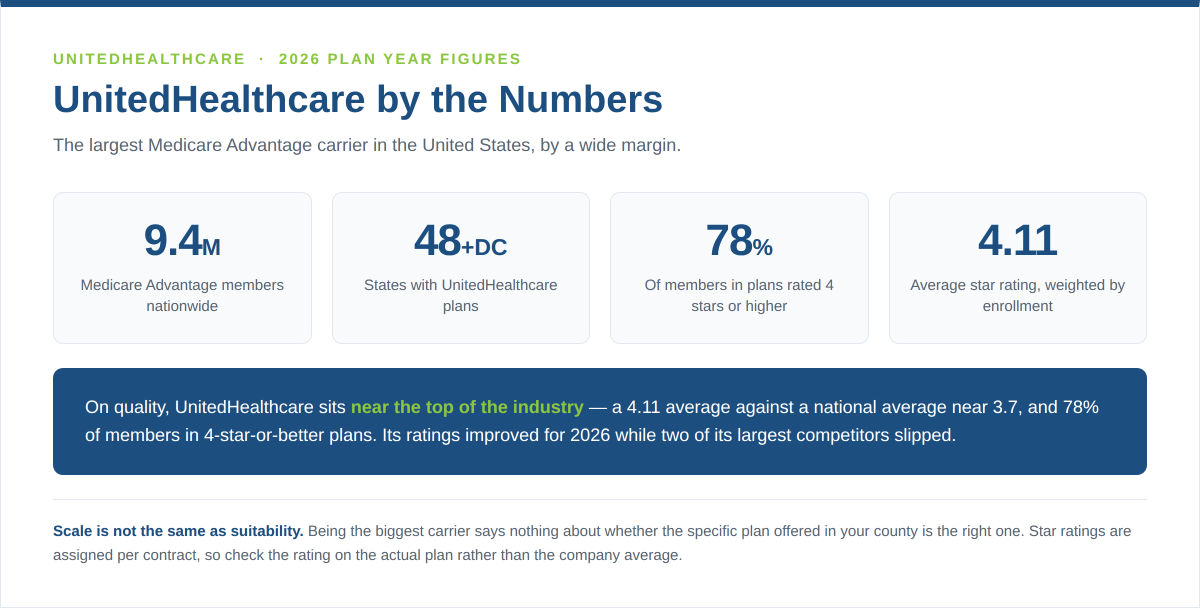
UnitedHealthcare is the largest Medicare Advantage carrier in the country, with roughly 9.4 million members and a provider network approaching a million doctors and facilities. If network breadth is what you care about, no competitor comes close.

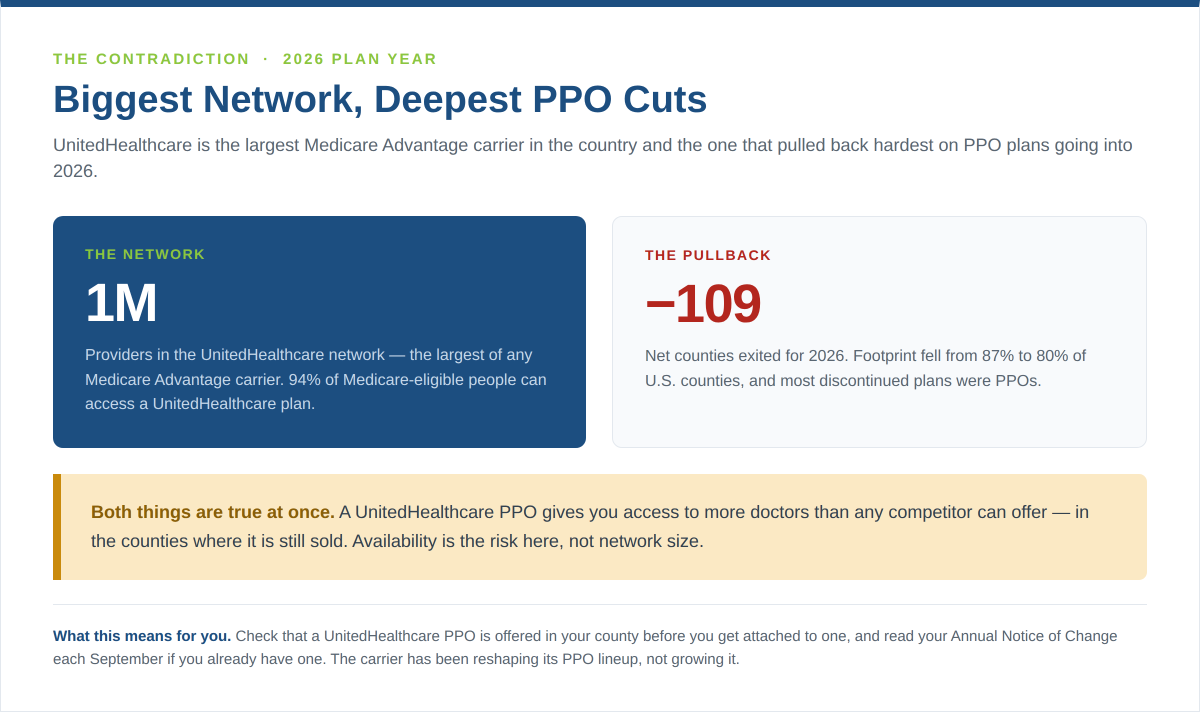
It is also the carrier that cut the most PPO plans going into 2026. Its footprint fell from 87% to 80% of U.S. counties; it exited Vermont entirely, and most of the plans it discontinued were PPOs.

Both of those things are true, and holding them together is the honest way to shop this carrier. This page covers how UnitedHealthcare’s PPO plans work, what CMS has locked in for the 2027 plan year, how the quality ratings look, and what the pullback means if you have one of these plans now.

For the full lineup, including HMO plans, start with our UnitedHealthcare Medicare Advantage plans guide.

Compare UnitedHealthcare Medicare Advantage for 2027

The Contradiction at the Heart of This Carrier

Most carrier pages pick a side. This one cannot, because the two most important facts about UnitedHealthcare’s PPO business point in opposite directions.

Comparison showing UnitedHealthcare's one million provider network against its net loss of 109 counties for 2026, with most discontinued Medicare Advantage plans being PPOs

The 2027 number is now public, and it lands on PPO members. UnitedHealthcare is exiting 34 counties across 12 states for 2027, and roughly two-thirds of the affected policies are PPO plans. That is a smaller footprint reduction than the 2026 round above, but it is aimed disproportionately at PPOs. County-level detail arrives with non-renewal notices and the October 1, 2026 plan data release.

The case for it. A PPO already covers out-of-network care. Layer that on top of the largest provider network in Medicare Advantage and you get the widest practical access available in this product category — roughly a million providers in network, plus coverage outside it.

The case against it. UnitedHealthcare shed a net 109 counties for 2026 and is exiting 34 more across 12 states for 2027 — and PPO products have taken the brunt of both rounds. The risk with this carrier is not the quality of the plan you get; it is whether the plan you want is still sold where you live next year.

UnitedHealthcare by the Numbers

Scale is the first thing to understand about this carrier, and quality is the second — because on quality, UnitedHealthcare does better than its size would lead you to expect.

UnitedHealthcare Medicare Advantage by the numbers: 9.4 million members, 48 states plus DC, 78 percent of members in 4-star or higher plans, and a 4.11 average CMS star rating

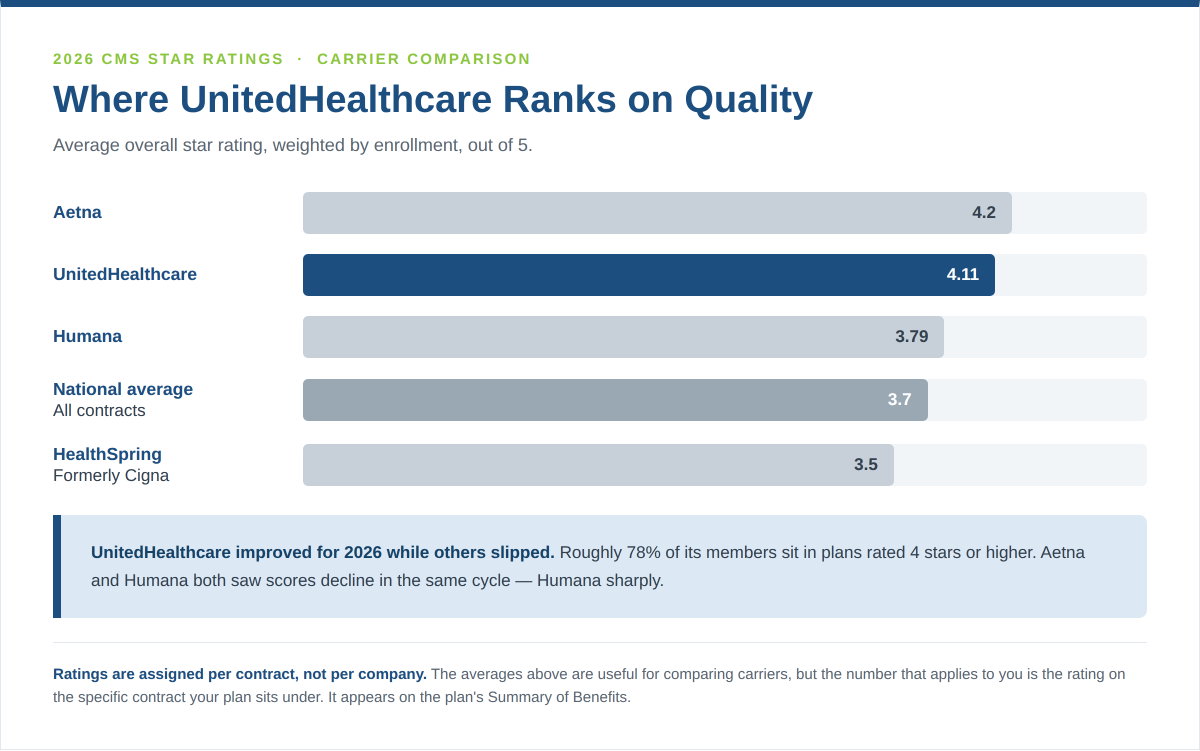
Roughly 78% of UnitedHealthcare members sit in plans rated 4 stars or higher, and its enrollment-weighted average is 4.11 against a national average near 3.7. Ratings improved for 2026, while Aetna and Humana both slipped.

Find & Compare Plans Online

Speak with a licensed insurance agent

1-855-454-9051TTY 711

Mon-Fri: 8am-9pm ET

How a UnitedHealthcare PPO Actually Works

PPO stands for Preferred Provider Organization. The operative word is preferred, not required. UnitedHealthcare negotiates rates with a network of doctors and hospitals, and you pay the lowest cost share when you use them. Step outside, and the plan still pays — it just pays less.

Plan names vary considerably by county, and the same name can carry different benefits in different markets, so it is more useful to understand the structure than to memorize product names.

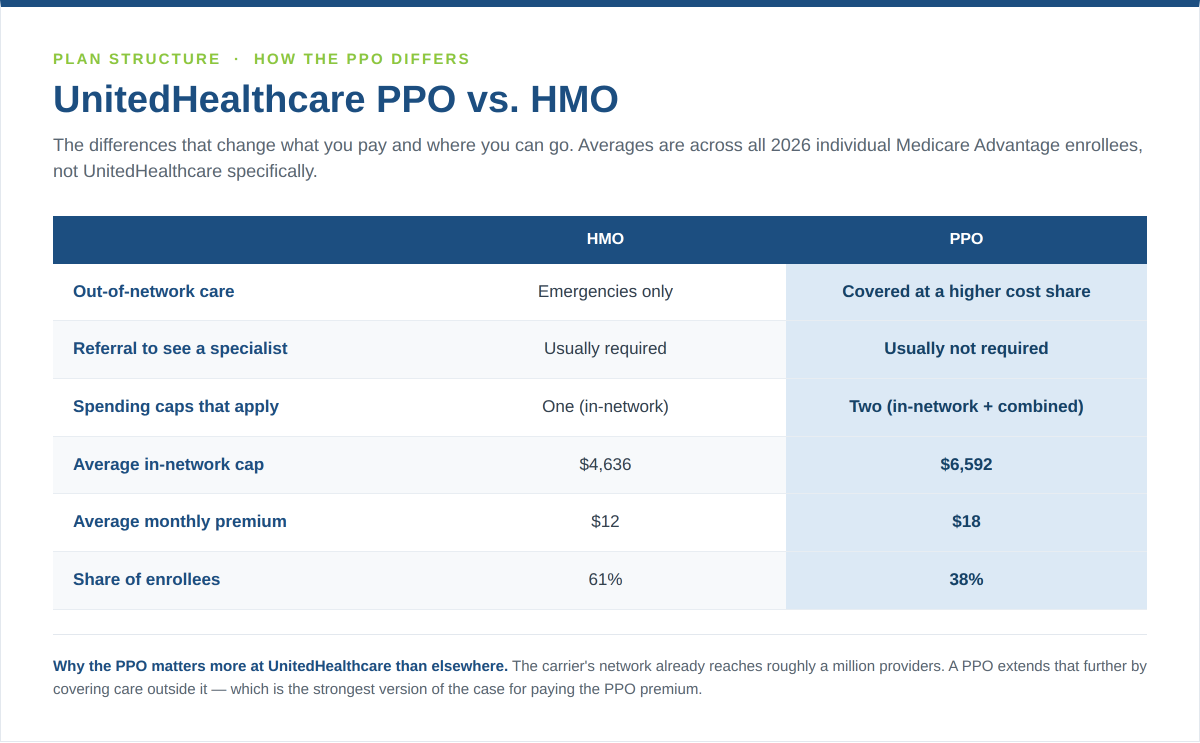
Table comparing Medicare Advantage PPO and HMO plans on out-of-network coverage, referrals, spending caps, average in-network cap of $6,592 versus $4,636, and average premiums of $18 versus $12

No referrals. You can book a cardiologist, dermatologist, or orthopedist directly. Most HMOs require your primary care doctor to send you first, which adds an appointment and a delay.

Out-of-network coverage is real. If you travel, split the year between two states, or want a second opinion at a hospital outside the network, a PPO covers it at a higher cost share. An HMO generally covers out-of-network care only in an emergency.

The network still matters most. With roughly a million providers in-network, your doctor is more likely to be inside a UnitedHealthcare network than any competitor’s. Out-of-network coverage is the backup, not the plan.

Out-of-network providers can still say no. Coverage does not obligate a provider to accept your plan. Call the office and confirm before the appointment, not after.

You pay for the flexibility twice. PPOs run a modestly higher premium than comparable HMOs, and they carry a second, higher spending ceiling that counts out-of-network care. The premium gap is small. The ceiling gap is not.

The Two Spending Caps — The Part Most Pages Skip

Every Medicare Advantage plan has a maximum out-of-pocket limit, or MOOP. Once you hit it, the plan pays 100% of covered services for the rest of the year. It is the single most important number on the plan, because it answers “what is the worst this can cost me?”

An HMO has one. A PPO has two: an in-network limit, and a combined limit that counts in-network and out-of-network spending together. CMS has finalized both ceilings for 2027.

CMS MOOP Tier (2027) In-Network Limit Combined Limit (PPO)
Lower $0 – $4,450 $0 – $6,700
Intermediate $4,451 – $7,150 $4,451 – $10,750
Mandatory (highest allowed) $7,151 – $9,850 $7,151 – $14,800

Those are ceilings, not price tags. Carriers set each plan’s actual caps at or below them. For context, UnitedHealthcare’s enrollment-weighted average maximum out-of-pocket across all its plans was $6,492 for 2026 — comfortably inside the intermediate tier.

What UnitedHealthcare Plans Have Cost

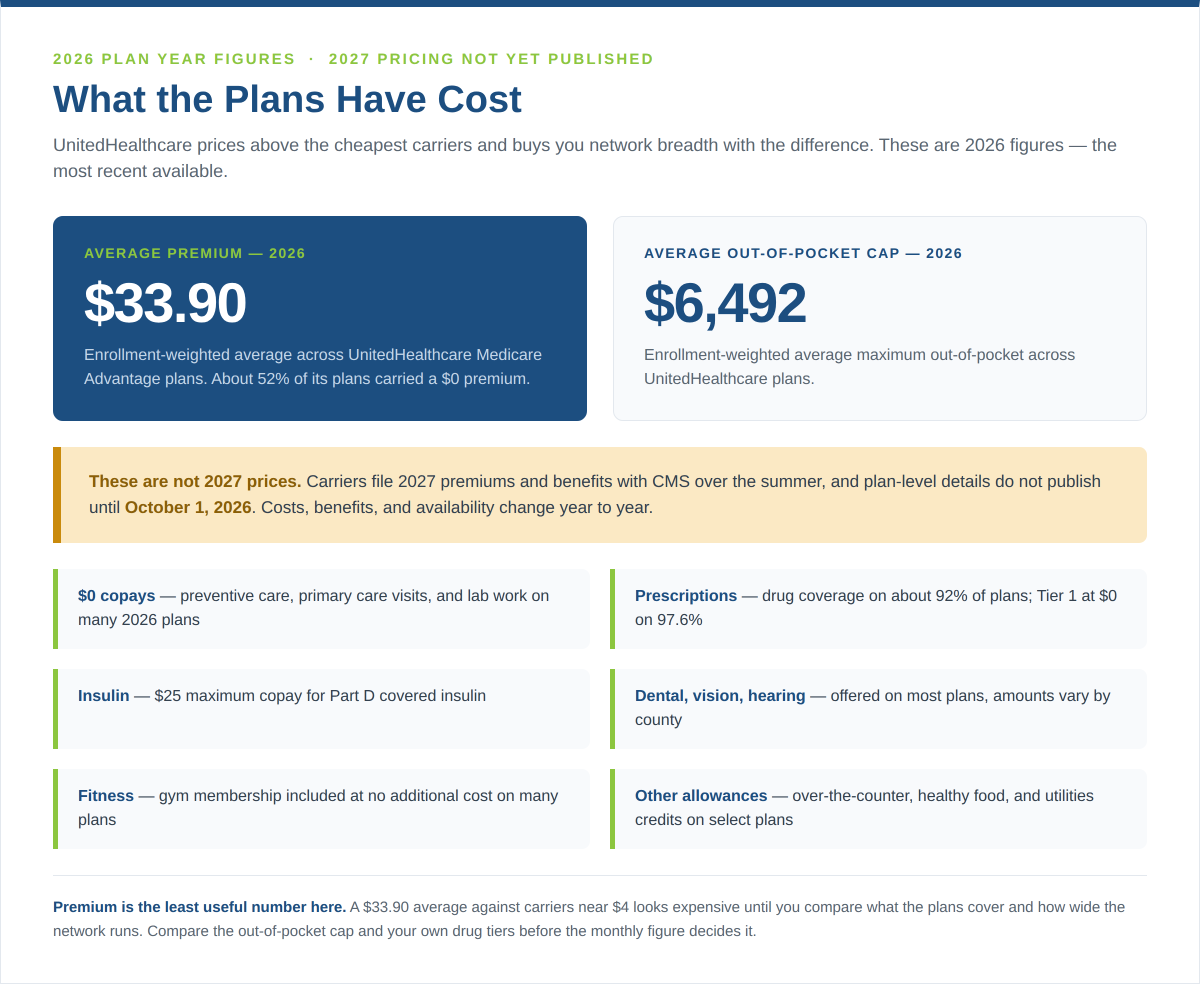
One caveat before the numbers. Carriers file 2027 premiums and benefits with CMS over the summer, and plan-level details for your county are not published until October 1, 2026. Everything below reflects the 2026 plan year — the most recent data available — and should be read as a guide to how UnitedHealthcare has priced its plans, not as a quote for 2027.

UnitedHealthcare does not compete on being the cheapest, and its pricing reflects that.

UnitedHealthcare 2026 Medicare Advantage costs showing a $33.90 average monthly premium and a $6,492 average maximum out-of-pocket, with a note that 2027 pricing publishes October 1, 2026

A $33.90 enrollment-weighted average premium is meaningfully above carriers like HealthSpring, which averaged around $4. But roughly 52% of UnitedHealthcare plans still carried a $0 premium in 2026, and the money buys network breadth that cheaper carriers cannot match.

Whether that trade is worth it depends entirely on whether you would ever use the extra access.

2027 costs are not published yet. Carriers across the industry have been trimming benefits and exiting counties, so do not assume 2026 pricing carries forward. Compare your actual options in your ZIP code once plan details publish October 1, 2026.

Compare UnitedHealthcare Medicare Advantage for 2027

Where UnitedHealthcare Ranks on Quality

This is the carrier’s quiet strength, and the thing most shoppers get wrong about it. Size tends to invite skepticism about service quality. The CMS data does not support that here.

Bar chart of 2026 CMS star ratings by carrier showing Aetna at 4.2, UnitedHealthcare at 4.11, Humana at 3.79, the national average at 3.7, and HealthSpring at 3.5

One caution worth stating plainly: these are company-wide averages, and CMS assigns ratings per contract, not per company. A high corporate average does not guarantee the specific plan offered in your county rates well. The contract ID and its star rating appear on the plan’s Summary of Benefits — check that number, not the headline.

What's Confirmed for the 2027 Plan Year

What’s Confirmed for the 2027 Plan Year

CMS finalized the 2027 Medicare Advantage and Part D rule on April 2, 2026. Plan-level details publish October 1, 2026 — but the framework every UnitedHealthcare PPO has to operate inside is already set. We break these figures down across every major carrier in our 2027 Medicare Advantage costs and benefits by carrier guide.

What Changes 2026 2027
Part D out-of-pocket cap $2,100 $2,400
Maximum Part D deductible $615 $700
Highest allowed in-network MOOP $9,250 $9,850
Highest allowed combined MOOP (PPO) $13,900 $14,800

Two other changes are worth understanding.

The drug cap protects you; the medical caps did not move in your favor. The $2,400 Part D ceiling is a real backstop on prescription costs. But the medical ceilings rose — $600 higher in network, $900 higher combined. Both apply separately: drug spending does not count toward your medical cap, and vice versa.

Supplemental benefit cards no longer roll over. Starting in 2027, allowances loaded onto a plan-issued card for groceries or over-the-counter items do not carry across plan years, and the card must verify eligibility electronically at the point of sale. Use any allowance inside the period it is issued.

Who a UnitedHealthcare PPO Fits — and Who It Doesn't

Good fit: you have several doctors you refuse to give up. With roughly a million in-network providers, the odds that your existing doctors are already covered are better here than with any other carrier — and the PPO structure covers the ones who are not.

Good fit: you travel or live in two places. Out-of-network coverage plus the widest network in the market is the strongest combination available for someone who is not in one place all year.

Good fit: quality ratings matter to you. A 4.11 average with 78% of members in 4-star-or-better plans puts UnitedHealthcare near the top of the industry, and it moved up for 2026 while competitors moved down.

Weaker fit: monthly premium is your deciding factor. At a $33.90 average in 2026, this is not the cheapest carrier to carry. If low monthly cost is the priority, other carriers price well below it.

Weaker fit: all your doctors are already in one local network. You would be paying for out-of-network access you will never use. A UnitedHealthcare HMO plan for 2027 on the same network is usually the better buy.

Weaker fit: you want predictable yearly costs. Medicare Advantage trades a low premium for variable cost sharing, and a PPO adds a second, higher ceiling on top. If knowing your annual number in advance matters more, compare against Medicare Supplement coverage, which works on a different structure entirely.

When You Can Enroll for 2027

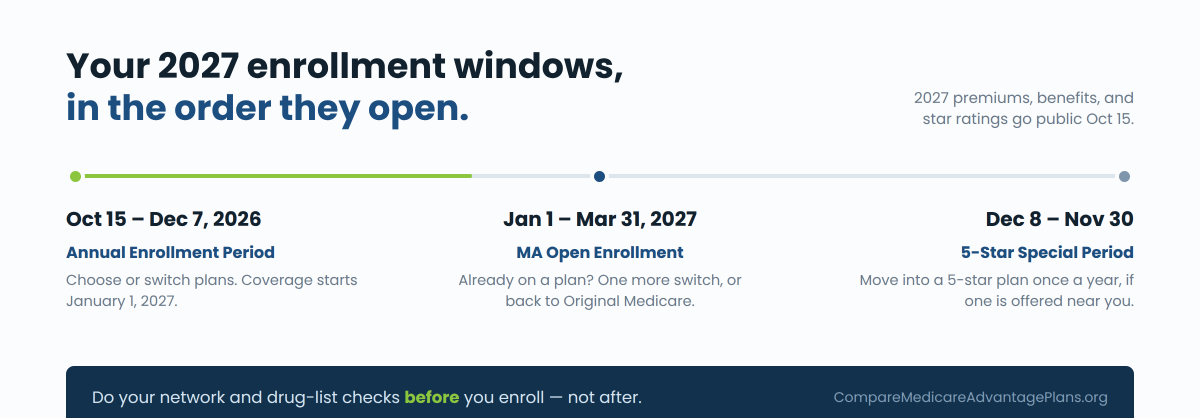
Annual Enrollment Period: October 15 – December 7, 2026. The main window. Coverage starts January 1, 2027. Plan details publish October 1, so you have two weeks to compare before it opens — start with our overview of 2027 Medicare Advantage plans.

Medicare Advantage Open Enrollment: January 1 – March 31, 2027. Already in a Medicare Advantage plan and it is not working? You get one switch here — to another plan, or back to Original Medicare.

If your plan is discontinued. Members whose plan is dropped generally qualify for a Special Enrollment Period, which gives you more time and more options than the standard window. Your Annual Notice of Change in September tells you whether this applies to you.

Medicare advantage enrollment period windows

UnitedHealthcare Medicare Advantage PPO 2027 — Frequently Asked Questions

UnitedHealthcare Medicare Advantage PPO 2027 — Frequently Asked Questions

  What is a UnitedHealthcare Medicare Advantage PPO plan?

It is a Medicare Advantage plan that uses a preferred provider network but still covers care outside that network at a higher cost share. You do not need a referral to see a specialist. UnitedHealthcare operates in 48 states plus Washington, D.C., and roughly 94% of Medicare-eligible people can access one of its plans, though PPO availability varies by county.

  How big is the UnitedHealthcare provider network?

Close to one million providers, the largest of any Medicare Advantage carrier. That matters more than out-of-network coverage for most people, because the wider the network, the more likely your existing doctors are already inside it at the lower in-network cost share.

  What is the maximum a UnitedHealthcare PPO can cost me in 2027?

For 2027, CMS caps in-network out-of-pocket spending at $9,850 and combined in-network plus out-of-network spending at $14,800. Those are the highest limits any Medicare Advantage PPO is permitted to set, and most plans set theirs lower — UnitedHealthcare's enrollment-weighted average was $6,492 for 2026. Prescription drug spending is capped separately at $2,400 in 2027.

  Why did UnitedHealthcare cancel so many PPO plans?

For the 2026 plan year, UnitedHealthcare exited a net 109 counties and its footprint fell from 87% to 80% of U.S. counties, with most discontinued plans being PPOs. It also exited Vermont entirely. Carriers across the industry pulled back on Medicare Advantage in the same cycle, citing cost pressure. If your plan was discontinued you were not left uncovered, but the replacement offered may have a different network and different caps.

  What star rating do UnitedHealthcare plans have?

UnitedHealthcare's enrollment-weighted average is 4.11 out of 5 for 2026, against a national average near 3.7, and roughly 78% of its members are in plans rated 4 stars or higher. Its ratings improved for 2026 while several competitors declined. Ratings are assigned per contract rather than per company, so check the rating on the specific plan in your county.

  How much do UnitedHealthcare Medicare Advantage plans cost?

For the 2026 plan year, the enrollment-weighted average premium was $33.90 per month, and about 52% of plans carried a $0 premium. 2027 pricing does not publish until October 1, 2026, so treat those as historical figures rather than a quote. You also pay your Medicare Part B premium separately.

  Do UnitedHealthcare PPO plans include prescription drug coverage?

Most do — roughly 92% of UnitedHealthcare Medicare Advantage plans included Part D coverage for 2026, and 97.6% of plans put Tier 1 drugs at a $0 copay. Part D-covered insulin was capped at a $25 copay. If you choose a plan without drug coverage, make sure you have creditable coverage elsewhere or you may face a late enrollment penalty.

  Can I keep my doctor with a UnitedHealthcare PPO?

Usually, but confirm before you enroll. If your doctor is in network you pay the lower in-network cost share. If they are out of network, a PPO still covers the visit at a higher cost share — but out-of-network providers are not required to accept the plan. Call the office and ask specifically about the UnitedHealthcare plan you are considering.

  Is a UnitedHealthcare PPO better than an HMO?

Neither is better in the abstract. A PPO covers out-of-network care and skips referrals, which matters if you travel or see several specialists. An HMO costs less in both premium and spending ceiling. Across all 2026 Medicare Advantage enrollees, HMOs averaged a $12 monthly premium and a $4,636 in-network cap, against $18 and $6,592 for PPOs. If every doctor you use is already in network, the HMO is usually the better value. For a look at how another carrier structures the same product, see our guide to Aetna Medicare Advantage PPO plans.

  When can I enroll in a UnitedHealthcare PPO for 2027?

The Annual Enrollment Period runs October 15 through December 7, 2026, with coverage starting January 1, 2027. If you are already in a Medicare Advantage plan, the Medicare Advantage Open Enrollment Period from January 1 to March 31, 2027 gives you one additional switch. If your current plan is being discontinued, you generally qualify for a Special Enrollment Period with more time and more options.

Have Questions?

Speak with a licensed insurance agent

1-855-454-9051

TTY users 711

Mon-Fri: 8am-9pm ET

Find & Compare Plans Online

Speak with a licensed insurance agent

1-855-454-9051TTY 711

Mon-Fri: 8am-9pm ET

ZRN Health & Financial Services, LLC, a Texas limited liability company