





Speak with a licensed insurance agent

1-855-454-9051

TTY user 711 Mon-Fri : 8am-9pm EST

Medicare Advantage HMO Plans 2027 - How They Work

Reviewed by Russell Noga, Licensed Medicare Insurance Broker (all 50 states) — Last updated September 20, 2026

The HMO is the most common kind of Medicare Advantage plan, and the one people most often enroll in without fully understanding what they agreed to. It is not a worse plan than the alternatives. It is a plan built on a specific trade, and whether that trade costs you anything depends entirely on facts about your own life.

This guide covers the rules that define an HMO, what actually happens when you go outside the network, the HMO-POS variant most people have never heard of, and an honest account of who these plans suit.

Some carriers are HMO-only on a given brand. Every plan sold as Keystone 65 in southeastern Pennsylvania is an HMO — the same insurer’s PPO is sold under an entirely different name, which catches people who assume one brand covers both structures.
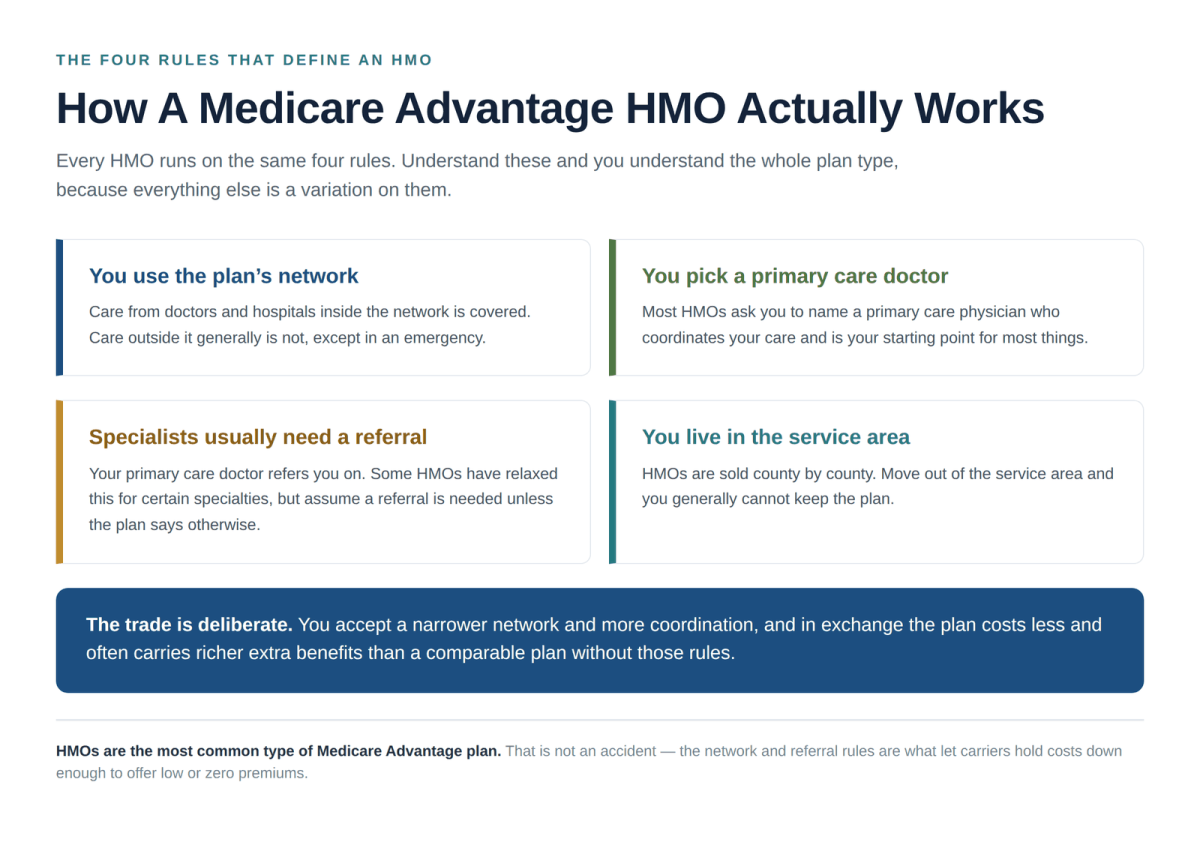

How Medicare Advantage HMO plans work for 2027 showing the four network and referral rules that define the plan type

Compare HMO plans and enroll online

Speak with a licensed insurance agent

1-855-454-9051TTY 711

Mon-Fri: 8am-9pm ET

Agent 08

The Four Rules That Define an HMO

Every Medicare Advantage HMO for 2027 runs on the same four rules. Everything else about the plan is a variation on these.

  • You use the plan’s network. Care from doctors and hospitals inside the network is covered. Care outside it generally is not, with specific exceptions covered below.
  • You choose a primary care doctor. Most HMOs ask you to name one. They coordinate your care and are the starting point for most of what follows.
  • Specialists usually require a referral. Some plans have relaxed this for certain specialties, but assume you need one unless the plan documents say otherwise.
  • You live in the service area. HMOs are sold county by county. Move outside the service area and you generally cannot keep the plan.

The trade is deliberate on the carrier’s part. A defined network and a coordinating physician let the plan predict and control what care costs, and that control is what funds the low premiums and the extra benefits HMOs are known for. You are not getting something for nothing. You are accepting constraints in exchange for price.

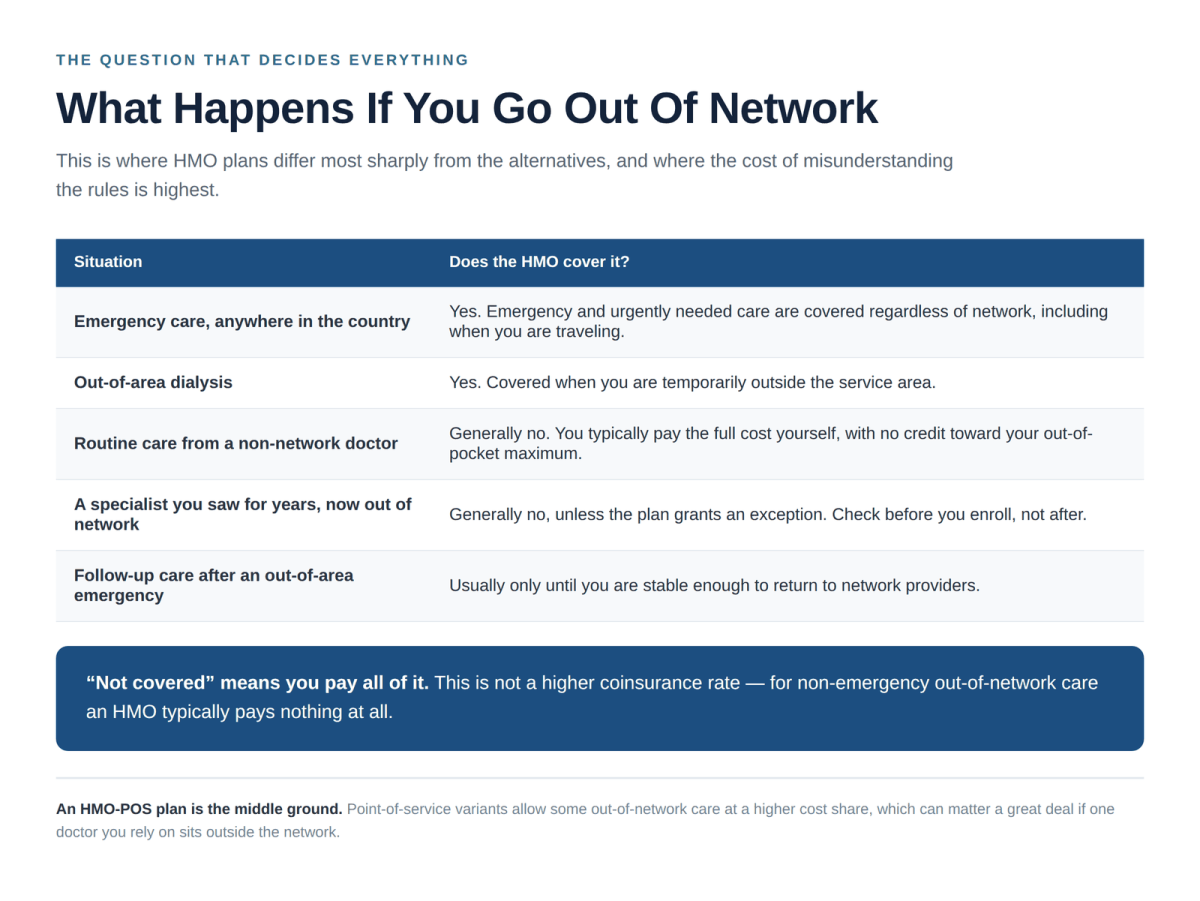
What Medicare Advantage HMO plans cover out of network including emergency care and routine care exclusions

What Happens If You Go Out of Network

This is the single most consequential thing to understand about an HMO, and the place where a misunderstanding costs the most money.

Situation Does the HMO cover it?
Emergency care, anywhere in the country Yes. Emergency and urgently needed care are covered regardless of network, including while traveling
Dialysis while temporarily out of the area Yes
Routine care from a non-network doctor Generally no. You typically pay the entire cost, and it does not count toward your out-of-pocket maximum
A specialist you have seen for years who is not in network Generally no, unless the plan grants an exception. Confirm before you enroll, not after
Follow-up care after an out-of-area emergency Usually only until you are stable enough to return to network providers

“Not covered” means you pay all of it

This is the part people get wrong. Out-of-network care under an HMO is not simply charged at a higher rate. For non-emergency care the plan typically pays nothing at all, and what you spend does not count toward the annual cap that would otherwise protect you.

HMO-POS: The Variant Most People Miss

Some HMOs carry the letters POS after the name, for point of service. These plans keep the HMO structure but allow some out-of-network care at a higher cost share, rather than refusing to cover it at all.

If one doctor you are unwilling to give up sits outside an otherwise ideal network, an HMO-POS plan is worth looking for specifically when 2027 plans are released. The flexibility is usually limited, often to particular service categories rather than everything, so read what the plan actually permits rather than assuming it works like a PPO.

Where HMO-POS sits on the spectrum

A standard HMO covers network care only. An HMO-POS covers network care plus some out-of-network care at a higher cost. A Medicare Advantage PPO covers out-of-network care broadly, usually with no referral requirement, at a higher premium. Those are the three rungs, in order.

Find & Compare Plans Online

Speak with a licensed insurance agent

1-855-454-9051TTY 711

Mon-Fri: 8am-9pm ET

Agent 08

Referrals and Prior Authorization

These two get conflated constantly and they are not the same thing. A referral is your primary care doctor sending you to a specialist. Prior authorization is the plan approving a service before it is delivered. You can need both, either, or neither, depending on the plan and the service.

Referrals are an administrative step that mostly costs you time. Prior authorization is the one worth investigating before you enroll, because it determines whether the coverage you were sold is coverage you can actually use without a fight. Imaging, planned surgery, skilled nursing stays, infusions and durable medical equipment are the usual candidates.

  • Ask the plan directly which of the services you rely on require prior authorization.
  • Ask how long a standard decision takes and how long an expedited one takes.
  • Check the plan’s customer service and appeals scores, which feed into the Medicare Advantage star ratings and are one of the few public signals on how a plan behaves when you need something approved.

Why HMOs Usually Cost Less

A carrier that controls where you receive care can negotiate harder with the providers in that network, because it is delivering them volume. Those negotiated rates are what allow HMO premiums to sit lower than comparable plans, and what funds the dental, vision, hearing and over-the-counter allowances that HMOs frequently carry.

Benefits vary by plan and by county, and not all plans offer all benefits, so treat any general statement about what HMOs include as a starting point rather than a promise. What is reliably true is the structural relationship: the tighter the network, the more room the plan has on price. Our overview of Medicare Advantage plans for 2027 covers how the plan types compare on cost more broadly.

A low premium is not a low cost

Compare the maximum out-of-pocket, the specialist copay, the hospital cost share and what your prescriptions land at under the plan’s formulary. A zero premium HMO with a high hospital copay can cost more in a bad year than a plan charging a monthly premium.

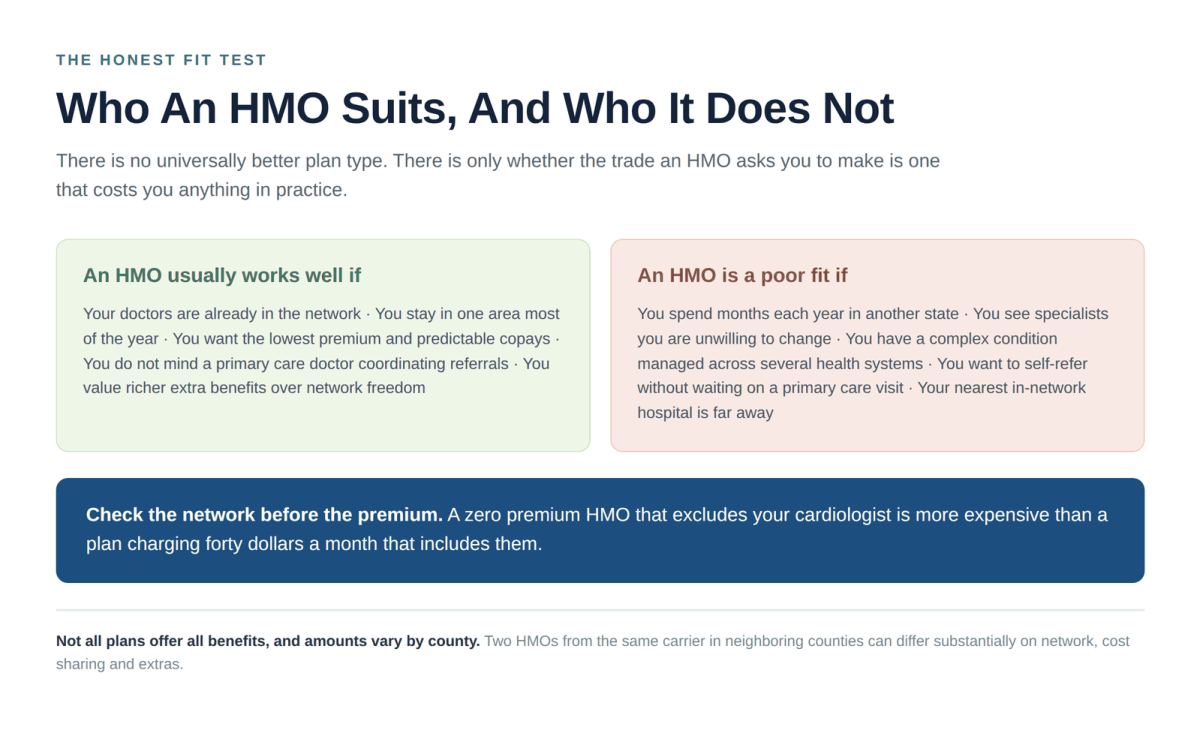
Who Medicare Advantage HMO plans suit in 2027 compared with who should consider a different plan type

Who an HMO Suits, and Who It Does Not

There is no universally better plan type. There is only whether the constraint an HMO imposes costs you anything in practice.

An HMO usually works well if

Your doctors are already in the network, you stay in one area most of the year, you want the lowest premium and predictable copays, you do not mind a primary care doctor coordinating your referrals, and you would rather have richer extra benefits than network freedom you will not use.

An HMO is a poor fit if

You spend months each year in another state, you see specialists you are unwilling to change, you have a complex condition managed across several health systems, you want to self-refer without waiting on a primary care visit, or your nearest in-network hospital is a long drive.

If your situation is more specific than either list — you have both Medicare and Medicaid, or a chronic condition a plan is built around — a Special Needs Plan may fit better than a standard HMO, and most SNPs are structured as HMOs anyway.

How to Check an HMO Before You Enroll

Step 1

Call every doctor, not the plan

Name the exact plan and ask whether they take it for 2027 and whether they are accepting patients under it. Provider directories are frequently out of date, and this is the check that prevents the most expensive surprise an HMO can produce.

Step 2

Check the hospital, separately

A network can include your primary care doctor while excluding the hospital system they admit to. Ask which hospitals in your area the plan contracts with for 2027, and confirm at least one is somewhere you would be willing to go.

Step 3

Price it with your actual drug list

Once 2027 plans go live on October 1, enter every prescription with its dose and your real pharmacy in the Medicare Plan Finder, then sort by total yearly cost rather than premium. Two HMOs with identical premiums can differ by thousands once your formulary tiers are accounted for.

Carriers structure their HMOs differently, and it is worth looking at a specific one to see how the pieces fit together — our breakdown of Aetna Medicare Advantage HMO plans walks through one national carrier’s approach in detail. Regional, health-system-owned carriers take a different route: UPMC for Life HMO plans build the network around the carrier’s own hospitals, which suits people already treated inside that system.

In upstate New York, CDPHP Medicare Advantage plans are now sold only as HMOs after the carrier dropped its PPOs for 2026. Before you commit to any of it, check what is changing next year in our guide to Medicare Advantage plan changes for 2027.

Compare HMO plans and enroll online

Speak with a licensed insurance agent

1-855-454-9051TTY 711

Mon-Fri: 8am-9pm ET

Agent 08

Frequently Asked Questions

➤  What is a Medicare Advantage HMO plan?

An HMO is a Medicare Advantage plan that covers care from doctors and hospitals inside its network. You typically choose a primary care doctor who coordinates your care and refers you to specialists, and you generally must live in the plan’s service area. In exchange for those rules, HMOs usually carry lower premiums than plans with broader network access.

➤  When can I compare 2027 Medicare Advantage HMO plans?

2027 plan details become viewable on October 1, 2026. You can enroll in or switch to a 2027 HMO during the Annual Enrollment Period, October 15 through December 7, with coverage starting January 1, 2027.

➤  Does a Medicare Advantage HMO cover me when I travel?

For emergency and urgently needed care, yes, anywhere in the United States regardless of network. For routine care, generally no. If you spend extended periods away from home, an HMO is usually the wrong plan type for you.

➤  Do I need a referral to see a specialist with an HMO?

Usually yes. Your primary care doctor refers you on. Some plans have removed the requirement for certain specialties, so check the plan documents rather than assuming either way. A referral is separate from prior authorization, which is the plan approving a service before it is provided.

➤  What is the difference between an HMO and an HMO-POS?

An HMO-POS keeps the HMO structure but allows some out-of-network care at a higher cost share, rather than not covering it at all. The flexibility is usually limited to specific service categories, so read what the plan actually permits before treating it as equivalent to a PPO.

➤  What happens if my doctor leaves the HMO network?

The plan is required to notify you. Depending on the circumstances you may be able to continue treatment for a transitional period, and a network change can sometimes qualify you for a special enrollment period. Contact the plan as soon as you are notified rather than waiting for your next appointment.

Have Questions?

Speak with a licensed insurance agent

1-855-454-9051

TTY users 711

Mon-Fri: 8am-9pm ET

Find & Compare Plans Online

Speak with a licensed insurance agent

1-855-454-9051TTY 711

Mon-Fri: 8am-9pm ET

Agent 08

ZRN Health & Financial Services, LLC, a Texas limited liability company