Speak with a licensed insurance agent

1-855-454-9051

TTY user 711 Mon-Fri : 8am-9pm EST

2027 Medicare Advantage Star Ratings: When They Publish and What They Mean

Reviewed by Russell Noga, Licensed Medicare Insurance Broker (all 50 states) — Last updated September 20, 2026

Every Medicare Advantage plan carries a star rating from one to five, and that number sits next to the plan everywhere you shop. It is the closest thing Medicare has to a quality score, it is calculated by the federal government rather than the carrier, and most people glance at it for two seconds and move on to the premium.

This guide covers when the 2027 ratings are published, where the major carriers stood going into this year, what the number actually measures, and how to use it without over-trusting it.

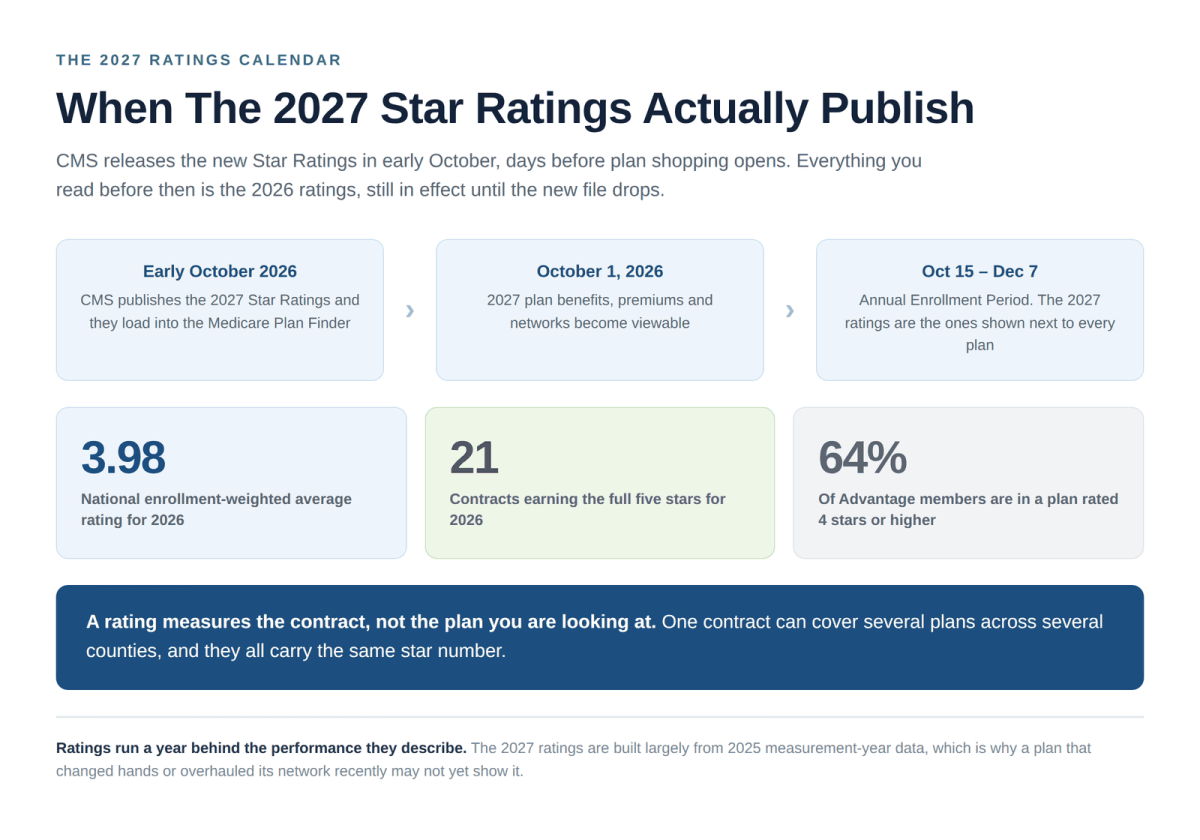
2027 Medicare Advantage star ratings publication timeline showing early October release before annual enrollment

Compare 2027 plans and enroll online

When the 2027 Star Ratings Publish

CMS releases the new star ratings in early October, a few days before the Annual Enrollment Period opens on October 15. Until that file drops, every star rating you see anywhere, including in the Medicare Plan Finder, is the 2026 rating.

That matters more than it sounds. If you start shopping on October 1, when 2027 plan details first become viewable, the plan information is new but the ratings alongside it may not be. Check which rating year is shown before you lean on it, and check again a week later.

Ratings describe the past, not the coming year

The 2027 ratings are built largely from 2025 measurement year data. A plan that changed hands, rebuilt its network or overhauled its customer service recently will not show that for another year or two. The rating is a lagging indicator by design.

Where the Carriers Stood for 2026

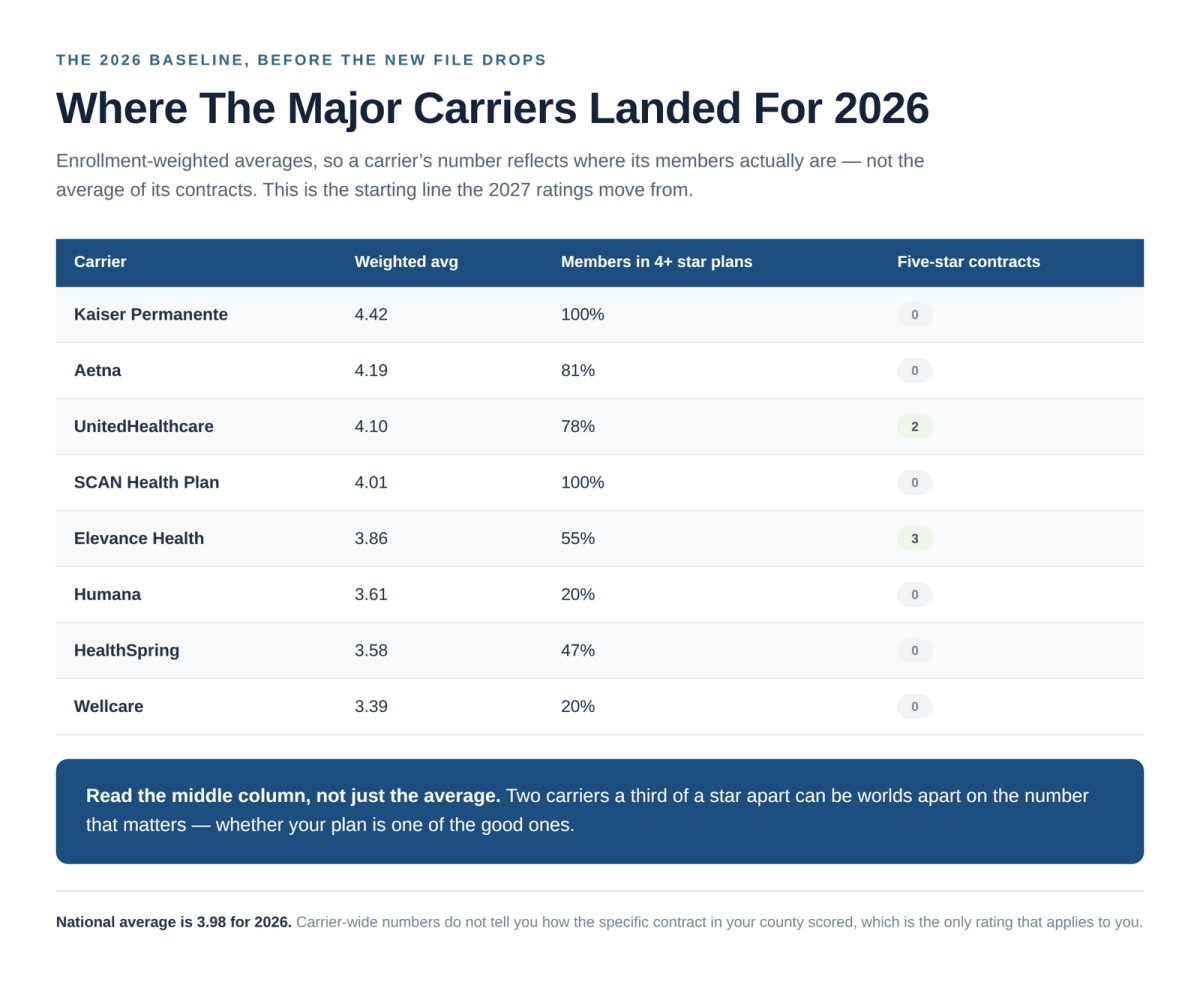
2026 Medicare Advantage star ratings by carrier with enrollment weighted averages and five star contract counts

The table below is the 2026 baseline, which is the starting line the 2027 ratings move from. These are enrollment-weighted averages, meaning each carrier’s number reflects where its members actually are rather than the simple average of its contracts. That distinction matters: a carrier can hold a handful of excellent contracts while most of its members sit in mediocre ones.

Carrier Weighted average Members in 4+ star plans Five-star contracts
Kaiser Permanente 4.42 100% 0
Aetna 4.19 81% 0
UnitedHealthcare 4.10 78% 2
SCAN Health Plan 4.01 100% 0
Elevance Health 3.86 55% 3
Humana 3.61 20% 0
HealthSpring 3.58 47% 0
Wellcare 3.39 20% 0

The national enrollment-weighted average for 2026 was 3.98. Twenty-one contracts earned the full five stars, and roughly 64 percent of all Medicare Advantage members were enrolled in a plan rated 4 stars or better.

Read the middle column rather than the average. Kaiser and SCAN both put 100 percent of their members in 4-plus star plans. Humana and Wellcare put 20 percent. That gap is far more useful than the third of a star separating two carriers’ averages, because it tells you the odds that the specific plan in front of you is one of the good ones.

Why Ratings Have Been Falling Across the Industry

If it seems like star ratings have been sliding for several years, that is because they have, and it is mostly not because plans got worse. CMS tightened how the scoring works. The thresholds a plan has to clear for each star level are recalculated every year against how everyone else performed, so as the industry improved, the bar rose with it. A plan can post identical numbers two years running and lose half a star.

CMS also changed how it handles statistical outliers when setting those thresholds, and restored the full weighting of the member survey measures after temporarily reducing them during the pandemic years. Both changes pushed ratings down across the board. The practical effect is that a 4-star plan today cleared a higher bar than a 4-star plan did five years ago.

What this means when you compare years

Comparing a plan’s 2027 rating to its 2024 rating is not comparing like with like. Compare plans against each other in the same year instead, which is the comparison the rating is actually built to support.

There is a second consequence that matters more to carriers than to you, though it eventually reaches you. Because the bonus payment threshold sits at 4 stars, a plan slipping from 4.0 to 3.5 loses a substantial revenue stream in one step. That is why you sometimes see a plan’s benefits shrink sharply in a single year rather than gradually.

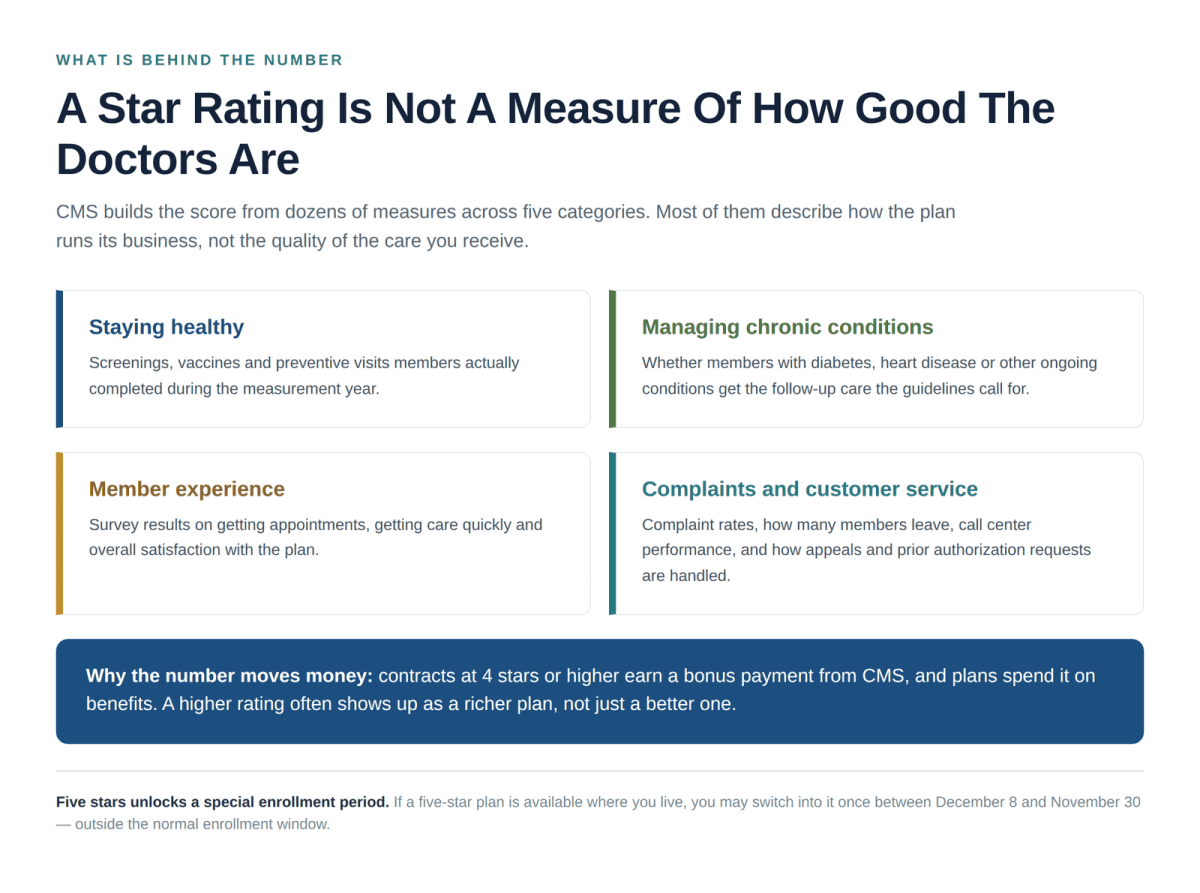
What Medicare Advantage star ratings measure including preventive care chronic condition management and member experience

What the Rating Actually Measures

CMS builds the score from dozens of individual measures across five categories. Most of them describe how the plan runs its business rather than how good your doctor is, which is the single most common misunderstanding about star ratings.

  • Staying healthy — the screenings, vaccines and preventive visits members actually completed during the measurement year.
  • Managing chronic conditions — whether members with diabetes, heart disease and similar conditions received the follow-up care the guidelines call for.
  • Member experience — survey results on getting appointments, getting care quickly, and overall satisfaction with the plan.
  • Member complaints and plan performance — complaint rates, how many members leave, and problems CMS identified with the plan directly.
  • Customer service — call center performance, and how the plan handles appeals and prior authorization requests.

That last category is the one worth paying attention to. How a plan handles appeals and authorizations is a genuine day to day experience issue that appears nowhere in a benefits summary, and it is one of the few places the star rating tells you something you could not otherwise find out.


Find & Compare Plans Online

Speak with a licensed insurance agent

1-855-454-9051TTY 711

Mon-Fri: 8am-9pm ET

Why Ratings Change What a Plan Can Offer

Star ratings are not just informational. Contracts rated 4 stars or higher earn a quality bonus payment from CMS, and plans generally push that money back into benefits to stay competitive. A higher rated plan in your county often carries a richer benefit package than a lower rated plan from the same carrier, which means the rating shows up in what you get, not only in what you are told.

It runs the other way too. When a carrier’s ratings fall, the bonus revenue falls with them, and the response is usually trimmed supplemental benefits or withdrawal from unprofitable counties. Our breakdown of Medicare Advantage plan changes for 2027 covers where that is happening.

Five stars unlocks a special enrollment period

If a 5-star Medicare Advantage plan is available where you live, you may switch into it one time between December 8 and November 30 of the following year, outside the normal enrollment window. It is one of the few genuinely flexible rules in Medicare, and almost nobody knows it exists.

How to Use Ratings When You Choose

Step 1

Use it as a filter, not a ranking

Set 4 stars as your floor and work from what remains. Sorting your entire county by star rating and picking the top one ignores network, drug coverage and cost, which are all more consequential to you than the gap between 4 and 4.5 stars.

Step 2

Check the contract rating, not the carrier average

A rating applies to a contract, and one contract can cover many plans across many counties. The carrier-wide number in the table above is useful for comparing companies. The only rating that applies to you is the one attached to the specific plan sold in your county, which you can see in the Medicare Plan Finder.

Step 3

Watch the direction, not just the level

A plan that dropped from 4.5 to 3.5 stars is telling you something a plan that has sat at 3.5 for years is not. Falling ratings often precede benefit cuts, because the bonus payment that funded those benefits goes away.

What If a Plan Has No Star Rating at All?

Some plans show no rating, or a note saying the plan is too new to be measured. This confuses people every year, and the instinct is usually to assume the worst. That instinct is wrong more often than it is right.

A plan is unrated for one of two reasons. Either it is genuinely new, meaning there is no measurement year data to score, or it has too few members for the results to be statistically meaningful. Neither says anything about quality. A new plan from an established carrier operating in the next county over is not an unknown quantity in any real sense.

  • Look at the carrier’s other contracts in your state or a neighboring one. The same organisation is administering the plan, with largely the same processes and often the same network.
  • Weight the things you can verify more heavily. Network, formulary and out of pocket maximum are all knowable today regardless of whether a rating exists.
  • Understand the trade-off. New plans are often priced or benefit-loaded aggressively to attract members. That can be genuine value, and it can also be an introductory offer that tightens in year two.

An unrated plan is a plan you have to evaluate on its own terms rather than on a shortcut. That is more work, not a warning.

What the Rating Does Not Tell You

A five star plan whose network excludes your cardiologist is worse for you than a three star plan that includes them. The rating measures the plan’s performance across its whole membership, and you are not its whole membership.

It also says nothing about whether your specific prescriptions sit on a favourable tier, what the plan’s maximum out of pocket is, whether the supplemental benefits it advertises are generous or token, or whether the plan intends to keep selling in your county next year. Treat the star rating as one input among several, weighted about as heavily as it deserves: meaningful, independently calculated, and nowhere near the whole picture.

If Your Plan's Rating Dropped This Year

A falling rating is worth attention, but it is not automatically a reason to switch. What matters is why it fell and whether the reason touches you.

What moved How much you should care
Dropped below 4 stars A lot. The plan loses its bonus payment, and benefit cuts commonly follow within a year or two
Fell from 4.5 to 4.0 Not much on its own. Still above the bonus threshold, and half a star is within normal year to year movement
Customer service and appeals scores fell A lot, if you use care regularly or rely on prior authorization for anything
Preventive screening scores fell Less. This largely measures whether members completed screenings, which is only partly within the plan’s control
Every carrier in your county fell Barely. That is the scoring thresholds moving, not your plan deteriorating

The one drop that should always prompt a fresh look is crossing below 4 stars, because that is where the money changes. Everything else is a signal to read the Annual Notice of Change carefully rather than to start over.

Compare 2027 plans and enroll online

Frequently Asked Questions

  When do the 2027 Medicare Advantage star ratings come out?

CMS publishes the new star ratings in early October, shortly before the Annual Enrollment Period opens on October 15. Until that file drops, the 2026 ratings are the ones in effect and the ones shown in the Medicare Plan Finder.

  What do Medicare Advantage star ratings measure?

CMS scores each contract on dozens of measures across five categories: staying healthy through preventive screenings, managing chronic conditions, member experience, member complaints and plan performance, and customer service. Most measures describe how the plan operates rather than the quality of individual doctors.

  Is a 5-star Medicare Advantage plan always better than a 4-star plan?

Not necessarily for your situation. A star rating applies to the contract, which can cover many plans across many counties. A 4-star plan whose network includes your doctors and covers your prescriptions may serve you better than a 5-star plan that does not.

  Can I switch to a 5-star plan outside of open enrollment?

Yes. If a 5-star Medicare Advantage plan is available where you live, a special enrollment period lets you switch into it one time between December 8 and November 30 of the following year, outside the normal Annual Enrollment Period.

  Why do star ratings affect plan benefits?

Contracts rated 4 stars or higher earn a quality bonus payment from CMS. Plans generally direct that money back into benefits, so a higher rated plan in your area often carries a richer benefit package than a lower rated one from the same carrier.

Have Questions?

Speak with a licensed insurance agent

1-855-454-9051

TTY users 711

Mon-Fri: 8am-9pm ET

Find & Compare Plans Online

Speak with a licensed insurance agent

1-855-454-9051TTY 711

Mon-Fri: 8am-9pm ET

ZRN Health & Financial Services, LLC, a Texas limited liability company