Speak with a licensed insurance agent

1-855-454-9051

TTY user 711 Mon-Fri : 8am-9pm EST

Best Medicare Advantage Plans 2027

Reviewed by Russell Noga, Licensed Medicare Insurance Broker (all 50 states) — Last updated August 31, 2026

Most “best Medicare Advantage plans” articles rank carriers by how many people bought them. That is a bad method, and 2026 proved it: the carrier that added the most members last year has the worst measured plan quality of any major insurer, and the carrier that lost the most members has among the best.

“Best” and “top rated” are not the same thing. Medicare’s own star ratings score plans on quality and service rather than cost or network — see 5-star Medicare Advantage plans for the full list of contracts that reached five stars and how the major carriers compare.

This page ranks the national Medicare Advantage carriers on four criteria we state up front and weight in the open, using 2026 CMS star ratings and enrollment data — the most recent published. It also does something the other lists refuse to do, which is tell you who each carrier is wrong for.

One thing this page deliberately does not contain: an explanation of what Medicare Advantage is, how enrollment periods work, or how Part C costs are structured. If you need that, start with our 2027 Medicare Advantage plans guide and come back. This is the verdict, not the primer.

For the full carrier-by-carrier breakdown including 2027 costs, star ratings, and supplemental benefit changes, see our 2027 Medicare Advantage plans compared by carrier.

Read this before the rankings. Every cost, benefit, and star rating below is 2026 plan-year data, because that is what exists today. Plan-level details for 2027 — premiums, networks, drug tiers, supplemental benefits and the 2027 star ratings — publish on October 1, 2026. Carriers have already said 2027 benefits will change. Treat everything here as a guide to which companies to shortlist, not a quote.

Compare 2027 Medicare Advantage Plans

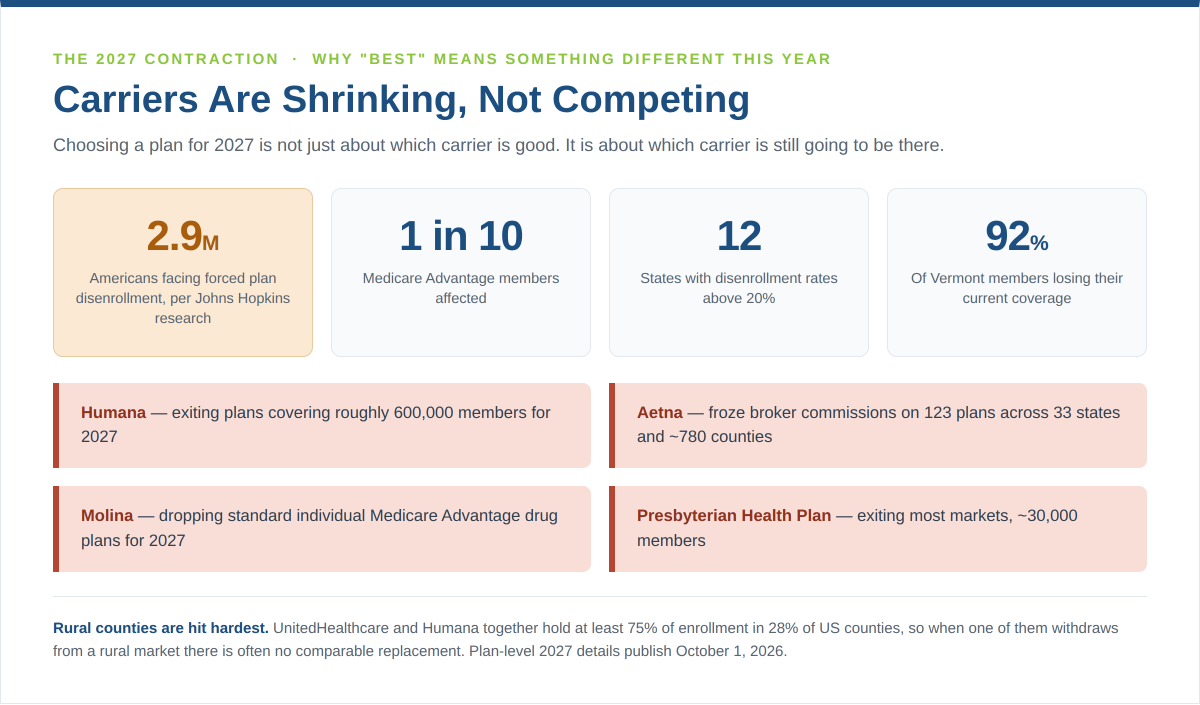
Medicare Advantage 2027 contraction: 2.9 million members facing plan disenrollment, carrier exit list

Why “Best” Means Something Different for 2027

In a normal year, picking a Medicare Advantage carrier is a question of which plan is best. For 2027 there is a prior question: which plans will still exist.

Research from the Johns Hopkins Bloomberg School of Public Health puts roughly 2.9 million Americans — about one in ten Medicare Advantage members — in plans being discontinued. Twelve states are seeing disenrollment rates above 20%. In Vermont, 92% of Medicare Advantage members are losing their current coverage. Rural counties are hit hardest, and that is not a coincidence: UnitedHealthcare and Humana together hold at least 75% of enrollment in 28% of US counties, so when one of them pulls out of a rural market there is frequently no comparable replacement waiting.

The announcements so far for 2027:

Humana is exiting plans covering roughly 600,000 members. UnitedHealthcare is leaving 34 counties across 12 states, with about two-thirds of the affected policies being PPO plans. Aetna froze broker commissions on 123 plans across 33 states and nearly 780 counties — roughly a fifth of those counties in Georgia. Molina is dropping its standard individual Medicare Advantage drug plans entirely. Presbyterian Health Plan is exiting most of its markets, affecting about 30,000 members.

A frozen commission is worth understanding, because it is the quietest signal on that list. When a carrier stops paying agents to sell a plan but does not formally cancel it, the plan technically remains available and quietly stops being offered to anyone. Plan exits and commission freezes are the same strategy at different intensities.

This is why our ranking weights stability at 25 points. A four-star plan you get moved out of in twelve months is worth less than a three-and-a-half-star plan that stays put.

Click here to learn more about UnitedHealthcare Medicare Advantage HMO Plans.

How We Ranked These Carriers

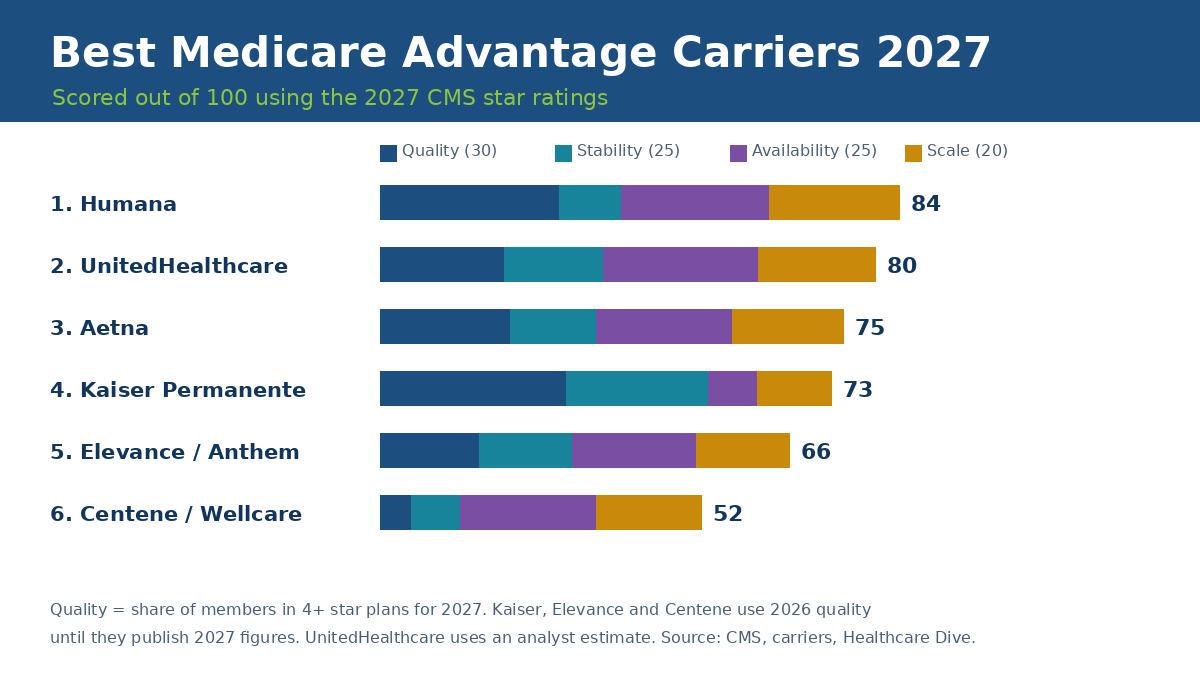
Four criteria, 100 points total. We are publishing the weights so you can disagree with them, because for a lot of people the right weights are different.

Plan quality — 30 points. The share of each carrier’s members enrolled in a plan CMS rates 4 stars or better. This is the only quality measure that is independently calculated, applied identically to every carrier, and published by the federal government. It is the most defensible number available.

2027 stability — 25 points. Announced plan exits, county withdrawals, commission freezes and market departures. A carrier that is contracting is a carrier that may move you next year, and a forced plan change costs you your network, your drug formulary and your deductible progress at once.

Availability — 25 points. How many counties and states the carrier serves, and how large its provider network is. A carrier that scores perfectly on quality is worth nothing to you if it does not sell in your county.

Scale and member trend — 20 points. Total enrollment, which drives provider negotiating power and plan variety, adjusted for whether members are joining or leaving. Weighted lowest on purpose — size is a proxy for quality, not a substitute for it.

Best Medicare Advantage carriers 2027 scored: UnitedHealthcare 83, Aetna 78, Kaiser 75, Elevance 66, Humana 61

Two honest caveats about this scorecard. First, it is a national ranking and Medicare Advantage is sold county by county, so the carrier that finishes first here can be the worst of three options where you live — or not sold there at all. Second, if you never travel outside your metro area, you should weight availability far lower than we did, and Kaiser wins outright.

Find & Compare 2027 Plans Online

Or speak with a licensed insurance agent now

1-855-454-9051TTY 711

Mon-Fri: 8am-9pm ET

The Carriers, Ranked

1. UnitedHealthcare — 83 points

The largest Medicare Advantage carrier in the country at roughly 9.3 million members and 26% of the market, and a provider network of about one million clinicians reaching more counties than anyone else. Seventy-seven percent of its members are in 4-star-or-better plans, second among the broadly available national carriers.

It finishes first because availability and network breadth are where it is genuinely unmatched, and because it pairs that reach with quality scores most of its competitors cannot approach. For someone who wants the widest possible choice of doctors and hospitals and a strong chance of a well-rated plan being available in their county, this is the default answer.

The case against it is real, though. UnitedHealthcare shed 647,000 members in 2026, the largest decline of any carrier, and it is exiting 34 counties across 12 states for 2027, with roughly two-thirds of the affected policies being PPO plans. It scores 16 out of 25 on stability, the second-worst mark among carriers that are not actively leaving the business. More detail on its structure is in our UnitedHealthcare 2027 overview and our UnitedHealthcare PPO breakdown.

2. Aetna (CVS Health) — 78 points

The highest measured quality of any broadly available carrier: 81% of Aetna members are in 4-star-or-better plans, and its national individual PPO contract is rated 4.5 stars. About 4.2 million members, 12% of the market, and enrollment essentially flat in 2026 at a loss of 29,000 — stable in a year when the two biggest carriers moved by hundreds of thousands in each direction.

It finishes second rather than first for two reasons. Its quality slipped from 89% to 81% in one rating cycle, which is a meaningful move in the wrong direction. And it carries the lowest stability score on this list at 14 out of 25, because of the commission freeze on 123 plans across 33 states. If your county is one of the roughly 780 affected, Aetna’s national quality average is not the number that matters to you. Our Aetna 2027 overview has the detail.

3. Kaiser Permanente — 75 points

On the two criteria that measure whether a plan is good, Kaiser is not close to being beaten. Essentially 100% of its members are in 4-star-or-better plans — a perfect 30 out of 30 — and it is the only major carrier with no announced 2027 contraction of any kind, taking a perfect 25 out of 25 on stability. It grew by 87,000 members in 2026.

It finishes third purely because most Americans cannot buy it. Kaiser operates in roughly eight states plus the District of Columbia and scores 8 out of 25 on availability. That is the entire gap between third place and first.

If Kaiser operates in your county, start there. On measured quality and 2027 stability it outscores every carrier on this page, and the only reason it is not ranked first is a geographic limitation that either applies to you or does not. Check whether it sells where you live before you read any further — for the people it covers, the ranking above this line is the wrong ranking.

4. Elevance / Anthem Blue Cross Blue Shield — 66 points

The most improved carrier of 2026. The share of Elevance members in 4-star-or-better plans climbed from roughly 40% to 53% in a single rating cycle, the largest quality gain among the majors. Roughly 1.8 million members and 5% of the market.

Two things hold it back. It lost 346,000 members in 2026, the second-largest decline of any carrier. And because Blue Cross Blue Shield plans are licensed regionally, quality and benefits vary sharply from state to state under the same brand — a 53% national average tells you much less about your specific plan than a national average does for a single-entity carrier. Our Blue Cross Medicare Advantage overview covers the regional structure.

5. Humana — 61 points

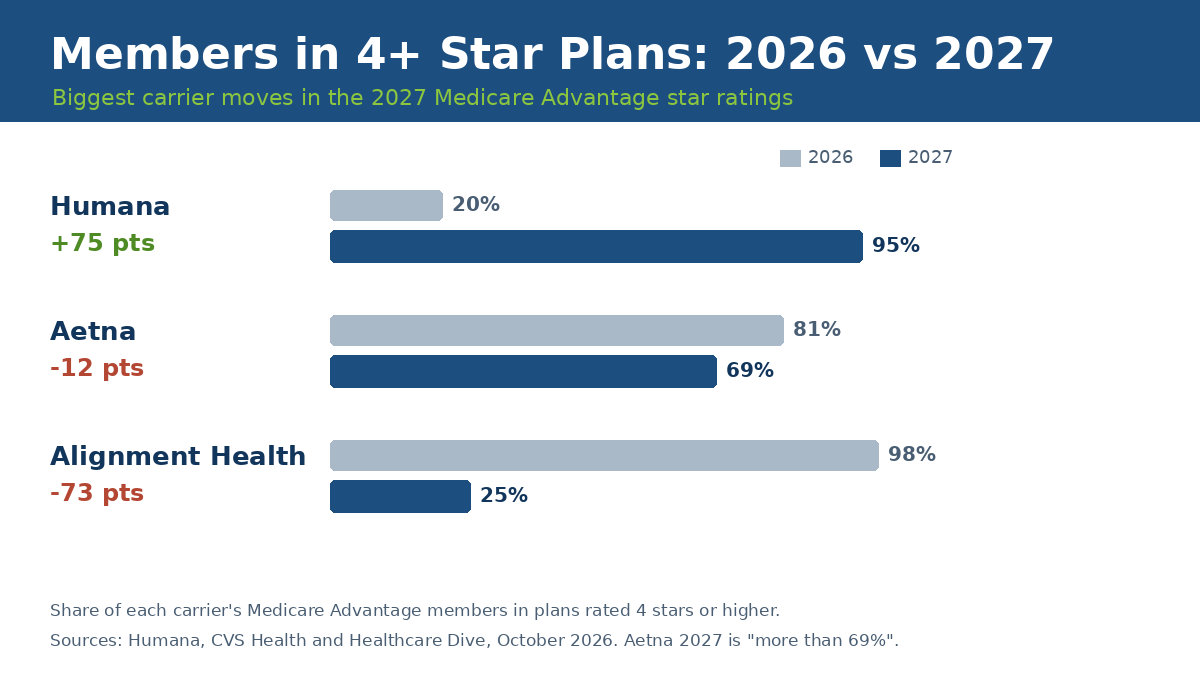
Humana is the clearest illustration of why popularity is not quality. It added 1.3 million members in 2026, by far the largest gain in the industry, reaching roughly 7.0 million members and 20% of the market. And only about 20% of its members are in 4-star-or-better plans — the lowest of any major carrier, down from 25% the year before.

It also scores 10 out of 25 on stability, second-worst on this page, because it is exiting plans covering roughly 600,000 members for 2027. Its own CFO framed the strategy as prioritizing higher-performing plans, which is a reasonable thing for a company to do and an uncomfortable one to be on the wrong side of. Humana’s national individual PPO contract is rated exactly 3.5 stars.

None of that makes Humana a bad choice for everyone. It is genuinely strong on price, its Part B giveback offering is among the most widely available in the market, and its average out-of-pocket maximum has historically run below both Aetna’s and UnitedHealthcare’s. If premium is your binding constraint, it belongs on your shortlist. See our Humana 2027 overview and Humana PPO breakdown.

6. Centene / WellCare — 52 points

Centene had the single largest quality improvement in the industry, going from 1% of members in 4-star-or-better plans to 18%. That is a genuine turnaround from a genuinely terrible starting point, and 18% is still the lowest figure on this page. It is broadly available and priced aggressively, which is why it ranks at all.

Centene had the single largest quality improvement in the industry, going from 1% of members in 4-star-or-better plans to 18%. That is a genuine turnaround from a genuinely terrible starting point, and 18% is still the lowest figure on this page. It is broadly available and priced aggressively, which is why it ranks at all.

Two Smaller Carriers That Outscore Everyone on Quality

They are not in the main ranking because their footprints are too small to compete on availability, but if either sells in your county it deserves a look ahead of most of the list above.

Alignment Healthcare has 100% of its members in 4-star-or-better plans, matching Kaiser. Devoted Health is a fast-growing regional carrier with strong ratings and an expanding footprint, and it is one of the few carriers actively entering markets rather than leaving them for 2027. Our Devoted 2027 page has its state list and ratings. HealthSpring, the former Cigna Medicare business now owned by HCSC, is a third regional option worth checking.

Star Ratings: The One Number That Separates Them

If you take one thing from this page, take the spread in the chart below. The gap between the best and worst carrier on measured plan quality is not a few percentage points. It is the difference between essentially all members in a highly rated plan and roughly one in five.

Share of members in 4-star Medicare Advantage plans by carrier, 2026 CMS star ratings

CMS rates plans from 1 to 5 stars on more than 40 measures covering clinical outcomes, member experience, customer service and complaints. The rating attaches to the contract, not the individual plan, so every plan sold under one contract inherits the same score whatever it is called in your county. Your plan’s contract ID appears on its Summary of Benefits, formatted like H5216-043, and it is the number to look up rather than trusting a carrier’s national average.

Ratings are recalculated every October, and they move. In one cycle Aetna fell from 89% to 81%, Humana fell from 25% to 20%, Elevance climbed from roughly 40% to 53% and Centene went from 1% to 18%. The 2027 star ratings publish in October 2026, alongside plan details. A carrier that looks strong on this page today can look different by the time you enroll.

What Changed for 2027

Medicare Advantage enrollment reached 35.2 million in 2026, or 55% of everyone eligible for Medicare — up from 19% in 2007 and projected to reach 63% by 2034. Growth slowed sharply, adding 1.1 million net members for a 3% increase, and special needs plans accounted for 85% of that net growth.

But the more useful number is where those members went.

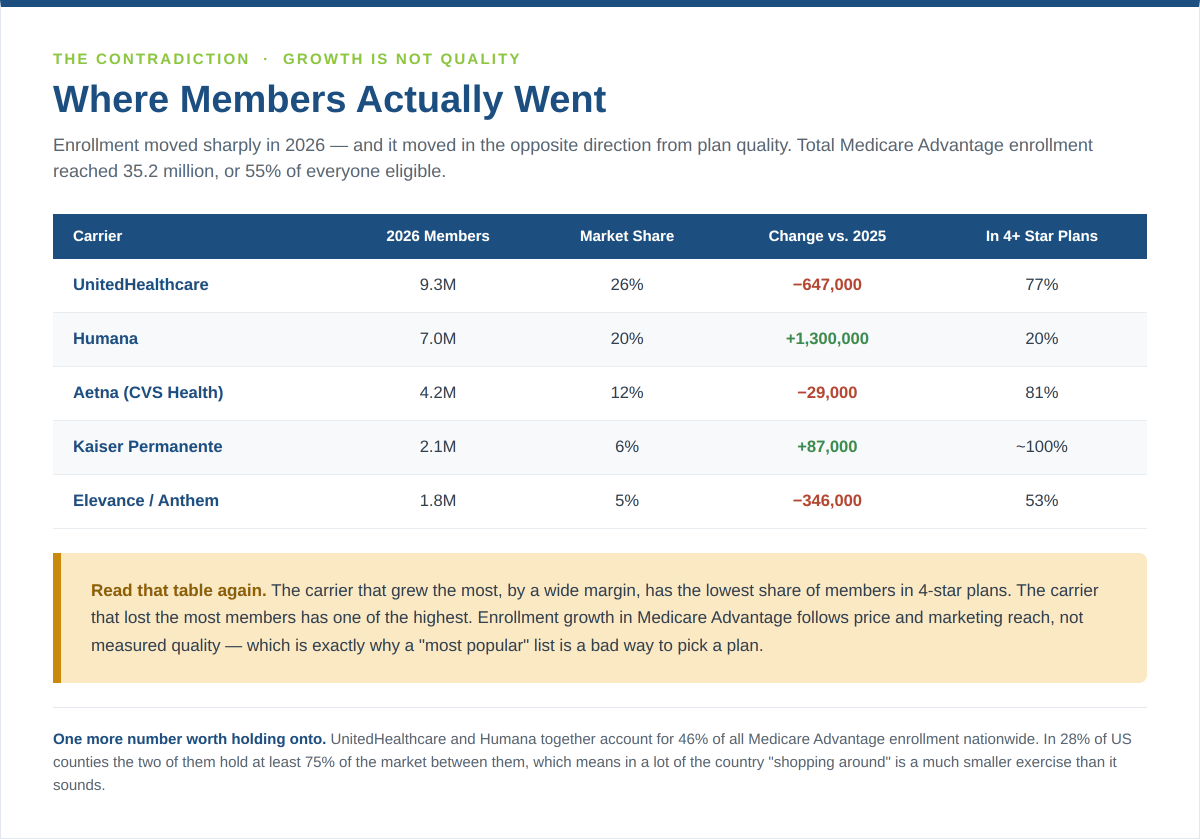
Medicare Advantage enrollment by carrier 2026: UnitedHealthcare, Humana, Aetna, Kaiser, Elevance member change

Enrollment moved in the opposite direction from quality. The carrier that grew most has the lowest share of members in well-rated plans. Two of the carriers with the highest quality scores lost members. Medicare Advantage enrollment follows price and marketing reach, not measured outcomes — which is the single best argument against choosing a plan from a “most popular” list.

Three federal changes also apply to every plan in 2027 regardless of carrier. The Part D out-of-pocket maximum rises to $2,400 from $2,100. The standard Part D deductible rises to a maximum of $700 from $615. And CMS set the 2027 in-network out-of-pocket cap at $9,850, with the combined in-network and out-of-network cap at $14,800. Our 2027 costs and benefits breakdown covers what these mean in practice.

Who Each Carrier Is Wrong For

Every carrier on this page is the wrong answer for somebody. Working out which somebody you are is faster than reading six reviews.

Which Medicare Advantage carrier to skip 2027 by situation, six carriers compared

How to Use This Ranking in Your County

A national ranking narrows the field. It does not pick your plan. Four steps close the gap:

1. Read your Annual Notice of Change. It arrives in September and tells you whether your current plan continues into 2027 and what changes if it does. If your plan is being discontinued you generally qualify for a Special Enrollment Period, which gives you more time and more options than the standard window.

2. Find out which of these carriers actually sell in your county. This is usually a shorter list than people expect. In 28% of US counties, two carriers hold at least three-quarters of the market between them.

3. Look up the contract-level star rating for each specific plan, not the carrier average. A carrier averaging 81% can still sell a 3-star plan in your county, and a carrier averaging 20% can sell a 4.5-star one.

4. Check your own doctors and your own prescriptions against each plan. Every number on this page is an average. Whether your cardiologist is in network and whether your medication sits on tier 2 or tier 4 will affect your actual costs more than any ranking will.

Plan-level details for 2027 publish October 1, 2026. Annual Enrollment runs October 15 to December 7, 2026, for coverage that begins January 1, 2027.

Find a 2027 Medicare plan in your area

Frequently Asked Questions

  What company has the highest rated Medicare Advantage plan?

By the share of members enrolled in 4-star-or-better plans, Kaiser Permanente and Alignment Healthcare lead at essentially 100%, though both operate in limited geographies. Among carriers available across most of the country, Aetna leads at 81%, followed by UnitedHealthcare at 77%. These are 2026 CMS ratings; the 2027 ratings publish in October 2026. Note that CMS rates the contract rather than the individual plan, so a carrier with a strong national average can still sell a lower-rated plan in your specific county.

  What will happen to Medicare Advantage plans in 2027?

The market is contracting. Research from Johns Hopkins puts roughly 2.9 million members — about one in ten — in plans being discontinued, with twelve states seeing disenrollment above 20% and Vermont at 92%. Humana is exiting plans covering about 600,000 members, UnitedHealthcare is leaving 34 counties across 12 states, Aetna has frozen broker commissions on 123 plans in 33 states, and Molina is dropping standard individual Medicare Advantage drug plans entirely. Federally, the Part D out-of-pocket cap rises to $2,400 and the standard deductible to a maximum of $700.

  What is the best Medicare Advantage plan for 2027?

There is no single best plan, because Medicare Advantage is sold county by county and the options available to you may be a fraction of what exists nationally. On our scoring, UnitedHealthcare ranks first nationally at 83 points on the strength of availability and network breadth, Aetna second at 78 on quality, and Kaiser Permanente third at 75 — though Kaiser outscores both on quality and stability and ranks third only because most people cannot buy it. If Kaiser sells in your county, start there.

  Which Medicare Advantage carriers are cutting plans for 2027?

Humana is exiting plans covering roughly 600,000 members. UnitedHealthcare is leaving 34 counties across 12 states, with about two-thirds of affected policies being PPO plans. Aetna froze broker commissions on 123 plans across 33 states and nearly 780 counties. Molina is dropping its standard individual Medicare Advantage drug plans. Presbyterian Health Plan is exiting most markets, affecting about 30,000 members. Kaiser Permanente is the only major carrier with no announced 2027 contraction. Specific county and plan lists arrive with non-renewal notices and the October 1, 2026 plan data release.

  What insurance is better than UnitedHealthcare?

On measured plan quality, several carriers score higher. Kaiser Permanente and Alignment Healthcare have essentially 100% of members in 4-star-or-better plans against UnitedHealthcare’s 77%, and Aetna reaches 81%. On availability and network size, nothing beats UnitedHealthcare — it serves more counties than any competitor with a network of roughly one million providers. Which carrier is better depends entirely on whether the higher-quality options sell where you live, and for most of the country Kaiser and Alignment do not.

  Is Humana a good Medicare Advantage plan for 2027?

It depends on what you are optimizing for. Humana is genuinely strong on price, its Part B giveback offering is among the most widely available in the market, and its average out-of-pocket maximum has historically run below both Aetna’s and UnitedHealthcare’s. But only about 20% of its members are in 4-star-or-better plans, the lowest of any major carrier and down from 25% the prior year, and it is exiting plans covering roughly 600,000 members for 2027. If premium is your binding constraint it belongs on your shortlist; if measured quality is your priority it does not.

  How do I know if my Medicare Advantage plan is being discontinued?

Your plan must send you an Annual Notice of Change in September, and a separate non-renewal notice if the plan is ending. Read both. If your plan is being discontinued you generally qualify for a Special Enrollment Period, which gives you more time and more options than the standard Annual Enrollment window, including the right to move to Original Medicare with a Medigap policy under certain guaranteed-issue protections. Do not wait for the news to tell you — carriers notify members directly and the notice is the document that matters.

  Do Medicare Advantage star ratings actually matter?

They are the only quality measure that is independently calculated, applied identically to every carrier, and published by the federal government, covering more than 40 measures across clinical outcomes, member experience, customer service and complaints. They are not perfect — they lag by a year and they rate the contract rather than the individual plan — but no better standardized comparison exists. They also carry financial weight: contracts rated 4 stars and above earn bonus payments, which is part of why carriers are exiting lower-rated plans.

  When will 2027 Medicare Advantage plan details be available?

October 1, 2026. That is when CMS publishes plan-level premiums, networks, drug formularies, supplemental benefits and the 2027 star ratings for every county. Annual Enrollment opens two weeks later on October 15 and runs through December 7, for coverage beginning January 1, 2027. Those two weeks are a real advantage — you can compare everything before anyone can enroll.

  Is Medicare Advantage worth it in 2027?

Enrollment says most people think so — 35.2 million Americans, or 55% of everyone eligible for Medicare, are in a Medicare Advantage plan, up from 19% in 2007. The trade is real either way: Medicare Advantage typically costs less monthly and bundles drug coverage and extras, in exchange for a provider network and prior authorization requirements Original Medicare does not impose. The 2027 contraction changes the calculation for one specific group — people in rural counties where a carrier withdrawal may leave no comparable replacement. If that is you, price a Medigap policy alongside your Advantage options while you still have guaranteed-issue rights.
Have Questions?

Speak with a licensed insurance agent

1-855-454-9051

TTY users 711

Mon-Fri: 8am-9pm ET

Find & Compare Plans Online

Speak with a licensed insurance agent

1-855-454-9051TTY 711

Mon-Fri: 8am-9pm ET

ZRN Health & Financial Services, LLC, a Texas limited liability company