Speak with a licensed insurance agent

1-855-454-9051

TTY user 711 Mon-Fri : 8am-9pm EST

UnitedHealthcare Medicare Advantage HMO 2027

Reviewed by Russell Noga, Licensed Medicare Insurance Broker (all 50 states) — Last updated September 3, 2026

UnitedHealthcare is not treating its HMO and PPO lines the same way heading into 2027. It cut more than 100 Medicare Advantage plans covering roughly 600,000 members for the 2026 plan year, and the great majority of those were PPOs. The company said plainly why: its PPO products underperform its HMOs on both outcomes and affordability, so it is moving resources into HMOs instead.

That makes the HMO the product line UnitedHealthcare is actually betting on — and it changes what you should be asking about one. This page covers how a UnitedHealthcare Medicare Advantage HMO is structured, what the 2027 spending caps will be, what is genuinely confirmed for next year, and where the HMO trade-offs bite.

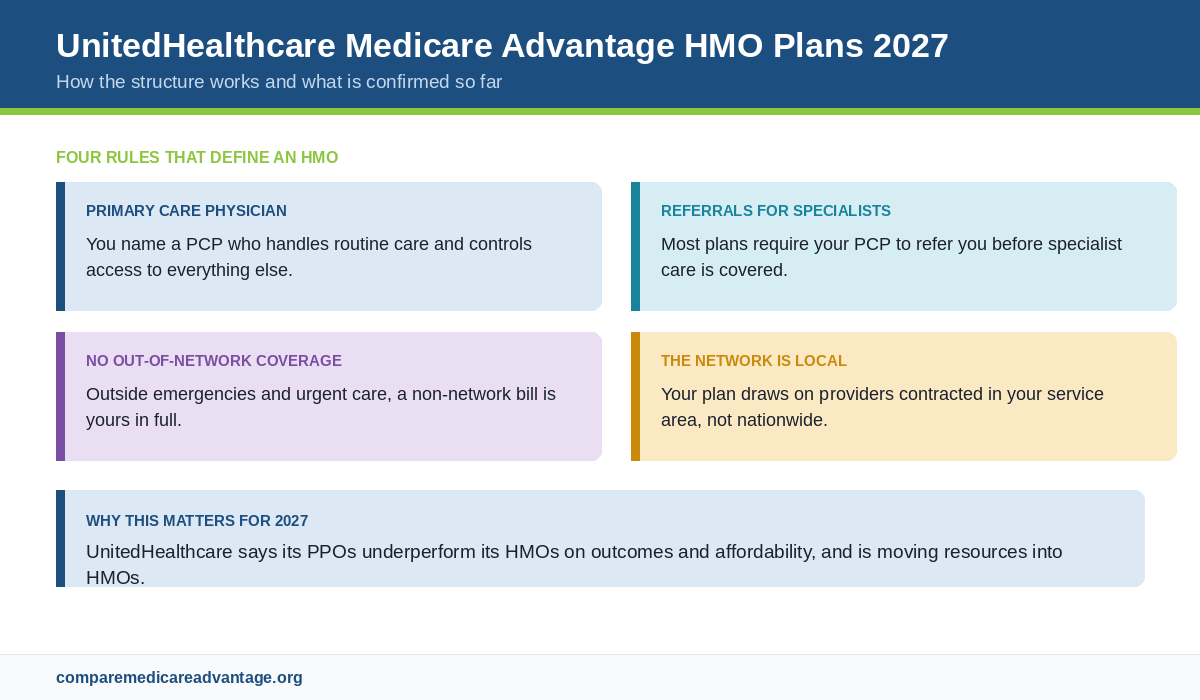
UnitedHealthcare Medicare Advantage HMO plans 2027 overview showing network structure, referral requirement and coordinated care model

What UnitedHealthcare HMO Plans Look Like Going Into 2027

UnitedHealthcare remains the largest Medicare Advantage carrier in the country, with roughly 9.3 million Medicare Advantage members and about a quarter of the national market. Its provider network runs to roughly one million care providers across 48 states and the District of Columbia. For the 2026 plan year the company said its HMO offerings reached about 92% of Medicare-eligible Americans, and that it would continue offering some form of Medicare Advantage plan to about 94% of them.

Scale is the reason the HMO question matters at all. When a carrier this size reshapes which structures it sells, it moves millions of people — and in most counties where UnitedHealthcare stays, the HMO is increasingly the option it wants you in.

The short version: a UnitedHealthcare HMO keeps you inside a defined local network, usually asks you to name a primary care physician, and generally requires a referral before you see a specialist. In exchange, member costs on HMOs have run lower than on the equivalent PPOs — the carrier has pointed specifically to specialist visits and prescription drug deductibles.

Compare UHC PPO and HMO plans in your area

Why UnitedHealthcare Is Moving Toward HMOs

This is not a quiet drift. For the 2026 plan year UnitedHealthcare exited 109 net counties, withdrew entirely from 16 markets affecting roughly 180,000 members, and left Vermont altogether. Most of what it cut was PPO. The company told the trade press that PPOs underperform HMOs on outcomes and affordability, and that it was redirecting resources into HMOs because they let primary care physicians coordinate treatment, manage chronic conditions and push preventive care.

The pattern looks set to continue. Modern Healthcare reported on August 5, 2026 that UnitedHealthcare is considering exiting a further 34 counties across 12 states for the 2027 plan year, affecting more than 20,000 members. Roughly two-thirds of the policies on that preliminary list are PPO plans. UnitedHealth Group has stressed the list is not final.

Read this the right way. A carrier favouring HMOs does not mean an HMO is automatically the better plan for you. It means the economics of the HMO structure work better for the carrier, and some of that saving has historically been passed through to members as lower cost sharing. Whether that trade is worth it depends entirely on how you use doctors — which the rest of this page walks through.

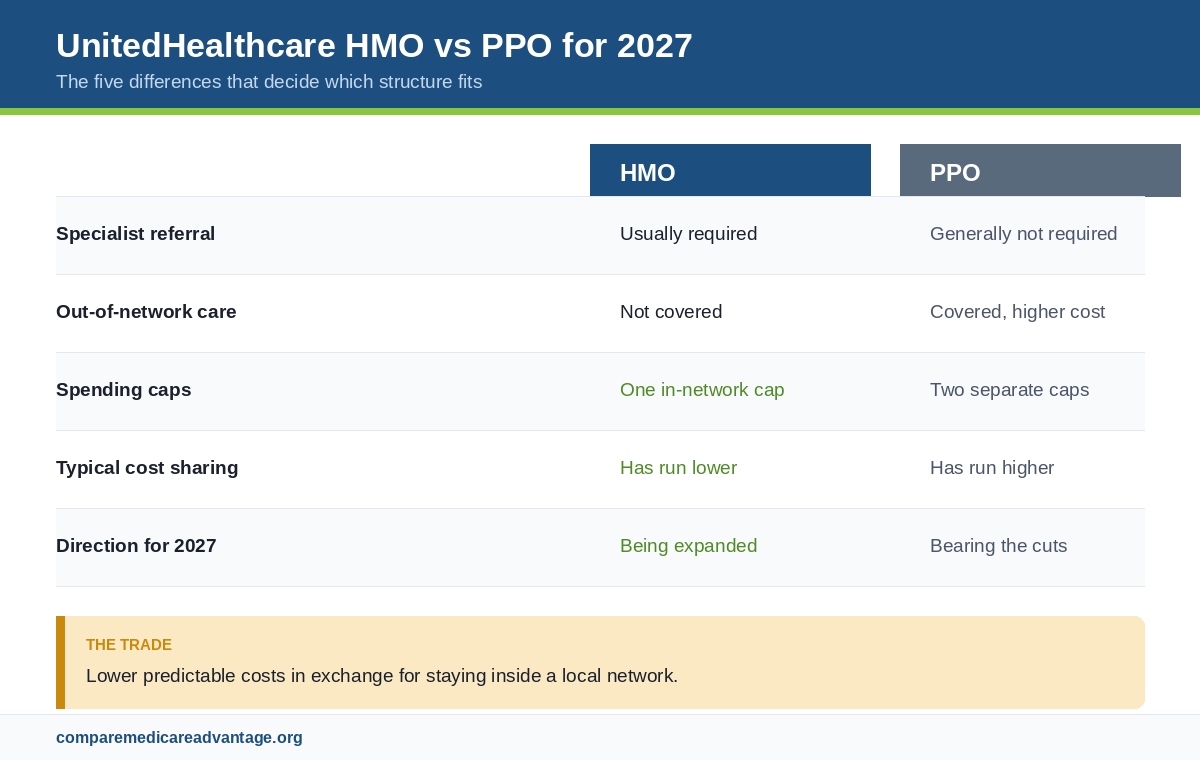
UnitedHealthcare HMO vs PPO 2027 comparison of referrals, out-of-network coverage, spending caps and typical member c

What's Confirmed for 2027 — and What Isn't

Confirmed by CMS for 2027: the maximum out-of-pocket limit an HMO may set for in-network care, the $2,400 cap on what you pay out of pocket for Part D prescription drugs, the $700 ceiling on a Part D deductible, and the enrollment dates. These are federal rules and they apply to every carrier.

Not confirmed yet: which specific UnitedHealthcare HMO plans will be sold in your county, what they will charge, which providers will be in network, and what supplemental benefits they will carry. None of that is public until October 1, 2026. Any page quoting 2027 premiums or benefits today is quoting 2026 figures.

Genuinely uncertain: the 34-county exit list. It is preliminary, it was shared with marketing organisations rather than published, and the company says it may change. If you are in one of those counties you will find out through a non-renewal notice, not through a news article.

How a UnitedHealthcare HMO Actually Works

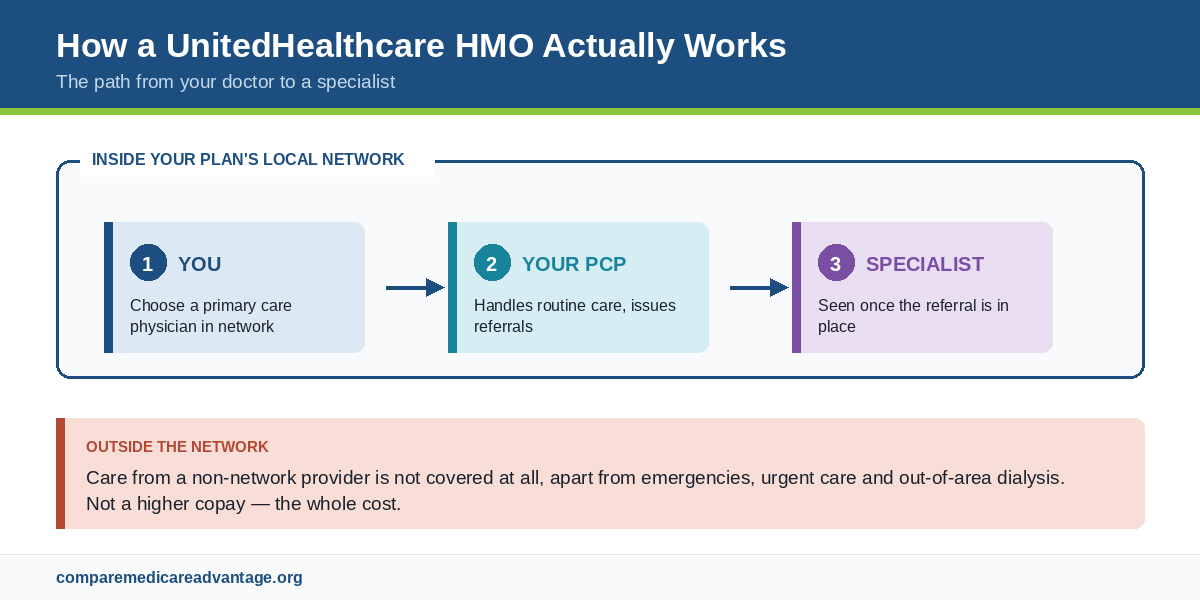
How a UnitedHealthcare Medicare Advantage HMO works: primary care physician selection, specialist referrals and in-network provider requirement

The mechanics are the same across carriers, but they are worth spelling out because they are where most complaints originate.

RULE 1 · YOU PICK A PRIMARY CARE PHYSICIAN

Your PCP is the hub. They handle routine care and they are the gate to everything else. If your current doctor is not in the plan’s network, you change doctors or you change plans — there is no third option on an HMO.

RULE 2 · SPECIALISTS USUALLY NEED A REFERRAL

Most HMOs require your PCP to refer you before a specialist visit is covered. Some plans waive this for certain services. Check the rule on the specific plan rather than assuming, because it varies and it is the single most common source of a surprise denial.

RULE 3 · OUT-OF-NETWORK CARE IS NOT COVERED

This is the hard edge of an HMO and the real difference from a PPO. Outside emergencies, urgent care and dialysis when you are travelling, care from a non-network provider is your bill in full. Not a higher copay — the whole cost.

RULE 4 · THE NETWORK IS LOCAL, NOT NATIONAL

UnitedHealthcare’s national network is roughly a million providers, but your HMO draws on the slice of it contracted in your service area. A large national footprint does not help you at a specialist two states away.

Find & Compare Plans Online

Speak with a licensed insurance agent

1-855-454-9051TTY 711

Mon-Fri: 8am-9pm ET

The Spending Cap on a UnitedHealthcare HMO for 2027

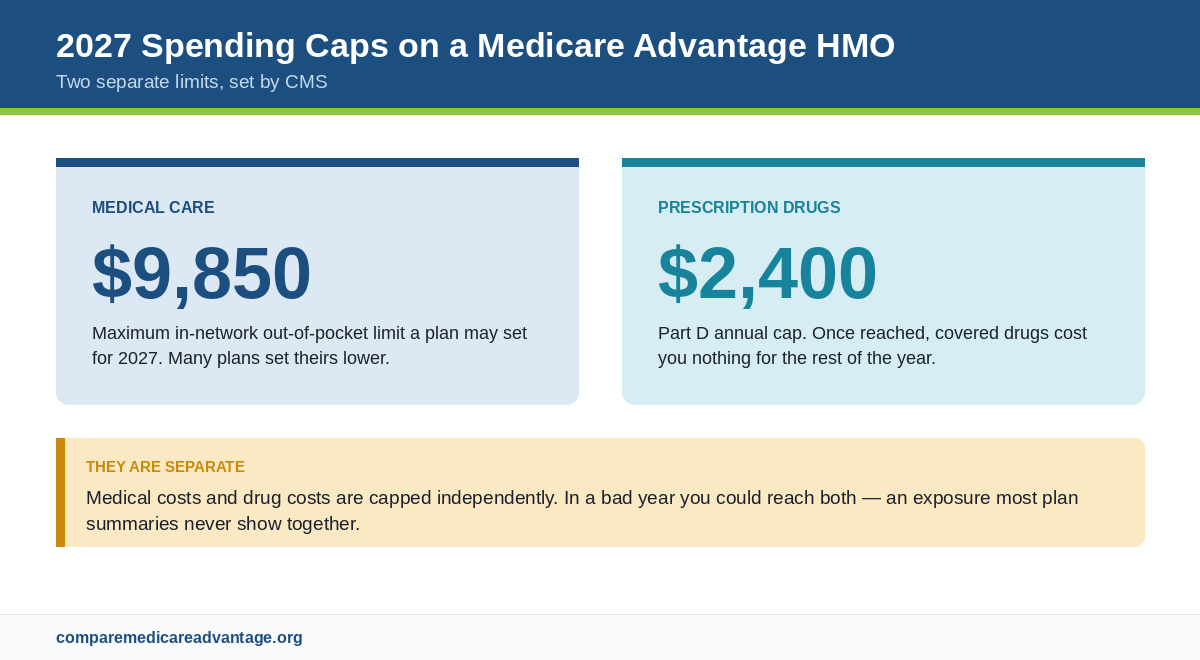
Every Medicare Advantage plan has to cap what you can be billed in a year. On a PPO there are two caps: one for in-network care and a higher combined one that includes out-of-network care. On an HMO there is only one that matters, because out-of-network care is not covered in the first place.

For the 2027 plan year, CMS set the maximum in-network out-of-pocket limit at $9,850. That is a ceiling, not a target — plans routinely set theirs lower, and the figure a specific plan chooses is one of the more useful things to compare once the October data is out.

Worth knowing: the out-of-pocket maximum covers medical care only. Prescription drugs sit under a separate Part D cap, which is $2,400 for 2027. In a bad year you could reach both, which is a combined exposure most plan summaries never present in one place.

2027 Medicare Advantage HMO out-of-pocket maximum of $9,850 in network compared with the $2,400 Part D prescription drug cap

What Changes in Part D for 2027

These figures apply to every Medicare Advantage plan that includes drug coverage, HMO or otherwise, so they are a fixed part of the 2027 picture regardless of which plan you land on.

Part D parameter 2027 What it means for you
Annual out-of-pocket cap $2,400 Once you hit it, covered drugs cost you nothing for the rest of the year
Maximum deductible $700 A plan may set a lower one, or none at all
Payment smoothing Available You can opt to spread drug costs across monthly payments instead of paying at the counter

Where UnitedHealthcare Ranks on Quality

On the 2026 star ratings, UnitedHealthcare averaged 4.11 stars across its Medicare Advantage contracts, with roughly 78% of its members in plans rated four stars or better. Against a national average that fell to 3.65 for Medicare Advantage prescription drug plans, that is a strong showing for a carrier of its size.

Two caveats. Star ratings are assigned at contract level, not plan level, so the rating attached to the plan you are shown may reflect performance across a much wider book of business than your county. And the 2027 star ratings do not publish until October 2026 — anything you read before then is 2026 data.

UnitedHealthcare HMO vs PPO for 2027

Factor HMO PPO
Referral to see a specialist Usually required Generally not required
Out-of-network care Not covered outside emergencies Covered at higher cost sharing
Spending caps One in-network cap Two — in-network and a higher combined cap
Typical member cost sharing Has run lower Has run higher
Direction for 2027 Carrier is expanding these Bearing most of the cuts

If the out-of-network question is the one that decides it for you, the structural detail is covered in more depth on our page on UnitedHealthcare Medicare Advantage PPO 2027. For the carrier’s full 2027 picture across both structures, see UnitedHealthcare Medicare Advantage plans 2027.

Who a UnitedHealthcare HMO Fits — and Who It Doesn't

Likely a good fit if you:

Get most of your care locally and rarely travel for treatment · already use doctors in the plan’s network, or have no strong attachment to a particular one · want lower predictable cost sharing and are willing to accept the referral process to get it · have chronic conditions that benefit from one physician coordinating everything · value a lower monthly cost over maximum flexibility.

Likely a poor fit if you:

Spend months of the year in another state · are being treated at a centre outside your county and want to keep going · see multiple specialists and would find referral requirements a genuine obstacle · have a long relationship with a doctor who is not in the network · are already mid-treatment on a course of care you cannot easily transfer.

When You Can Enroll for 2027

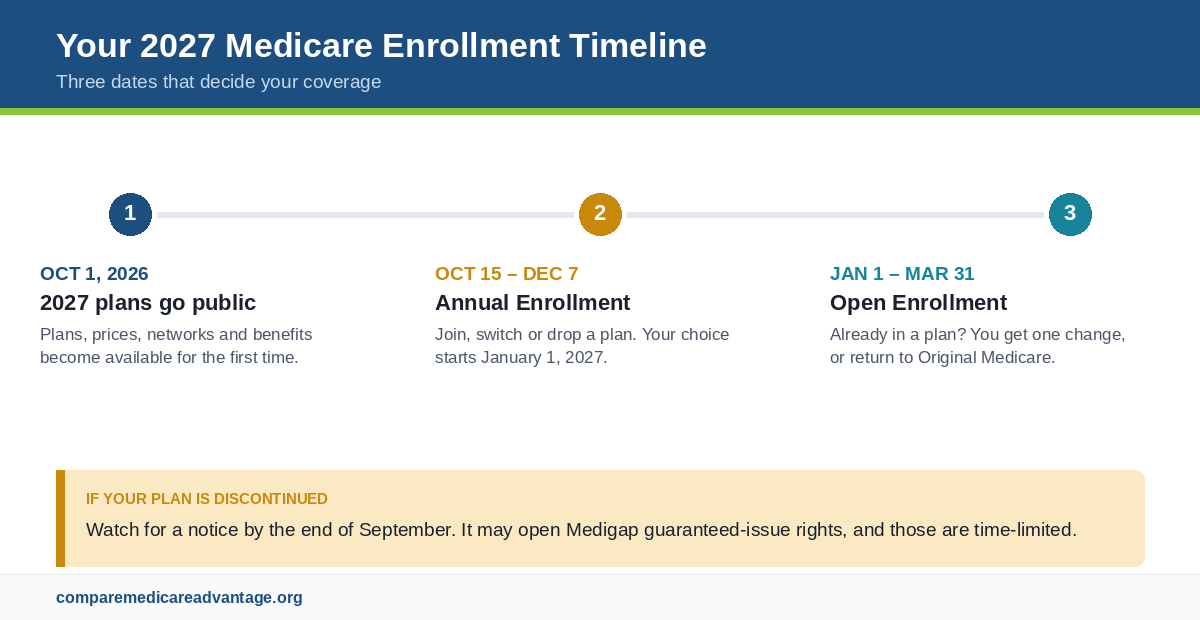
YOUR 2027 TIMELINE

Three dates that decide your coverage

1

October 1, 2026. Every 2027 plan becomes public — which plans exist in your county, what they cost, what they cover and who is in network. This is the first day real comparison is possible.

2

October 15 to December 7, 2026. Annual Enrollment. Join, switch or drop a Medicare Advantage plan. Whatever you choose takes effect January 1, 2027. Miss this window and your options narrow sharply.

3

January 1 to March 31, 2027. Medicare Advantage Open Enrollment. If you are already in a Medicare Advantage plan you get one change — switch to a different plan or return to Original Medicare.

If your plan is being discontinued: you should receive an Annual Notice of Change or a non-renewal notice by the end of September. Losing a plan involuntarily can open Medigap guaranteed-issue rights depending on the circumstances — a right that is time-limited and easy to lose by waiting. Read the notice the day it arrives.

Comparing across carriers rather than within one? Start with the best Medicare Advantage plans for 2027, or see 2027 Medicare Advantage plans compared by carrier. For the basics of how Part C works, see our guide to Medicare Advantage plans 2027.

2027 Medicare enrollment timeline showing October 1 plan release, October 15 to December 7 AEP and January 1 to March 31 open enrollment

Compare UHC PPO and HMO plans in your area

Frequently Asked Questions

  What will happen to Medicare Advantage plans in 2027?

Several carriers are trimming their footprints for 2027 as medical costs rise, with trade reporting suggesting the collective pullback could touch around 225 counties. UnitedHealthcare is reportedly considering exits from 34 counties across 12 states. None of it is final until plans complete their bids, and the confirmed picture publishes on Medicare.gov on October 1, 2026.

  Why is UnitedHealthcare dropping Medicare Advantage plans?

The company has pointed to rising medical costs, heavier use of services and tighter federal reimbursement. It expected Medicare funding to fall roughly 20% by 2026 against 2023 levels. Its response was to exit markets it could not run profitably and concentrate on plan structures that control cost better — which is why the cuts fell mainly on PPOs.

  Is a UnitedHealthcare HMO cheaper than a PPO?

Historically yes on cost sharing. The carrier has said member costs for medical care and prescription drugs — specialist visits and drug deductibles in particular — run lower on its HMOs, and that HMOs tend to carry more generous extras such as over-the-counter credit and dental. Whether that holds for any given 2027 plan will not be known until pricing publishes on October 1, 2026.

  Do I need a referral to see a specialist on a UnitedHealthcare HMO?

Usually. Most Medicare Advantage HMOs require your primary care physician to refer you before specialist care is covered, though some plans waive it for particular services. Because the rule varies by plan, confirm it on the specific plan’s documents rather than assuming — an unreferred visit is the most common cause of an unexpected denial.

  What is the out-of-pocket maximum on a Medicare Advantage HMO in 2027?

CMS set the maximum in-network out-of-pocket limit at $9,850 for the 2027 plan year. Individual plans frequently set a lower one, so the figure on the plan you are considering is what actually applies. Prescription drugs are capped separately at $2,400 under Part D.

  How much will UnitedHealthcare premiums increase in 2027?

Nobody can answer this yet, and be sceptical of any page that claims to. Plan premiums for 2027 are not public until October 1, 2026. What can be said is that carriers across the market are under cost pressure, and that pressure typically shows up as changed cost sharing and supplemental benefits rather than as headline premium alone.

  Can I use a UnitedHealthcare HMO when I travel?

For emergencies, urgently needed care and out-of-area dialysis, yes — those are covered nationwide. Routine and planned care while travelling is not. If you spend extended periods away from home, an HMO is the wrong structure and a PPO is the one to look at.

  What happens if my UnitedHealthcare plan is discontinued for 2027?

You will receive written notice, typically by the end of September. You can choose another Medicare Advantage plan during Annual Enrollment, or return to Original Medicare. Losing coverage involuntarily may also open guaranteed-issue rights to buy a Medigap policy without medical underwriting, depending on your circumstances — but that right is time-limited, so act on the notice rather than waiting.

  How does UnitedHealthcare rate on quality compared with other carriers?

On the 2026 star ratings it averaged 4.11 stars with roughly 78% of members in plans rated four stars or better, against a national Medicare Advantage prescription drug average of 3.65. That places it well for a carrier of its scale. Ratings are set at contract level rather than plan level, and 2027 ratings publish in October 2026.

  Should I wait until October to choose a 2027 plan?

You cannot enroll before October 15 regardless, so there is no cost to waiting. Use the time before October 1 to write down what you actually need — which doctors you want to keep, which drugs you take, whether you travel — so that when the real 2027 data lands you are comparing against your own requirements instead of a marketing sheet.

Have Questions?

Speak with a licensed insurance agent

1-855-454-9051

TTY users 711

Mon-Fri: 8am-9pm ET

Find & Compare Plans Online

Speak with a licensed insurance agent

1-855-454-9051TTY 711

Mon-Fri: 8am-9pm ET

ZRN Health & Financial Services, LLC, a Texas limited liability company