Speak with a licensed insurance agent

1-855-454-9051

TTY user 711 Mon-Fri : 8am-9pm EST

Are Medicare Advantage Plans Going Away in 2027?

Reviewed by Russell Noga, Licensed Medicare Insurance Broker (all 50 states) — Last updated September 1, 2026


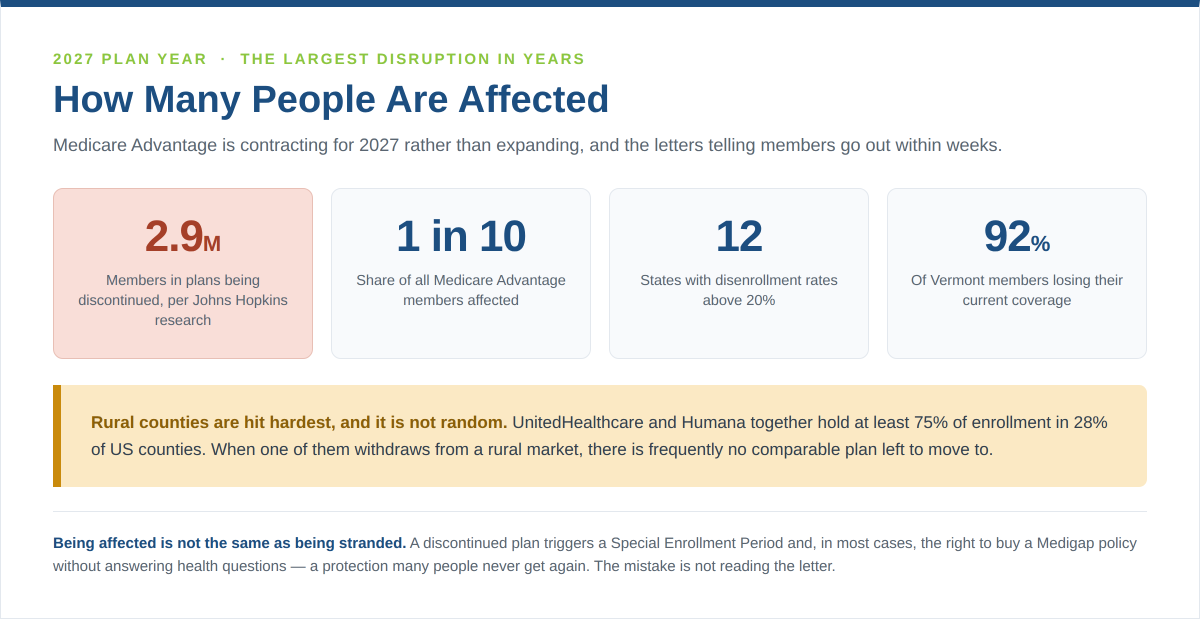
If you are in a Medicare Advantage plan, there is roughly a one-in-ten chance it is going away for 2027.

That is not a scary figure. Research from the Johns Hopkins Bloomberg School of Public Health puts about 2.9 million members in plans going away, and the letters telling those members go out within weeks. Carriers are required to notify you by October 1.

This page explains how to tell whether you are affected, what happens if you ignore it, and what your options are — including one protection that expires 63 days after your coverage ends and is very difficult to get back.

If your plan is ending and you are choosing a replacement, start with our full guide to 2027 Medicare Advantage plans — what is changing, the four plan types, and how to compare coverage in your county.

Chart showing 2.9 million Medicare Advantage members in plans going away for 2027

How You Will Find Out

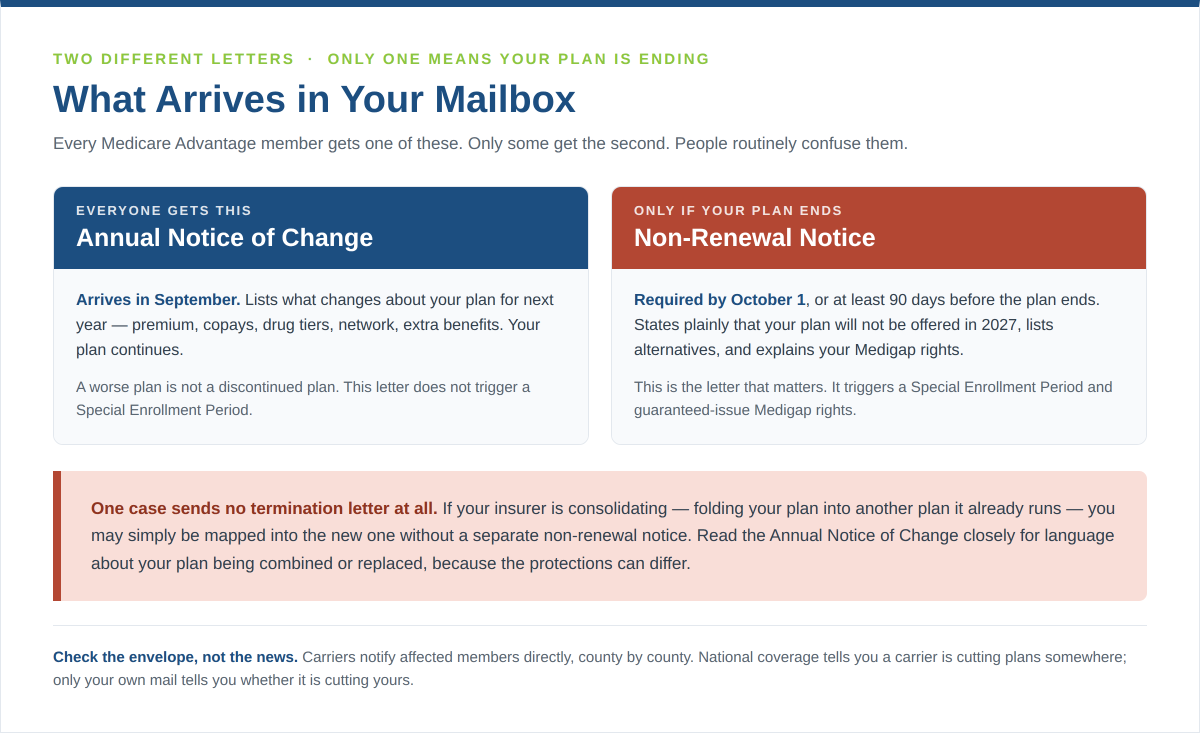
Comparison of the Medicare Advantage non-renewal notice versus the Annual Notice of Change

You cannot answer this question from news coverage. Medicare Advantage is sold county by county, and a carrier cutting plans in Georgia may be leaving yours untouched. The only reliable source is your own mail.

Two letters arrive in the fall, and people confuse them constantly.

ARRIVES SEPTEMBER  ➤  EVERY MEMBER GETS ONE

The Annual Notice of Change lists what changes about your plan next year — premium, copays, drug tiers, network, supplemental benefits. Your plan continues. A plan getting worse is not a plan being discontinued, and this letter does not give you any extra enrollment rights.

BY OCTOBER 1  ➤  ONLY IF YOUR PLAN IS ENDING

The non-renewal notice goes only to members whose plan is ending. Carriers must send it by October 1, or at least 90 calendar days before the plan terminates. It says plainly that the plan will not be offered next year, lists the alternatives available in your area, and explains your Medigap rights. This is the letter that matters.

!

One situation produces no termination letter at all. If your insurer is consolidating — folding your plan into another plan it already operates — you may simply be mapped into the replacement without a separate non-renewal notice. Read your Annual Notice of Change carefully for language about your plan being combined, replaced or renamed, because the protections available to you can differ from a straight non-renewal.

Your options depend on your county — See yours now

Which Carriers Have Plans Going Away for 2027

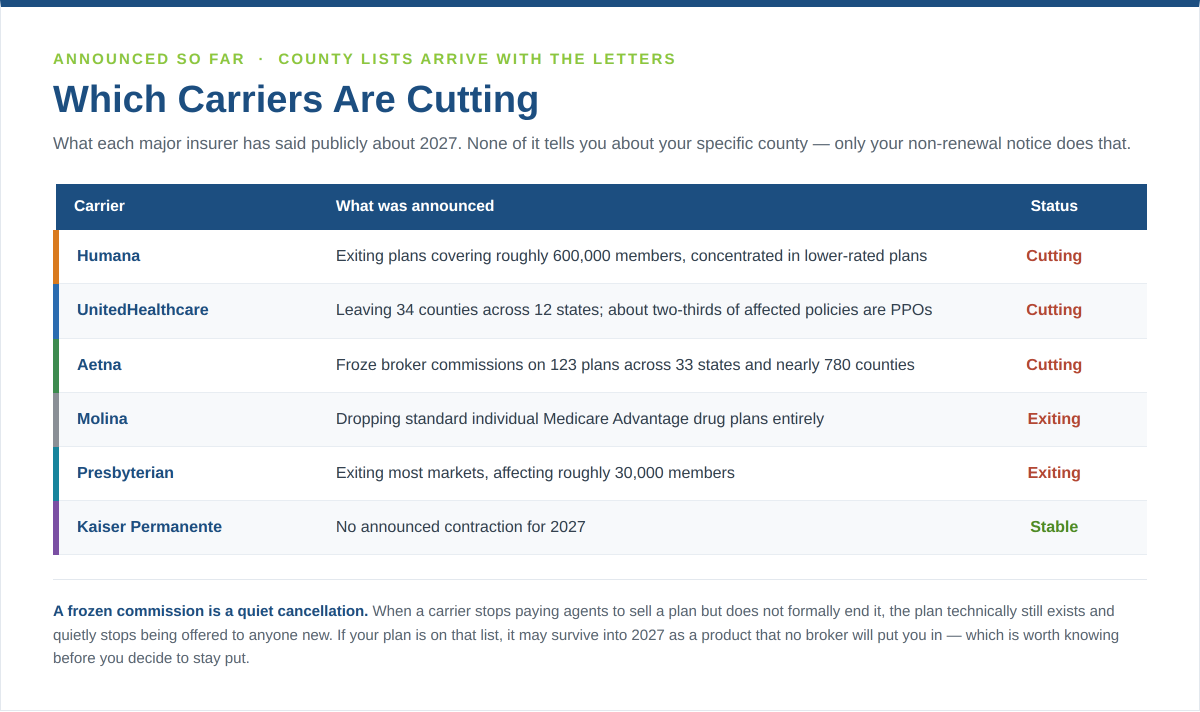
Table of Medicare Advantage carriers cutting plans for 2027 including Humana, UnitedHealthcare and Aetna

Non-renewal is not the only kind of change worth watching. Carriers in transition can restructure or rebrand plans without formally ending them — HealthSpring is one example, operating in legacy Cigna markets where plan lineups have shifted repeatedly. A plan that is combined or renamed may not trigger a non-renewal notice at all.

A carrier changing its name is not the same as a carrier leaving. The Cigna to HealthSpring transition is the clearest recent example — the plans continued, only the ownership and the name on the envelope changed.

Here is what the major insurers have said publicly. Treat it as a reason to watch your mail, not as an answer about your specific plan.

One item on that list deserves explaining, because it is the quietest signal and the easiest to miss. Aetna did not cancel 123 plans — it froze broker commissions on them. When a carrier stops paying agents to sell a plan without formally ending it, the plan technically still exists and quietly stops being offered to anyone new. If your plan is among them, it may well survive into 2027, as a product no broker will place anyone into. That is worth knowing before you decide to stay put by default.

Rural counties carry the most risk. UnitedHealthcare and Humana together hold at least 75% of enrollment in 28% of US counties, so when one withdraws from a rural market, there is often no comparable replacement. Twelve states are seeing disenrollment above 20%, and in Vermont it reaches 92%.

Humana is cutting deepest of any carrier for 2027. Our page on Humana Medicare Advantage plans 2027 breaks down what has been confirmed, what has only been signalled, and when you will find out whether your own plan is affected.

The impact is not spread evenly. Florida has more Medicare Advantage members at stake than any other state, because it has the largest concentration of enrollees with the carrier making the deepest reductions.

The detail matters enough that we broke it out separately — Aetna froze commissions on 123 plans across 33 states and nearly 780 counties, without cancelling a single one of them.

Anthem has announced no 2027 exits

What Happens If You Do Nothing

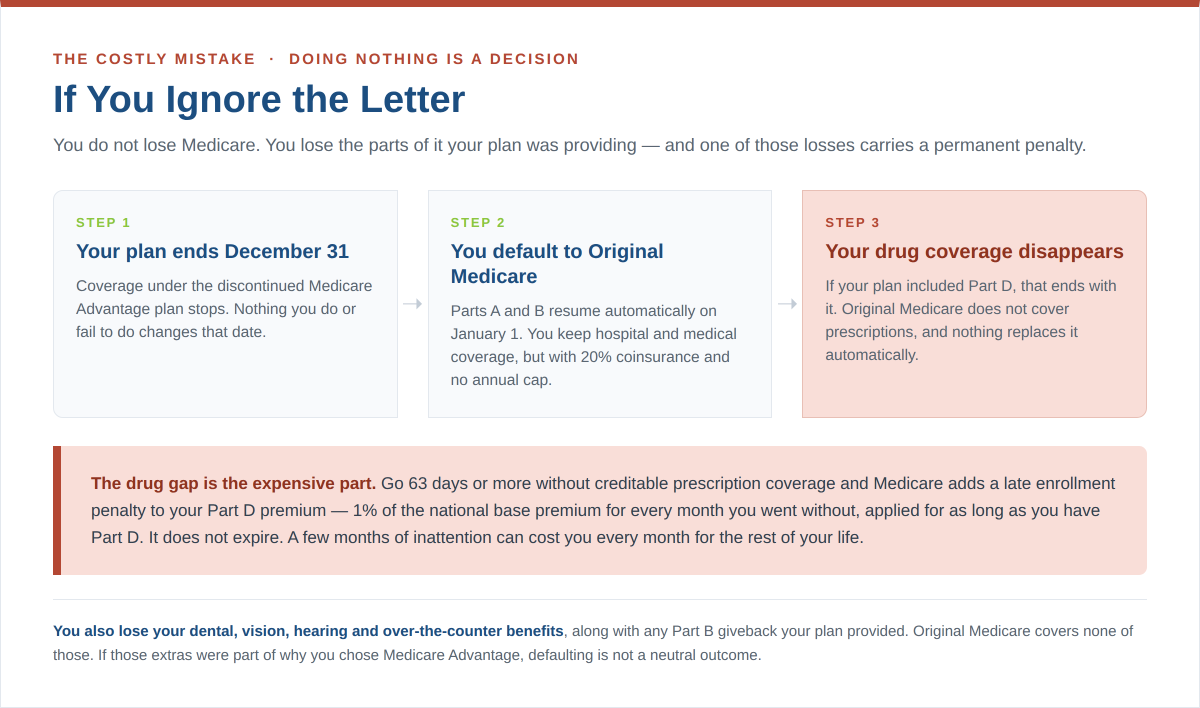
Three-step diagram of what happens if you ignore a Medicare Advantage non-renewal notice

You will not lose Medicare. You will lose the parts of it your plan was providing, and one of those losses carries a penalty that never goes away.

Your Medicare Advantage coverage ends December 31. On January 1 you fall back to Original Medicare automatically — Parts A and B resume, so you still have hospital and medical coverage, but with 20% coinsurance and no annual limit on what you can be asked to pay.

The problem is everything else. If your plan included prescription coverage, that ends with the plan, and nothing replaces it automatically. Original Medicare does not cover drugs. Your dental, vision, hearing and over-the-counter benefits end too, along with any Part B giveback the plan provided.

The drug gap is the part that follows you. Go 63 days or more without creditable prescription coverage and Medicare adds a late enrollment penalty to your Part D premium — 1% of the national base beneficiary premium for every month you went without, charged for as long as you have Part D coverage. It does not expire and it is not forgiven. A few months of inattention becomes a permanent monthly cost.

See companies in your area

Speak with a licensed insurance agent

1-855-454-9051TTY 711

Mon-Fri: 8am-9pm ET

Your Options If Your Plan Is Going Away

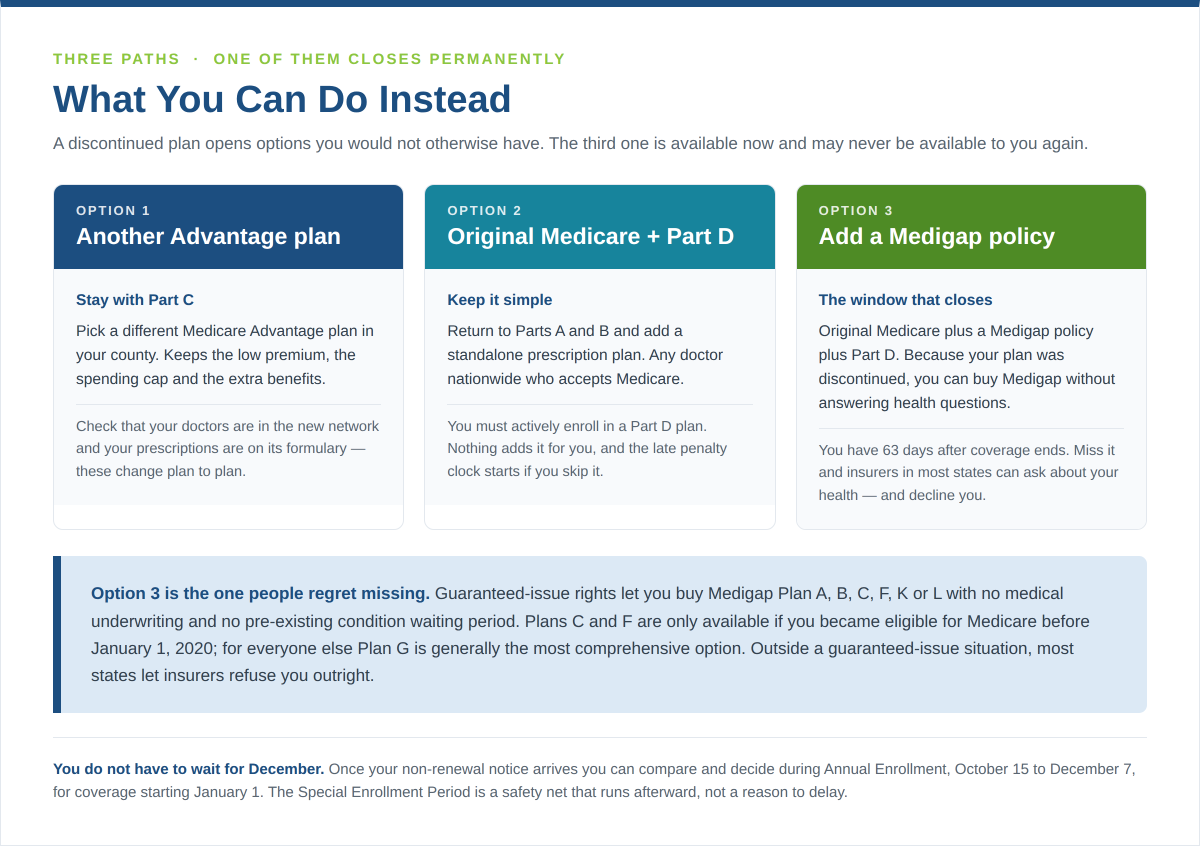
Three options if your Medicare Advantage plan is going away, including guaranteed issue Medigap

A plan going away actually opens up choices you would not otherwise have. There are three real paths, and the third one has a deadline.

OPTION 1  ·  STAY WITH PART C

Another Medicare Advantage plan. The simplest move. You keep the structure you are used to — low premium, capped annual spending, extra benefits. Check two things before you commit: whether your doctors are in the new plan’s network, and whether your prescriptions sit on its formulary at a tier you can afford. Both change from plan to plan even within the same carrier. Our 2027 carrier rankings score the majors on quality, stability and availability.

OPTION 2  ·  KEEP IT SIMPLE

Original Medicare plus a standalone Part D plan. Any doctor in the country who accepts Medicare, no network, minimal prior authorization. You must actively enroll in the drug plan — this is the path where people accidentally trigger the late enrollment penalty by assuming coverage carries over.

OPTION 3  ·  THE WINDOW THAT CLOSES

Original Medicare plus Medigap plus Part D. This is the option worth understanding properly, because your plan going away gives you a right you may never have again.

Guaranteed issue means they cannot say no. Because your plan is terminating, you can buy a Medigap policy without answering health questions and with no pre-existing condition waiting period. The qualifying plans are Medigap A, B, C, F, K and L — though Plans C and F are only available to people who became eligible for Medicare before January 1, 2020, which makes Plan G the most comprehensive choice for everyone else. You have 63 days after your coverage ends to apply. Outside a guaranteed-issue situation, insurers in most states can ask about your health and decline you outright.

What to Do Right Now

Your Action List

Four Things, In This Order

1

Open the mail. Both letters. The Annual Notice of Change in September and, if it comes, the non-renewal notice by October 1. Neither one looks urgent from the envelope, and both are easy to set aside.

2

Find your plan’s contract ID. It appears on your Summary of Benefits and on your member card, formatted like H5216-043. That number, not the carrier’s name, is what identifies your specific plan and its star rating.

3

Wait for October 1, then compare. Plan details for every 2027 Medicare Advantage and Part D plan — premiums, networks, formularies, star ratings — publish October 1, two full weeks before enrollment opens. That gap is a real advantage. Use it.

4

If you want Medigap, start early. The 63-day guaranteed-issue clock runs from when your coverage ends, but you do not have to wait for it to run out. Applying before your plan terminates avoids a gap between policies.

Annual Enrollment runs October 15 through December 7, 2026 for coverage beginning January 1, 2027. If your plan is going away you also get a Special Enrollment Period that continues past that deadline — but it is a safety net, not a reason to wait.

If losing your plan has you rethinking the whole approach rather than just picking another one, it is worth understanding the difference between Medigap and Medicare Advantage before Annual Enrollment closes. The two paths handle costs and doctor access in opposite ways, and moving between them is easier in one direction than the other.

Know your local options before the letter arrives

Frequently Asked Questions

  How do I know if my Medicare Advantage plan is going away in 2027?

Your plan must send you a written non-renewal notice by October 1, 2026, or at least 90 calendar days before the plan ends. That letter states plainly that the plan will not be offered next year and lists your alternatives. It is separate from the Annual Notice of Change, which every member receives in September and which only describes changes to a plan that is continuing. News coverage cannot answer this for you, because Medicare Advantage is sold county by county and a carrier cutting plans in one state may be leaving yours alone.

  Which Medicare Advantage plans are going away for 2027?

Humana is exiting plans covering roughly 600,000 members. UnitedHealthcare is leaving 34 counties across 12 states, with about two-thirds of affected policies being PPOs. Aetna froze broker commissions on 123 plans across 33 states and nearly 780 counties. Molina is dropping its standard individual Medicare Advantage drug plans entirely, and Presbyterian Health Plan is exiting most of its markets. Kaiser Permanente is the only major carrier with no announced contraction. Specific county and plan lists arrive with the non-renewal notices and the October 1 plan data release.

  What happens if my Medicare Advantage plan goes away and I do nothing?

Your plan ends December 31 and you are automatically returned to Original Medicare on January 1. You keep Part A and Part B, but with 20% coinsurance and no annual cap. Critically, if your plan included prescription coverage that ends too, and nothing replaces it automatically. Your dental, vision, hearing and over-the-counter benefits end as well. Going 63 days or more without creditable drug coverage triggers a permanent Part D late enrollment penalty.

  Can I get a Medigap policy if my Medicare Advantage plan is going away?

Yes, and without medical underwriting. A terminating plan gives you guaranteed issue rights, meaning insurers cannot ask health questions, cannot decline you and cannot impose a pre-existing condition waiting period. The qualifying policies are Medigap Plans A, B, C, F, K and L. Plans C and F are only available to people who became eligible for Medicare before January 1, 2020, so for most people today Plan G is the most comprehensive option. You must apply within 63 days of your coverage ending.

  Why are Medicare Advantage plans going away?

Carriers are prioritizing profitability and plan quality over footprint. Medical costs have risen faster than the federal payments plans receive, and contracts rated 4 stars and above earn bonus payments that lower-rated ones do not, so insurers are concentrating on their better-performing plans and dropping the rest. Humana’s CFO described the strategy as using plan exits to prioritize higher-performing plans. The effect falls hardest on rural counties, where fewer carriers compete to begin with.

  My plan is not going away but the benefits got worse. What can I do?

You can change plans during Annual Enrollment, October 15 through December 7, like anyone else. What you do not get is a Special Enrollment Period or guaranteed-issue Medigap rights, because those are triggered by a plan ending, not by a plan getting worse. If your Annual Notice of Change shows higher copays, a smaller network or drugs moving to higher tiers, treat Annual Enrollment as your window and compare properly rather than renewing by default.

  What if there are no other Medicare Advantage plans in my county?

This is a real possibility in rural areas, where two carriers often hold three-quarters of the market. If no comparable Advantage plan is available, your path is Original Medicare plus a standalone Part D plan, ideally with a Medigap policy purchased under your guaranteed issue rights. That combination costs more monthly but is accepted by any provider nationwide, which matters more when local plan choice is thin.

  Does a plan going away affect my Part B or my Social Security?

No. Your Part A and Part B enrollment continues regardless of what happens to a Medicare Advantage plan, and your Part B premium is unaffected. The one financial change some people notice is losing a Part B giveback, a benefit some Advantage plans offer that reduces part of your Part B premium. If the plan going away included a giveback, that reduction ends and your full Part B premium resumes.

  When do I need to decide by for 2027 coverage?

Annual Enrollment runs October 15 through December 7, 2026, and choosing within that window gives you coverage starting January 1 with no gap. If your plan is going away you also get a Special Enrollment Period that extends past December 7, and your Medigap guaranteed issue rights run for 63 days after your coverage ends. Those are safety nets rather than a reason to delay, since deciding during Annual Enrollment is the only way to guarantee continuous coverage from January 1.

  Where can I see the 2027 plans available in my area?

Plan-level details for every 2027 Medicare Advantage and Part D plan publish October 1, 2026 — premiums, provider networks, drug formularies, supplemental benefits and the new star ratings, for every county. Nothing before that date reflects actual 2027 plan offerings in your area. Once the data is live, compare the specific plans available where you live rather than relying on national carrier averages, since a strong carrier nationally can offer a weak plan in your county and the reverse is equally true.

Have Questions?

Speak with a licensed insurance agent

1-855-454-9051

TTY users 711

Mon-Fri: 8am-9pm ET

Find & Compare Plans Online

Speak with a licensed insurance agent

1-855-454-9051TTY 711

Mon-Fri: 8am-9pm ET

ZRN Health & Financial Services, LLC, a Texas limited liability company