Speak with a licensed insurance agent

1-855-454-9051

TTY user 711 Mon-Fri : 8am-9pm EST

Anthem Medicare Advantage Plans 2027: Coverage, Costs and What's Changing

Reviewed by Russell Noga, Licensed Medicare Insurance Broker (all 50 states) — Last updated September 2, 2026

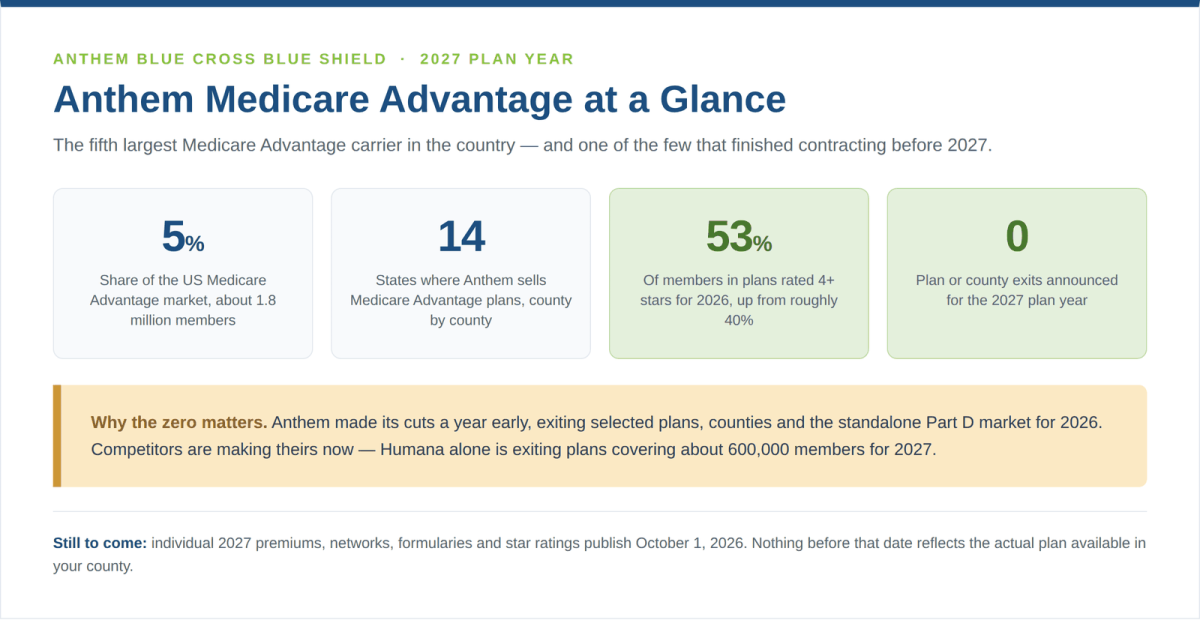
Anthem covers about 5% of the Medicare Advantage market — roughly 1.8 million members across 14 states. That makes it the fifth largest carrier in the country, well behind UnitedHealthcare and Humana, and it is easy to read that as a reason to look elsewhere.

For the 2027 plan year, size is the wrong thing to be looking at.

Anthem is one of the very few major carriers that has not announced Medicare Advantage plan cuts for 2027. It already made its cuts — a year ago, for 2026 — and its quality ratings moved further in the right direction than any large carrier except Centene while Humana’s and Aetna’s went backwards. In a year when about one in ten Medicare Advantage members is losing their plan, a carrier that has already finished contracting is worth understanding properly.

What's Confirmed About Anthem's 2027 Plans — and What Isn't

A lot of pages you will find about 2027 Anthem plans are showing you 2026 information under a 2027 headline. Here is the honest split, because it determines what you can actually decide today.

Confirmed for 2027: the Part D annual out-of-pocket cap rises to $2,400 and the maximum Part D deductible rises to $700. The Medicare Advantage maximum out-of-pocket limit is $9,850 for in-network care and $14,800 combined in-and-out-of-network. Anthem has submitted its 2027 bids to CMS and has publicly stated its strategic priorities for the year. Those apply to every Anthem plan.

Not yet available: individual 2027 Anthem plan premiums, copays, provider networks, drug formularies and supplemental benefit amounts. Plan-level data for every 2027 Medicare Advantage plan in the country publishes October 1, 2026. Nothing before that date — on this site or any other — reflects the actual 2027 plan available in your county. The 2027 star ratings publish in October as well, so any star figure you see quoted today is a 2026 rating.

What this means practically. Use the next four weeks to work out whether Anthem is the right carrier for you — its footprint, its plan structures, its quality trajectory. Do the plan-versus-plan comparison after October 1, when the real numbers exist. Anyone quoting you a specific 2027 Anthem premium before then is guessing.

Anthem Medicare Advantage at a glance - 5% market share, 14 states, 53% of members in 4+ star plans, zero announced 2027 exits

Compare Anthem Medicare plans in your area

Anthem Is One of the Few Carriers Not Cutting Plans for 2027

This is the single most useful thing to know about Anthem going into this enrollment season, and it is a result of timing rather than generosity.

Anthem’s parent company, Elevance Health, made its contraction a year early. In September 2025, CFO Mark Kaye told the Wells Fargo Healthcare Conference that the company would exit the standalone Part D market entirely and drop selected Medicare Advantage plans and counties for the 2026 plan year, affecting roughly 150,000 members. His explanation was blunt: “We made the decision to exit some plans and counties where we did not see a path to attractive economic performance.”

That was painful for the members involved. But it means Anthem entered the 2027 bidding cycle having already shed its unprofitable business, while competitors were only starting.

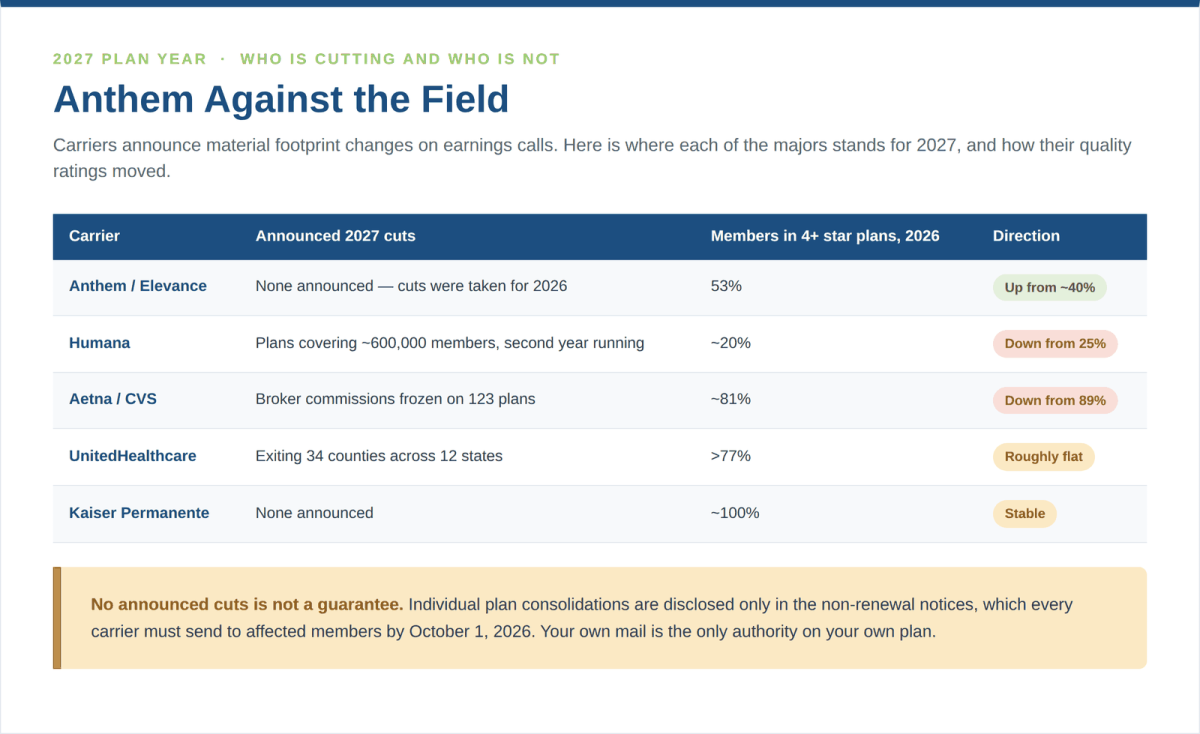
Which carriers are cutting Medicare Advantage plans for 2027 compared with Anthem, alongside 2026 star rating direction

On Elevance’s second-quarter 2026 earnings call in July, Aimée Dailey, President of Government Health Benefits, described the 2027 bids as submitted “with a prudent view of trend and a continued focus on sustainable margin improvement” and said “the actions we took in 2026 are performing as we expected.” The company reaffirmed it is on track for at least a 2% Medicare Advantage margin. No county exits and no plan withdrawals were announced for 2027.

Compare that with Humana, which announced on its own July 2026 earnings call that it is exiting plans covering roughly 600,000 members for 2027 — about 8% of its 7.2 million members — and expects to recapture only around 240,000 of them. That is Humana’s second consecutive year of cuts.

Two cautions, because “no announced exits” is not the same as “guaranteed to renew.” Carriers announce material footprint changes on earnings calls, but individual plan consolidations surface only when the non-renewal notices go out. And Anthem’s stated focus is on HMO and dual-eligible special needs plans, which is where it sees margin — if you are in an Anthem PPO in a thin market, that is the profile most likely to be quietly folded into another plan. Your own mail is the only authority. Every carrier must notify affected members by October 1. Our guide to Medicare Advantage plans going away in 2027 explains how to tell a non-renewal notice from the routine Annual Notice of Change.

Where Anthem Medicare Advantage Plans Are Available

Anthem is not a national carrier. It offers Medicare Advantage plans in parts of 14 states, and only in parts — availability is set county by county, not statewide.

The 14 states are California, Colorado, Connecticut, Georgia, Indiana, Kentucky, Maine, Missouri, Nevada, New Hampshire, New York, Ohio, Virginia and Wisconsin.

If you live outside those 14 states, Anthem is not an option for you and no amount of comparison shopping will change that. If you live inside one, you still need to confirm that Anthem sells plans in your specific county, because large parts of several of these states have no Anthem Medicare Advantage presence at all.

Anthem vs. Blue Cross Blue Shield: Why the Names Overlap

This confuses more people than any other aspect of shopping for an Anthem plan, and it is worth two minutes to get straight.

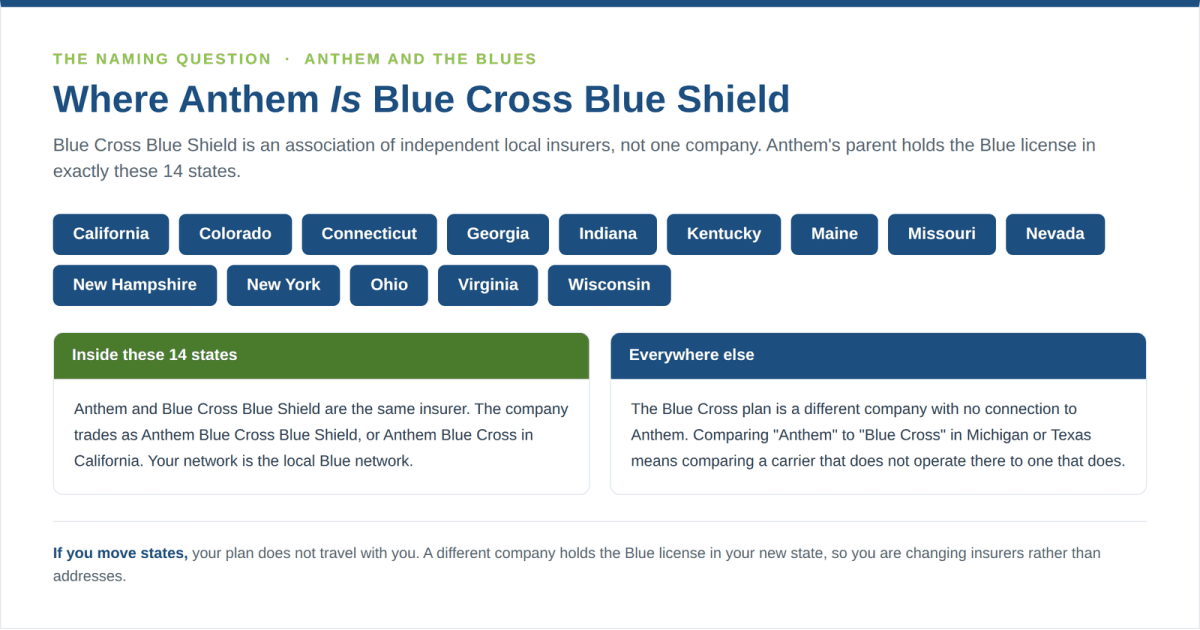
The 14 states where Anthem is Blue Cross Blue Shield, and what the name means everywhere else

Blue Cross Blue Shield is not a company. It is an association of independent, locally operated insurers, each holding the Blue Cross and Blue Shield license for its own territory. Elevance Health holds those licenses in 14 states, and it trades under the Anthem Blue Cross Blue Shield name in most of them — and simply Anthem Blue Cross in California.

So in Ohio, “Anthem” and “Blue Cross Blue Shield” are the same insurer. In Michigan, Blue Cross Blue Shield is an entirely different company that has nothing to do with Anthem. Someone in Texas comparing “Anthem” to “Blue Cross” is comparing a carrier that does not operate in their state to one that does.

The practical consequences are real. Your Anthem plan’s network is the local Blue network, so provider participation depends on your region rather than on a national roster. And if you move to a state where a different company holds the Blue license, your plan does not travel with you — you are changing insurers, not addresses. If you are researching the Blue system more broadly, our overview of Blue Cross Medicare Advantage plans covers how the licensees differ from one another.

Anthem Medicare Advantage Plan Types Compared

Anthem offers five plan structures, marketed under the MediBlue name. Which are available to you depends entirely on your county.

Plan type Best for Network rules Who can enroll
MediBlue HMO Lowest premiums, and the structure Anthem is investing in most In-network only except emergencies; primary care physician coordinates care, referrals usually required Anyone with Parts A and B in the service area
MediBlue PPO Seeing specialists without referrals, or splitting time between two areas Out-of-network care covered at a higher cost share; no referrals needed Anyone with Parts A and B in the service area
D-SNP Members on both Medicare and Medicaid — Anthem’s other priority product HMO-style network with a care coordinator; Part D always included Dual eligibility for Medicare and Medicaid required
C-SNP Managing a specific qualifying chronic condition Network built around the condition; benefits and formulary tailored to it Documented qualifying condition required
I-SNP Long-term nursing facility residents Care delivered largely in the facility; Part D always included Institutional residence, generally 90 days or more

One point that matters more than it looks. Anthem has said publicly that HMO and D-SNP are the product lines it is prioritizing. That is a reasonable signal about where its 2027 benefit design and network investment are going — and, by the same logic, where they are not. It is not a prediction that PPOs will be withdrawn, but if you are choosing between an Anthem HMO and an Anthem PPO in a market where Anthem is thin, it belongs in the decision.

What Anthem Medicare Advantage Plans Cover

Every Anthem Medicare Advantage plan covers everything Original Medicare Parts A and B cover, because federal law requires it. The differences are in what gets added on top, and Anthem names these benefits specifically:

Dental, vision and hearing. The three biggest gaps in Original Medicare, and the reason most people choose Medicare Advantage at all. Coverage depth varies enormously between plans — an annual cleaning allowance and full restorative dental coverage are not the same benefit.

Monthly allowances for over-the-counter items and healthy foods. A preloaded card with a set monthly amount. Read the eligible-item list rather than the headline dollar figure; the restrictions are where these differ.

Utility assistance allowances. Less common across the industry and worth flagging, though typically limited to certain SNP plans rather than offered across the board.

SilverSneakers fitness membership. Gym access at participating facilities, included on most Anthem plans.

+Part D prescription coverage. Included in most Anthem Medicare Advantage plans. This is now the only way to get drug coverage through Anthem — the company exited standalone Part D entirely for 2026, so if you want an Anthem plan and you need drug coverage, it has to come bundled.

Anthem also caps insulin at $35 per month with no deductible applied, matching the federal requirement, and updated behavioral health cost sharing for 2026.

Anthem's Star Ratings: The Number That Moved Most

CMS rates every Medicare Advantage contract from 1 to 5 stars on clinical quality, member experience and customer service. Ratings matter beyond bragging rights: contracts at 4 stars and above earn bonus payments that fund richer benefits, which is why a carrier’s star trajectory is a reasonable proxy for whether its plans are about to get better or worse.

For 2026, 53% of Elevance’s Medicare Advantage members are in plans rated 4 stars or higher, up from roughly 40% the year before. That is a substantial one-year improvement, and only Centene moved further.

The context is what makes it interesting. Over the same period Humana fell to around 20% from 25%, and Aetna fell to about 81% from 89%. The industry’s weighted average barely moved, from 3.96 to 3.98 stars. Anthem was gaining ground while the two carriers making the deepest cuts were losing it.

Two honest qualifications. At 53%, Anthem still trails UnitedHealthcare at over 77%, Aetna at 81% and Kaiser at nearly 100% — the direction is excellent, the absolute level is mid-pack. And ratings are assigned per contract, not per carrier, so the plan available in your county may be rated well above or below Anthem’s average. Check the star rating on the specific plan, which appears on the Medicare Plan Finder once 2027 data is live. Our 2027 carrier comparison puts these figures side by side across all eight major carriers.

The 2027 Part D Changes That Hit Every Anthem Plan

These are federal parameters, so they apply identically to every Anthem plan and every competitor’s plan. They are also confirmed, which makes them the one part of your 2027 costs you can plan around today.

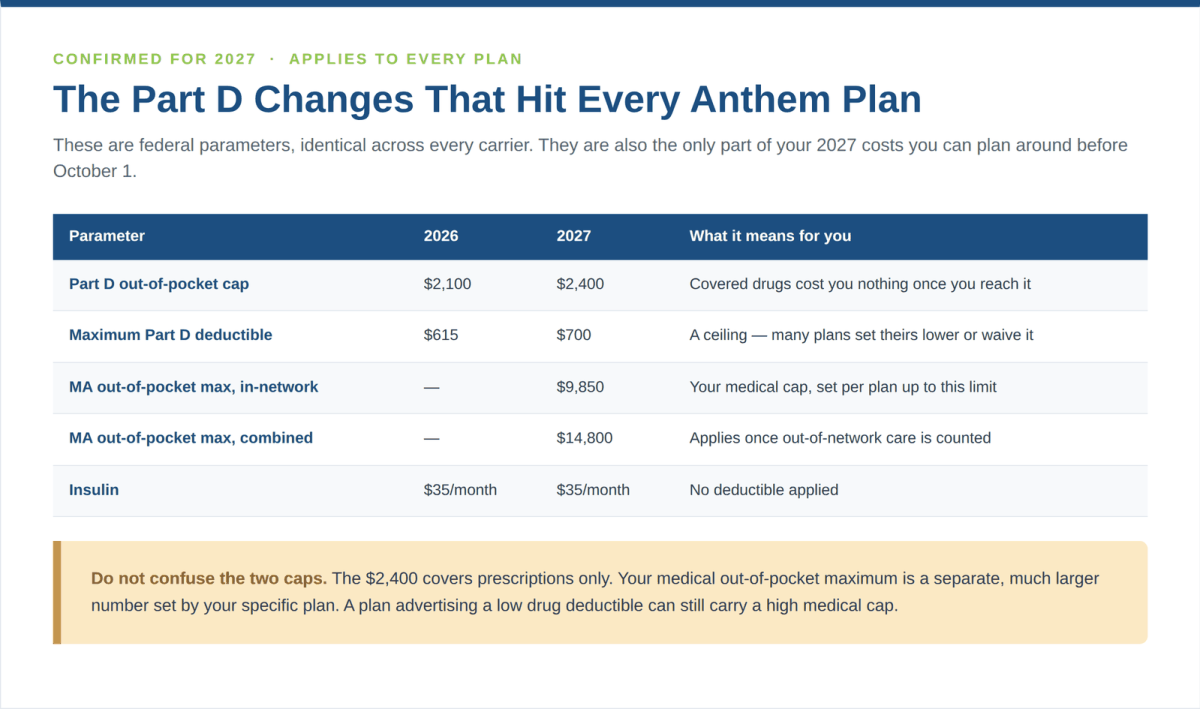
Confirmed 2027 Part D changes affecting every Anthem Medicare Advantage plan, 2026 versus 2027

The annual out-of-pocket maximum for prescription drugs rises from $2,100 in 2026 to $2,400 in 2027. Once you hit it, your covered drugs cost you nothing for the rest of the year. The maximum allowable Part D deductible rises from $615 to $700 — that is a ceiling, and many Anthem plans set theirs lower or waive it on preferred tiers.

The Medicare Prescription Payment Plan, which spreads your annual drug costs across monthly installments rather than front-loading them, renews automatically for anyone already enrolled. If you opted in for 2026 you do not need to do anything for 2027.

Do not confuse the drug cap with your medical cap. They are separate limits. The $2,400 applies only to Part D prescriptions. Your medical out-of-pocket maximum is a different number set by your specific plan, and in 2027 it can go as high as $9,850 for in-network care or $14,800 counting out-of-network. A plan advertising a low drug deductible can still carry a high medical cap.

What to Check Before You Enroll in an Anthem Plan

Your county, first. Anthem operates in 14 states but not in every county within them. Everything else is academic until you confirm plans are sold where you live.

Your doctors, by name, in the 2027 directory. Anthem networks are the local Blue networks and they change annually. A physician in-network this year may not be next year, and on an HMO that is the difference between a copay and the full bill.

Every prescription, at its tier. Formularies are rebuilt each year. A drug moving from tier 2 to tier 3 can cost you hundreds annually without any change to your premium.

The medical out-of-pocket maximum, not the premium. The premium is what you pay when nothing goes wrong. The maximum is what protects you when something does.

The specific plan’s star rating. Anthem’s carrier-level improvement does not guarantee the contract in your county improved.

Your mail, through early October. Even with no announced 2027 exits, individual plan consolidations are only disclosed in the non-renewal notices.

When You Can Enroll for 2027

Annual Enrollment runs October 15 through December 7, 2026, with coverage starting January 1, 2027. This is the window in which most people switch into or out of an Anthem plan, and enrolling within it is the only way to guarantee continuous coverage on January 1.

If you are already in a Medicare Advantage plan, the Medicare Advantage Open Enrollment Period from January 1 to March 31, 2027 lets you make one further change — switch to a different Medicare Advantage plan or drop back to Original Medicare with a standalone Part D plan.

A Special Enrollment Period may apply outside those windows if you move out of your plan’s service area, become eligible for Medicaid or Extra Help, or your plan is discontinued. If you are new to Medicare, your Initial Enrollment Period runs from three months before through three months after the month you turn 65.

For a broader view of the 2027 landscape across all carriers, start with our 2027 Medicare Advantage plans guide.

Medicare Advantage Plan open enrollment period 2027

Anthem Medicare Advantage 2027 — Frequently Asked Questions

  Is Anthem the same as Blue Cross Blue Shield?

In 14 states, yes. Blue Cross Blue Shield is an association of independent local insurers rather than a single company, and Anthem’s parent Elevance Health holds the Blue Cross and Blue Shield license in California, Colorado, Connecticut, Georgia, Indiana, Kentucky, Maine, Missouri, Nevada, New Hampshire, New York, Ohio, Virginia and Wisconsin. In those states the company trades as Anthem Blue Cross Blue Shield, or Anthem Blue Cross in California. Everywhere else, the Blue Cross plan is a different company entirely and has no connection to Anthem. This matters if you move, because your plan does not transfer to another state’s Blue licensee.

  What states does Anthem offer Medicare Advantage plans in?

Anthem offers Medicare Advantage plans in parts of 14 states: California, Colorado, Connecticut, Georgia, Indiana, Kentucky, Maine, Missouri, Nevada, New Hampshire, New York, Ohio, Virginia and Wisconsin. Availability is set county by county rather than statewide, so large portions of several of those states have no Anthem Medicare Advantage plans at all. If you live outside the 14, Anthem is not an option for you regardless of what you find advertised nationally.

  Is Anthem cutting Medicare Advantage plans for 2027?

Anthem has not announced any Medicare Advantage plan or county exits for 2027. It made its cuts a year earlier, exiting selected plans and counties plus the standalone Part D market for 2026, which affected roughly 150,000 members. On Elevance Health’s second-quarter 2026 earnings call the company said the 2026 actions were performing as expected and that 2027 bids were submitted with a focus on sustainable margin improvement, with no footprint reductions announced. That is not a guarantee your specific plan renews, since individual plan consolidations are only disclosed in the non-renewal notices carriers must send by October 1.

  How good are Anthem’s Medicare Advantage star ratings?

Mid-pack in absolute terms, but improving faster than almost anyone. For 2026, 53% of Elevance’s Medicare Advantage members are in plans rated 4 stars or higher, up from roughly 40% the prior year. Over the same period Humana fell to about 20% and Aetna fell to about 81%, while UnitedHealthcare held above 77% and Kaiser stayed near 100%. Star ratings are assigned per contract rather than per carrier, so check the rating on the specific plan available in your county rather than relying on the company average. The 2027 ratings publish in October 2026.

  Does Anthem Medicare Advantage include prescription drug coverage?

Most Anthem Medicare Advantage plans include Part D prescription coverage, and every special needs plan is required to. This is now the only route to drug coverage through Anthem, because the company exited the standalone Part D market entirely for the 2026 plan year. If you want an Anthem plan and you take prescriptions, the coverage has to come bundled inside the Medicare Advantage plan. Check that each of your medications appears on that specific plan’s 2027 formulary and at what tier, since formularies are rebuilt annually.

  What is MediBlue?

MediBlue is Anthem’s brand name for its Medicare Advantage plans. You will see it as MediBlue HMO, MediBlue PPO and variants such as MediBlue Access. It is a marketing name rather than a plan type, so two MediBlue plans in different counties can have completely different premiums, networks and benefits. Anthem also offers dual-eligible, chronic-condition and institutional special needs plans, which may or may not carry the MediBlue name depending on the market.

  How much do Anthem Medicare Advantage plans cost in 2027?

Individual 2027 premiums and copays are not available yet. Plan-level data for every 2027 Medicare Advantage plan publishes October 1, 2026, and any specific 2027 Anthem premium quoted before that date is an estimate rather than a real figure. What is confirmed is the federal framework: the Part D annual out-of-pocket cap is $2,400, the maximum Part D deductible is $700, and the Medicare Advantage medical out-of-pocket maximum can go as high as $9,850 in-network or $14,800 counting out-of-network care. Anthem sets its own numbers underneath those ceilings, county by county. Bear in mind, too, that the premium is the least important cost on the page — a $0 premium plan with a $9,000 maximum can cost you far more in a bad year than one charging $40 a month with a lower cap.

Have Questions?

Speak with a licensed insurance agent

1-855-454-9051

TTY users 711

Mon-Fri: 8am-9pm ET

Find & Compare Plans Online

Speak with a licensed insurance agent

1-855-454-9051TTY 711

Mon-Fri: 8am-9pm ET

ZRN Health & Financial Services, LLC, a Texas limited liability company