Speak with a licensed insurance agent

1-855-454-9051

TTY user 711 Mon-Fri : 8am-9pm EST

Medigap vs Medicare Advantage 2027: Which One Is Right for You

Reviewed by Russell Noga, Licensed Medicare Insurance Broker (all 50 states) — Last updated September 6, 2026

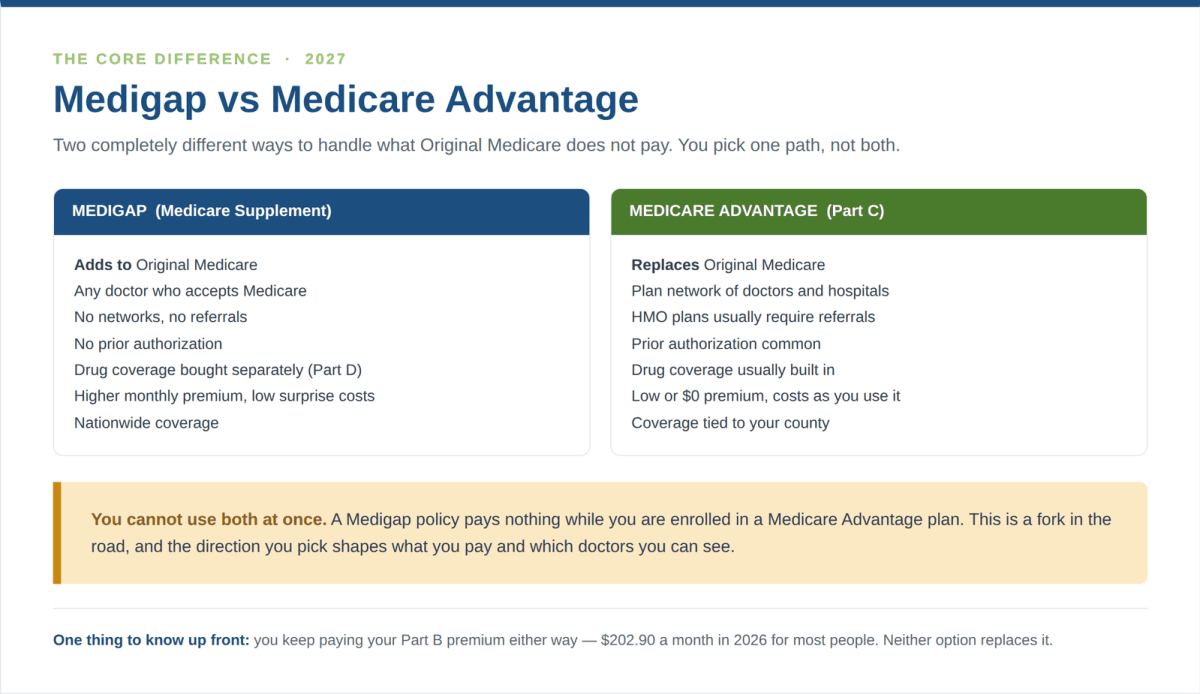
This is the single biggest decision in Medicare, and most people make it once. Medigap and Medicare Advantage are two entirely different ways of handling what Original Medicare leaves unpaid, and you cannot use both at the same time. One adds to Original Medicare. The other replaces it. Everything else — what you pay, which doctors you can see, whether you need approval before a procedure — follows from that one difference.

Neither is better. They fit different budgets, different health situations, and different lives. What follows is the honest comparison, including the part most articles skip: switching back later is not always your choice to make.

Medigap vs Medicare Advantage side-by-side comparison of coverage, networks and costs for 2027

Compare both Medicare plan types to see which is best

The Core Difference Between Medigap and Medicare Advantage

Original Medicare — Part A and Part B — covers most of your hospital and medical care, but it leaves deductibles, coinsurance and copays open-ended with no annual limit. Both options exist to solve that problem. They solve it in opposite ways.

Medigap adds a layer on top

You stay in Original Medicare. A private Medigap policy then pays the deductibles and coinsurance Medicare leaves behind. Medicare is still your insurance; the supplement just picks up the pieces. You keep the freedom to see any provider in the country who accepts Medicare, and you buy a separate Part D plan if you need drug coverage.

Medicare Advantage takes over the whole thing

A private insurer takes on your Medicare coverage and administers it through its own plan. You get an insurance card from the carrier instead of using your red, white and blue Medicare card. Drug coverage is usually built in, extra benefits are common, and in exchange you use the plan’s network and follow its rules.

You cannot hold both. A Medigap policy pays nothing while you are enrolled in a Medicare Advantage plan. If you have a supplement and move to Advantage, you are paying a premium for a policy that has stopped working — drop it. This is a fork in the road, not a menu.

Medigap vs Medicare Advantage Costs in 2027

Medigap vs Medicare Advantage cost comparison showing premiums, copays and out-of-pocket limits

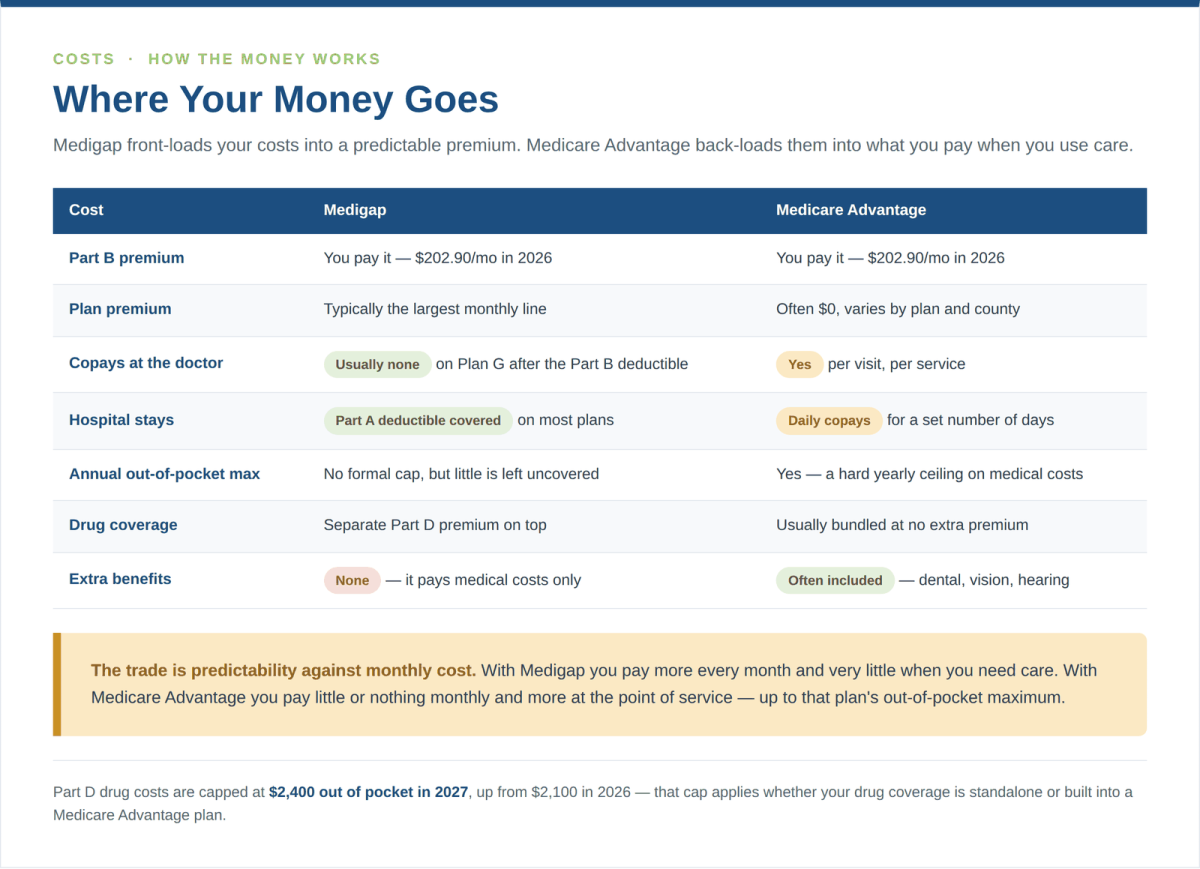
Here is the part that trips people up: both options cost real money, they just collect it at different times. Medigap front-loads your spending into a predictable monthly premium. Medicare Advantage back-loads it into what you pay when you actually use care. Someone who never sees a doctor pays less on Advantage. Someone in and out of specialists all year often pays less on Medigap, despite the higher premium.

Cost Medigap Medicare Advantage
Part B premium You still pay it You still pay it
Plan premium Usually your largest monthly line item; varies by plan letter, age, state and tobacco use Frequently $0, though premium plans exist; varies by county
Doctor visits On Plan G, nothing after the annual Part B deductible A copay per visit, higher for specialists
Hospital stay Most plans cover the Part A deductible in full A daily copay for a set number of days, then $0
Annual out-of-pocket maximum No formal cap, but comprehensive plans leave little uncovered A hard yearly ceiling on in-network medical costs, set by the plan
Prescription drugs A separate Part D plan with its own premium Usually bundled into the plan at no additional premium
Dental, vision, hearing Not included — it pays medical costs only Commonly offered, though what is included varies by plan and area

Two numbers apply no matter which path you take. You keep paying the Part B premium either way — $202.90 a month in 2026 for most people, with the 2027 figure due from CMS in November. And your Part D drug spending is capped at $2,400 out of pocket in 2027, up from $2,100 in 2026, whether that coverage is standalone or built into an Advantage plan. If you want carrier-level detail on premiums and benefits, our breakdown of 2027 Medicare Advantage costs and benefits by carrier goes plan type by plan type.

Doctor Networks, Referrals and Travel

For a lot of people this matters more than the money, and it is where the two paths genuinely diverge.

1Medigap has no network. Any doctor, hospital or specialist in the country that accepts Medicare accepts your supplement. No referrals, no in-network list to check, no prior authorization. If you split the year between two states or want access to a specific out-of-state cancer center, this is the reason people choose it.

2Medicare Advantage builds coverage around a network. HMO plans generally require you to stay in network and use a primary care doctor for referrals. PPO plans allow out-of-network care at a higher cost. Emergency care is covered anywhere either way, but routine care outside your service area usually is not.

3Prior authorization only exists on one side. Advantage plans can require approval before certain procedures, imaging or hospital admissions. Original Medicare with a supplement does not work that way. Whether that matters to you depends entirely on the kind of care you expect to need.

Networks are also renegotiated every year, which is why checking your own doctors against next year’s directory is worth the twenty minutes it takes. If you are weighing carriers on quality rather than price alone, start with the top rated Medicare Advantage plans and the star ratings behind them.

Find & Compare Plans Online

Speak with a licensed insurance agent

1-855-454-9051TTY 711

Mon-Fri: 8am-9pm ET

Prescription Drug Coverage Works Differently

Medigap policies do not cover prescriptions. That is not a gap in the product, it is by design — drug coverage has been sold separately as Part D since 2006. If you go the Medigap route, you buy a standalone Part D plan alongside it, and you should, because going without it and enrolling later means a late enrollment penalty that follows you for life.

Most Medicare Advantage plans bundle drug coverage in, which is why they are often called MAPD plans. Convenient, but it also means your drug formulary and your medical plan are locked together: if the plan drops one of your medications from its formulary, you cannot change drug plans without changing your medical coverage too. On Medigap you can switch Part D plans every year without touching anything else.

Which One Fits You

Who Medigap suits and who Medicare Advantage suits, including the Medigap open enrollment window

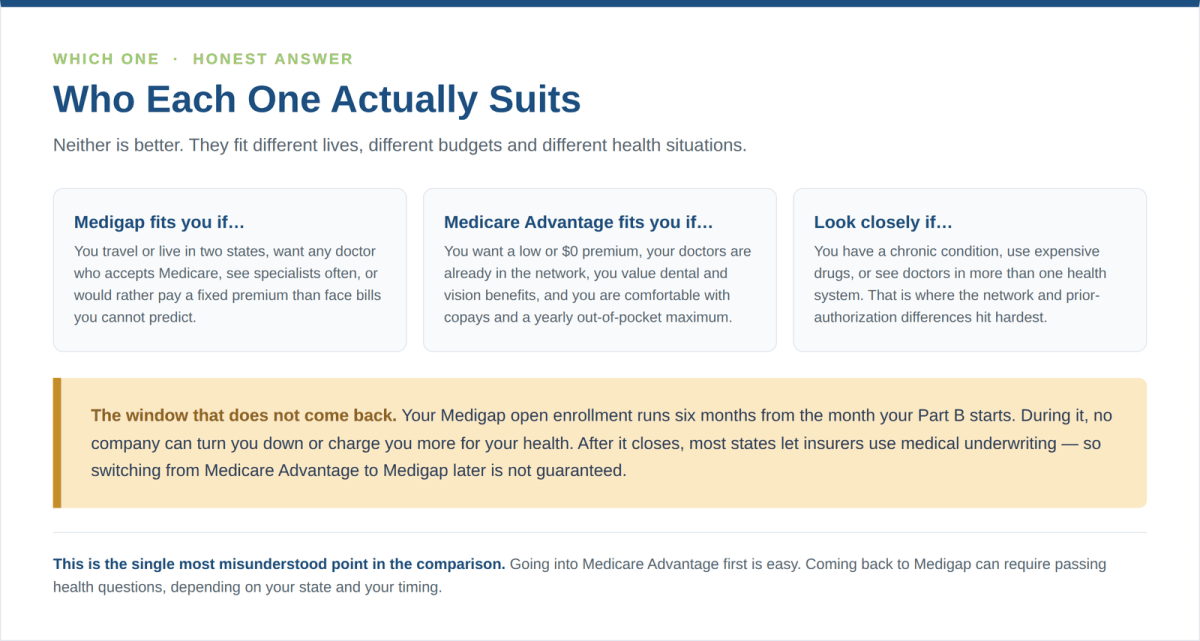
There is no universally right answer, and anyone who gives you one without asking about your doctors, your medications and your budget is selling rather than advising. Here is the honest sort.

Medigap tends to fit you if

You travel often or live in two states during the year, you want any doctor who accepts Medicare without checking a list, you see specialists regularly or manage a serious condition, or you would simply rather pay a known premium than face bills you cannot predict. It also fits people who want their coverage decisions made once rather than reviewed every fall.

Medicare Advantage tends to fit you if

A low or $0 monthly premium matters to your budget, your doctors are already in a plan’s network, you stay close to home for care, and you want the extra benefits that often come attached — things like dental coverage, vision and hearing, which vary by plan and by area. The annual out-of-pocket maximum also gives you a defined worst case, which Original Medicare alone does not.

Look harder before deciding if

You have a chronic condition, take expensive specialty medications, or see doctors across more than one health system. Those are exactly the situations where network limits, prior authorization and formulary changes have the most impact, and where the cheaper monthly premium can end up costing more over a year.

Switching Between Them Is Not Symmetrical

This is the most important paragraph on the page, and it is the one most comparisons leave out. Moving from Medigap into Medicare Advantage is easy at any Annual Enrollment Period. Moving the other direction can require passing health questions.

Your Medigap open enrollment window lasts six months and does not come back. It starts the month you are 65 or older and enrolled in Part B. During those six months, no insurer can refuse you a Medigap policy or charge you more because of your health. Once it closes, most states allow medical underwriting on Medigap applications — meaning a company can decline you. A few states have their own rules that are more generous, and limited federal guaranteed-issue rights exist in specific situations, including a trial-right window if you tried Medicare Advantage for the first time and want out within twelve months. Outside those, coming back to Medigap is not guaranteed.

Practically, that means the decision is more reversible in one direction than the other. It does not mean you should default to Medigap — plenty of people are better served by an Advantage plan and stay happy on one for twenty years. It means you should make the first choice deliberately, with your own doctors and medications in front of you, rather than picking the lowest premium and assuming you can undo it later.

If you are leaning toward Advantage, the plan landscape is worth understanding before you enroll: our guide to Medicare Advantage plans for 2027 covers plan types, what changes each year, and how to compare them properly. Carrier names move around too — Cigna Medicare is now HealthSpring after Health Care Service Corporation bought that business, which catches people off guard when they go looking for a plan they held before. And if you have heard rumors about carriers pulling out of markets, are Medicare Advantage plans going away in 2027 separates what is actually happening from what is not.

Easily find the right Medicare plan for 2027

When You Can Make the Change

Medicare Advantage Plan open enrollment period 2027

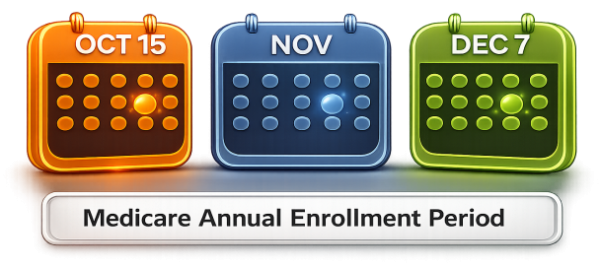
Annual Enrollment runs October 15 through December 7, 2026, for coverage that starts January 1, 2027. That is when most people move between Medicare Advantage plans, join or drop one, or change Part D plans.

If you are already in an Advantage plan, the Medicare Advantage Open Enrollment Period from January 1 to March 31, 2027 gives you one additional change — you can switch to a different Advantage plan or return to Original Medicare, though returning does not by itself guarantee you a Medigap policy.

Medigap works on a different calendar entirely. There is no annual enrollment period for supplements. You can apply any time of year, but outside your one-time open enrollment window or a guaranteed-issue situation, the insurer decides whether to accept you.

Frequently Asked Questions

  What is the main difference between Medigap and Medicare Advantage?

Medigap adds to Original Medicare by paying the deductibles and coinsurance Medicare leaves behind, and you keep using any provider that accepts Medicare. Medicare Advantage replaces Original Medicare with a private plan that has its own network, its own copays and usually its own built-in drug coverage. One supplements Medicare, the other administers it.

  Can I have both Medigap and a Medicare Advantage plan?

No. A Medigap policy pays nothing while you are enrolled in a Medicare Advantage plan, so holding both means paying a premium for coverage that does not function. If you move to an Advantage plan, drop the supplement. It is also illegal for an agent to knowingly sell you a Medigap policy while you are on an Advantage plan, outside of narrow circumstances.

  Which one is cheaper, Medigap or Medicare Advantage?

Medicare Advantage is almost always cheaper month to month, frequently $0 in plan premium. Medigap is usually cheaper over a year for someone who uses a lot of care, because the copays add up on the Advantage side while a comprehensive supplement leaves little to pay. The honest answer is that it depends on how much care you use and what your out-of-pocket exposure looks like in a bad year rather than an average one.

  Do I still pay the Part B premium with either one?

Yes, both paths require you to keep paying your Part B premium, which is $202.90 a month in 2026 for most people. Neither Medigap nor Medicare Advantage replaces it. Some Advantage plans offer a partial giveback that reduces what comes out of your Social Security check, but the obligation itself does not go away.

  Does Medigap cover prescription drugs?

No. Medigap policies sold today do not include drug coverage, so you buy a standalone Part D plan alongside the supplement. Do not skip it even if you take no medications, because enrolling late without other creditable coverage triggers a penalty that is added to your premium permanently. In 2027 the Part D out-of-pocket cap is $2,400.

  Can I switch from Medicare Advantage to Medigap later?

Sometimes, but it is not guaranteed. Outside your six-month Medigap open enrollment window, most states let insurers use medical underwriting, which means they can decline your application based on your health. Limited exceptions exist, including a trial right if you joined a Medicare Advantage plan for the first time and want to leave within twelve months, and a handful of states with more generous rules. Assume it may not be available rather than counting on it.

  Which is better if I travel a lot or live in two states?

Medigap, in most cases. Because it follows Original Medicare rather than a network, it works with any provider in the country that accepts Medicare, so routine care in a second state is not a problem. Medicare Advantage coverage is built around a county-level service area, and while emergency care is covered anywhere, routine care outside the area usually is not.

  Do Medicare Advantage plans really include dental and vision?

Many do, but what is included varies significantly by plan and by area, and the allowances are not unlimited. Read the specific plan’s benefit summary rather than the advertising. Medigap includes none of these — it pays medical costs only — so if extra benefits matter to you, that is a genuine point in favor of Advantage.

  What is prior authorization and does Medigap have it?

Prior authorization is approval from the insurer before a procedure, scan or admission goes ahead. Medicare Advantage plans use it; Original Medicare with a Medigap policy generally does not work that way. Whether it matters depends on the care you expect to need, but it is a real difference in how quickly things move when you need something done.

  When can I change between Medigap and Medicare Advantage?

Annual Enrollment runs October 15 through December 7, 2026, for coverage beginning January 1, 2027, and that is when you can join, drop or switch Medicare Advantage plans. The Medicare Advantage Open Enrollment Period from January 1 to March 31, 2027 gives current Advantage members one further change. Medigap has no annual enrollment period at all — you can apply any time, but outside a guaranteed-issue situation the insurer decides whether to accept you.

Have Questions?

Speak with a licensed insurance agent

1-855-454-9051

TTY users 711

Mon-Fri: 8am-9pm ET

Find & Compare Plans Online

Speak with a licensed insurance agent

1-855-454-9051TTY 711

Mon-Fri: 8am-9pm ET

ZRN Health & Financial Services, LLC, a Texas limited liability company