Unlike a single national carrier such as Aetna or Humana, “Blue Cross Blue Shield” refers to a federation of roughly 34 independent, regionally licensed companies — including well-known names like Anthem (now branded as part of Elevance Health), Highmark, and individual state Blue Cross organizations.
Each operates its own Medicare Advantage plans, sets its own premiums and benefits, and earns its own CMS star rating.
✔
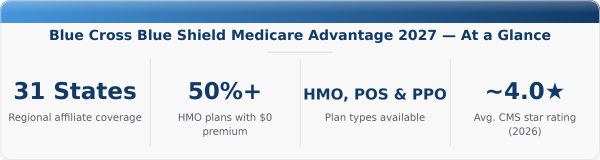
Regional coverage: BCBS Medicare Advantage plans are available in roughly 31 states through local affiliate companies
✔
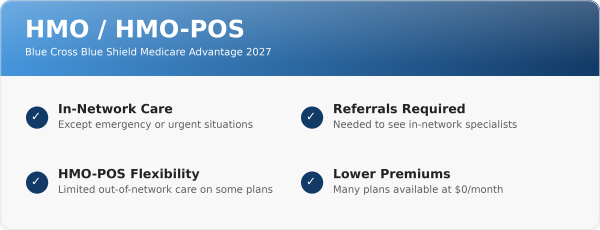
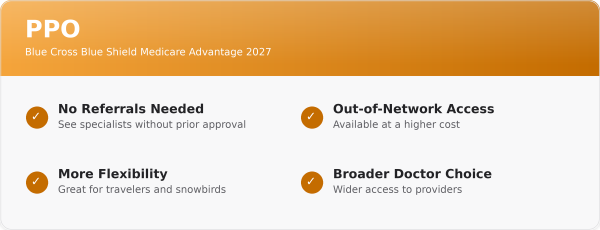
Plan types offered: HMO, HMO-POS, and PPO plans in most areas, with PFFS plans in select states
✔
What this means for you: the specific BCBS plan, premium, and benefits available depend entirely on which regional affiliate serves your ZIP code — a Blue Cross plan in one state may differ significantly from a Blue Cross plan in another
Because of this regional structure, it’s especially important to compare the specific BCBS plan available where you live rather than assuming benefits or ratings are the same nationwide.
Because each Blues plan is its own company, the one available to you depends entirely on your state. Florida Blue, the Blue Cross plan in Florida, is a good illustration — roughly 111,000 Medicare Advantage members, its own BlueMedicare product line, and star ratings that differ from the Blues plans in other states.
The mid-Atlantic works the same way. CareFirst BlueCross BlueShield is the Blues licensee for Maryland, Washington, D.C. and Northern Virginia, and the largest not-for-profit insurer in the region with about 3.5 million members. Its Medicare Advantage lineup is built mostly on PPOs rather than HMOs, and its individual plans are offered in Maryland and D.C. but not in the Virginia portion of its service area — a distinction that catches out plenty of Northern Virginia residents. See CareFirst Medicare Advantage plans for how its PPO network and plan options compare.
Highmark shows how far a single Blues licensee can stretch. It covers roughly 7 million people across Pennsylvania, Delaware, West Virginia and parts of New York, and it operates Pennsylvania through two separate entities — Highmark Blue Cross Blue Shield in the west and north-east, Highmark Blue Shield in the centre and south-east. It has also confirmed it will continue to operate in every state and county it served in 2026, which makes it one of the few carriers not exiting markets for 2027. See Highmark Medicare Advantage plans for the full plan lineup and service area.
Regence is the same model in the west, and a useful warning about how differently two Blues licensees can behave. It runs four separate companies across Idaho, Oregon, Utah and select Washington counties, covering only about 73,000 Medicare Advantage members — and unlike Highmark it has trimmed its county footprint repeatedly in recent plan years. Its premiums also sit well above what most carriers charge in those markets. See Regence Medicare Advantage plans for the service area, plan lineup and an honest look at the costs.
California is the sharpest illustration of this. It is one of the few states where a Blue Cross plan and a Blue Shield plan operate as two entirely separate companies — Anthem Blue Cross and Blue Shield of California — with different Medicare Advantage plans, different provider networks and different costs. A practice that contracts with one may not contract with the other. Our guide to Medicare Advantage plans in California covers how the two compare there.
Ohio shows the regional structure working as intended. Anthem Blue Cross Blue Shield competes statewide there against a deep bench of Ohio-only carriers built around individual hospital systems — Medical Mutual of Ohio in Cleveland, MediGold in Columbus, SummaCare in Akron. See Medicare Advantage plans in Ohio for how the Anthem plans stack up against them county by county.
Several licensees do not use the Blue Cross name on their Medicare Advantage plans at all. In Philadelphia, Keystone 65 from Independence Blue Cross is the brand you will see on the plan documents, and searching for the company name will not find it.