Speak with a licensed insurance agent

1-855-454-9051

TTY user 711 Mon-Fri : 8am-9pm EST

Medicare Advantage Plans With Dental Coverage 2027: What's Covered and What May Change

Reviewed by Russell Noga, Licensed Medicare Insurance Broker (all 50 states) — Last updated September 3, 2026

Ninety-eight percent of Medicare Advantage members have a dental benefit. Forty-two percent actually use one.

That gap is the most useful thing to understand before you choose a plan for 2027, because it is not caused by people forgetting to go to the dentist. It is caused by the word “dental” covering two completely different things — and most people finding out which one they bought at the reception desk.

This page explains what Medicare Advantage dental actually covers, what the 2027 plan year may look like, and how to read a dental benefit properly when the real numbers publish on October 1.

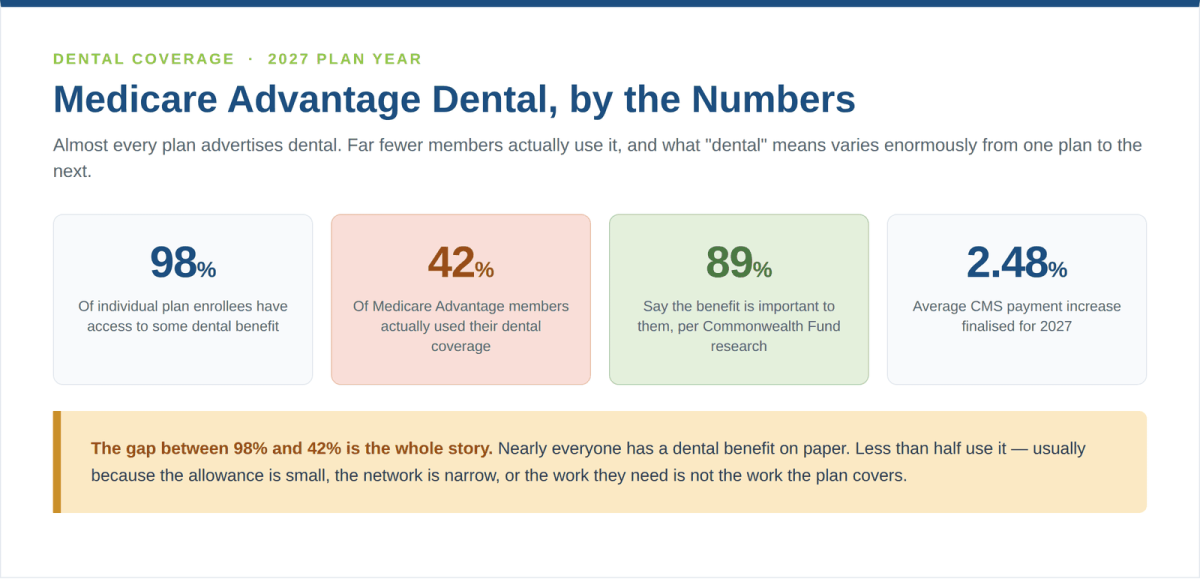
Medicare Advantage dental coverage by the numbers - 98% have access, 42% use it, 89% say it matters, 2.48% CMS payment increase for 2027

Medicare Advantage Dental, by the Numbers

Dental is the single most requested benefit Medicare Advantage offers, and carriers know it. Commonwealth Fund research found 89% of members consider it important. Ninety-eight percent of individual plan enrollees have access to some form of dental benefit, and most special needs plan members do too.

Usage tells a different story. Only 42% of members actually used their dental coverage. Some of that is people who simply did not need dental work. Much of it is people who found the allowance too small for what they needed, the network too narrow to include their dentist, or the specific procedure excluded.

Dental benefits can vary by plan and location, and some states, such as Texas, may have a wide range of Medicare Advantage plan options that include additional dental coverage.

See Medicare Advantage dental plans in your area

Why Medicare Advantage Has Dental At All

Original Medicare does not cover routine dental care. Not cleanings, not fillings, not extractions, not dentures, not implants. The exclusion is written into the statute and it has been there since 1965.

The narrow exception is dental work that is integral to a covered medical procedure — reconstruction of the jaw after an accident, or a dental examination required before an organ transplant or certain heart surgeries. That is a medical benefit that happens to involve teeth, not dental coverage in any useful sense.

So the entire dental conversation in Medicare is a Medicare Advantage conversation. If you stay with Original Medicare, your options are paying cash or buying a standalone dental policy.

Smaller regional carriers are worth a look here as well, since they often compete on supplemental benefits rather than footprint. Devoted Health Medicare Advantage plans are one example, with dental typically bundled alongside vision and hearing on their MAPD plans, though the allowance and covered-services list still vary by county and the 2027 figures are not published yet. The wider point holds regardless of carrier: compare the specific plans in your ZIP code, not the brands. Our 2027 Medicare Advantage overview covers how the benefit categories fit together.

Three Very Different Things, One Word

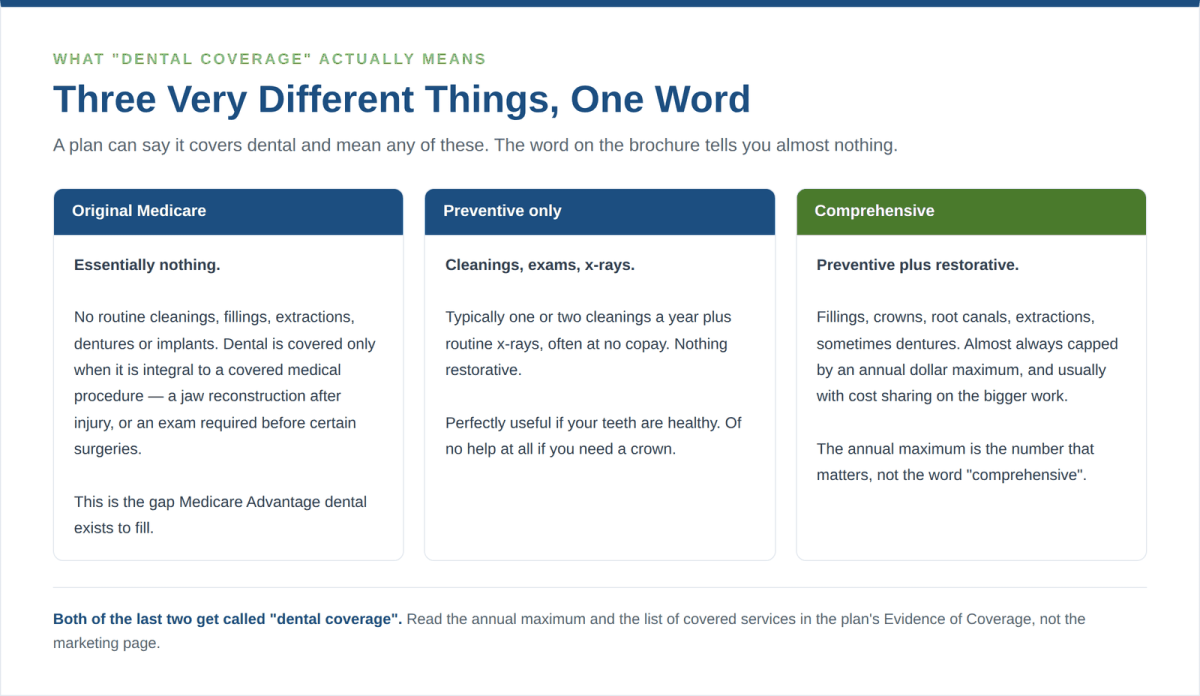
Original Medicare dental exclusion compared with preventive-only and comprehensive Medicare Advantage dental coverage

This is where most of the disappointment comes from. A plan can advertise “dental coverage” and mean either of two quite different products.

Preventive dental covers cleanings, routine exams and x-rays. Typically one or two cleanings a year, often with no copay. It is genuinely useful, and it is also the cheaper benefit for a carrier to offer. It does nothing for you if you need restorative work.

Comprehensive dental adds restorative services — fillings, crowns, root canals, extractions, and on some plans dentures. It is almost always capped by an annual dollar maximum, and there is usually cost sharing on the larger procedures, frequently around 50%.

Both of these get called “dental coverage” on the plan summary. The word that matters is not “dental”, it is the annual maximum and the list of covered services. A plan with a $500 preventive-only benefit and a plan with a $2,500 comprehensive benefit are described identically in most marketing.

What Is Typically Covered, and What Usually Is Not

Coverage varies by plan and by county, so treat this as the general shape rather than a guarantee. Always confirm against the specific plan’s Evidence of Coverage.

Service Preventive plans Comprehensive plans What to watch
Cleanings and exams Usually covered Usually covered How many per year — one or two
X-rays Usually covered Usually covered Routine only, or panoramic too
Fillings Generally not Often covered Cost share, commonly around 50%
Crowns and root canals No May be covered This is where the annual maximum runs out
Extractions Generally not Often covered Simple versus surgical are priced differently
Dentures No Sometimes covered Often once every several years
Implants No Rarely covered Where covered, the allowance rarely meets the cost

Two structural things matter more than the covered-services list. Many plans run dental through a separate dental network, so your medical network being fine tells you nothing about whether your dentist participates. And the annual maximum is a hard ceiling — once you reach it, you pay the full negotiated rate for everything else that year.

Find & Compare Plans Online

Speak with a licensed insurance agent

1-855-454-9051TTY 711

Mon-Fri: 8am-9pm ET

What We Actually Know About 2027 Dental

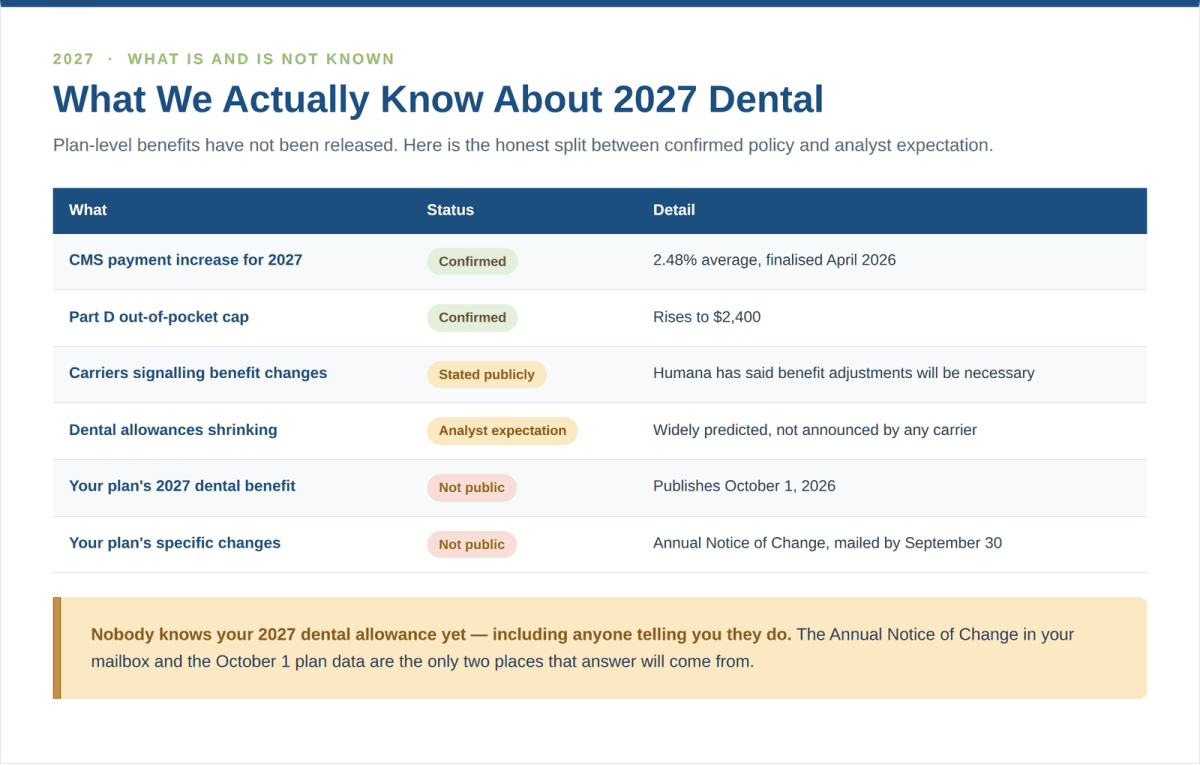
What is confirmed versus expected for 2027 Medicare Advantage dental benefits, and when plan-level data publishes

Here is the honest position, because a lot of what you will read on this topic presents expectation as fact.

Confirmed. CMS finalised an average 2.48% payment increase to Medicare Advantage plans for 2027. Federally, the Part D annual out-of-pocket cap rises to $2,400 and the maximum Part D deductible to $700. Those apply to every plan.

Stated by carriers. Humana has said publicly that benefit adjustments will be necessary for 2027. That is a company acknowledging change is coming, not a specification of what changes.

Analyst expectation, not announcement. Industry analysts broadly expect supplemental benefits including dental, over-the-counter allowances and fitness to be trimmed for 2027 while $0 premiums are preserved, on the reasoning that a headline premium is more visible to shoppers than an allowance. One published illustration puts a mid-tier dental allowance moving from $2,500 to $1,500. That figure is an example of the kind of change analysts anticipate, not a benefit any carrier has published.

Nobody knows your 2027 dental allowance yet. Plan-level benefits for every 2027 Medicare Advantage plan publish October 1, 2026, and your own plan’s specific changes arrive in the Annual Notice of Change that must be mailed by September 30. Any site quoting you a specific 2027 dental figure today is estimating, and so is this one until those dates pass.

How to Read a Dental Benefit Properly

When the real 2027 numbers publish, these are the six things to look at, roughly in this order.

1The annual maximum. One number, and the most important one. It is the ceiling on what the plan will pay for dental in a year, and everything above it is yours.

2Preventive or comprehensive. If the covered-services list stops at cleanings, exams and x-rays, it is a preventive benefit however it is described.

3Whether your dentist is in the dental network. Dental often runs through a separate network from your medical coverage. Check the dentist by name, not the carrier.

4The cost share on restorative work. Coverage at 50% on a crown is very different from coverage at 20%, and both are described as “covered”.

5Waiting periods and frequency limits. Some benefits restrict how often a service is covered, or when it becomes available after enrolment.

6The dental work you already know you need. Price that specific procedure against the plan, rather than comparing headline allowances in the abstract.

What to Do Between Now and Annual Enrollment

Read your Annual Notice of Change when it arrives. It must be mailed by September 30, 2026, and it lists every benefit change for the year ahead including dental. Go straight to the supplemental benefits section and compare the annual maximum against this year’s.

If dental is the reason you chose your plan and the allowance drops meaningfully, that is a legitimate reason to shop — but it does not give you any special enrollment rights. A plan getting worse is not a plan ending. Your window is Annual Enrollment, October 15 to December 7, 2026, the same as everyone else. Our guide to Medicare Advantage plans going away in 2027 explains the difference and what rights each situation carries.

If you have significant dental work planned, it is also worth pricing a standalone dental policy against the difference between plans, rather than assuming the Medicare Advantage benefit is automatically the better deal. For the full 2027 picture across carriers and benefits, start with our 2027 Medicare Advantage plans guide or compare carriers on our 2027 costs and benefits by carrier breakdown.

See Medicare Advantage dental plans in your area

Medicare Advantage Dental Coverage 2027 — Frequently Asked Questions

  Does Medicare Advantage cover dental?

Almost always in some form — 98% of individual Medicare Advantage plan enrollees have access to a dental benefit. What varies enormously is what that benefit includes. Some plans cover only preventive care such as cleanings, exams and x-rays. Others add restorative work like fillings, crowns and extractions, usually capped by an annual dollar maximum and with cost sharing on larger procedures. Original Medicare does not cover routine dental at all, which is why the benefit exists on Medicare Advantage plans in the first place.

  Which Medicare Advantage plan has the best dental coverage?

There is no single answer, because dental benefits are set plan by plan and county by county rather than by carrier. A carrier with a generous dental benefit in one market can offer a preventive-only benefit in the next county. The practical way to judge is by three numbers on the specific plan: the annual maximum, the cost share on restorative work, and whether your own dentist is in that plan’s dental network. Compare those, not the carrier’s national reputation. The 2027 plan-level figures publish October 1, 2026.

  Are Medicare Advantage dental benefits being cut for 2027?

Nothing has been announced. What is known is that CMS finalised an average payment increase of 2.48% for 2027, that carriers have said this may not keep pace with rising medical costs, and that Humana has stated benefit adjustments will be necessary. Industry analysts broadly expect supplemental benefits including dental to be trimmed while $0 premiums are preserved, on the reasoning that shoppers notice a premium more than an allowance. That is an expectation rather than a published change. Your own plan’s 2027 dental benefit appears in the Annual Notice of Change mailed by September 30, 2026.

  Does Original Medicare cover dental care?

No. Original Medicare does not cover routine dental — cleanings, fillings, extractions, dentures or implants are all excluded, and have been since the programme began. The narrow exception is dental work integral to a covered medical procedure, such as jaw reconstruction after an accident or a dental examination required before an organ transplant or certain heart surgeries. That is a medical benefit involving teeth rather than dental coverage. If you stay on Original Medicare, your options are paying out of pocket or buying a standalone dental policy.

  Do Medicare Advantage plans cover dental implants?

Rarely, and where they do the allowance rarely meets the cost. Implants sit at the top end of restorative dentistry and most comprehensive dental benefits either exclude them outright or cover a share that leaves a substantial balance. If implants are why you are choosing a plan, price the specific procedure against the plan’s annual maximum and cost share before enrolling, and compare that against a standalone dental policy. Do not assume a plan advertising comprehensive dental includes them.

  What is the difference between preventive and comprehensive dental coverage?

Preventive dental covers cleanings, routine exams and x-rays, usually one or two cleanings a year and often at no copay. Comprehensive dental adds restorative services — fillings, crowns, root canals, extractions and sometimes dentures — almost always subject to an annual dollar maximum with cost sharing on larger work, frequently around 50%. Both are commonly described simply as “dental coverage” in plan marketing, which is why the covered-services list and the annual maximum matter far more than the label.

  Why do so few people use their Medicare Advantage dental benefit?

Only 42% of members used their dental coverage, against 98% who have access to one. Some of that is people who did not need dental work in a given year. The rest comes down to three things: the annual maximum being too small for the work needed, the plan’s dental network not including the member’s dentist, or the specific procedure being excluded from the covered-services list. All three are visible in the plan documents before you enrol, which is why the annual maximum and the network check are worth the ten minutes.

  My dental benefit is being reduced. Can I switch plans?

Yes, during Annual Enrollment, October 15 through December 7, 2026, like anyone else. What a reduced benefit does not give you is a Special Enrollment Period or guaranteed-issue Medigap rights — those are triggered by a plan ending, not by a plan getting worse. If your Annual Notice of Change shows a smaller dental allowance and dental is the reason you chose the plan, treat Annual Enrollment as your window and compare properly rather than renewing by default.

  Should I buy standalone dental insurance instead?

It depends on what you need done. If your dental needs are routine, the preventive benefit on most Medicare Advantage plans covers them at little or no cost and a separate policy adds expense for nothing. If you have significant restorative work ahead — multiple crowns, dentures, implants — a standalone policy with a higher annual maximum may cost less overall than paying the balance above a Medicare Advantage plan’s cap. Price the specific work rather than comparing the products in the abstract.

  When will 2027 dental benefits be published?

Two dates. Your own plan’s 2027 changes arrive in the Annual Notice of Change, which must be mailed to you by September 30, 2026. Plan-level data for every 2027 Medicare Advantage plan in the country — including dental allowances, covered services and networks — publishes October 1, 2026. Nothing before those dates reflects actual 2027 benefits, so the useful move now is deciding what you need from a dental benefit, then comparing against real numbers once they exist.

Have Questions?

Speak with a licensed insurance agent

1-855-454-9051

TTY users 711

Mon-Fri: 8am-9pm ET

Find & Compare Plans Online

Speak with a licensed insurance agent

1-855-454-9051TTY 711

Mon-Fri: 8am-9pm ET

ZRN Health & Financial Services, LLC, a Texas limited liability company