





Speak with a licensed insurance agent

1-855-454-9051

TTY user 711 Mon-Fri : 8am-9pm EST

How Do Medicare Advantage Plans Make Money? How Plans Are Paid in 2027

Reviewed by Russell Noga, Licensed Medicare Insurance Broker (all 50 states) — Last updated October 29, 2026

Medicare Advantage plans make money mainly from Medicare itself. For each member, Medicare pays the insurer a set amount every month to cover that person’s care. The plan keeps whatever is left after paying doctors, hospitals, drug costs and its own expenses, and it can lose money if care costs more than expected.

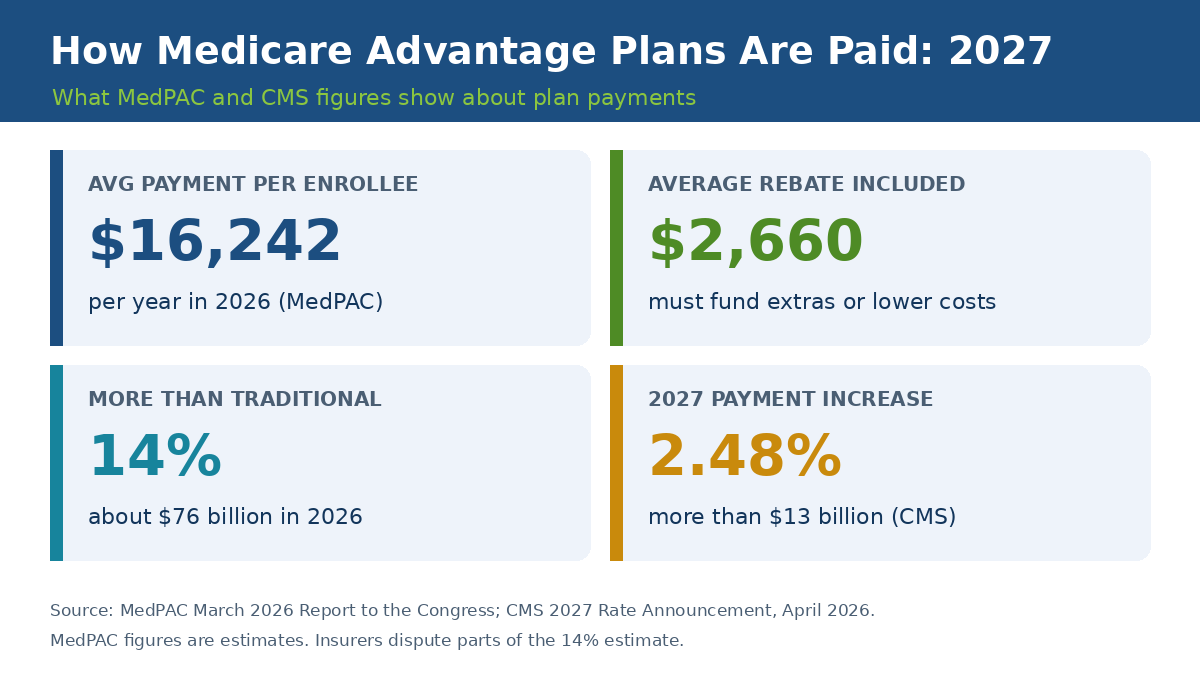
The amounts are large. MedPAC, the commission that advises Congress on Medicare, estimates Medicare pays Medicare Advantage plans an average of $16,242 per enrollee in 2026, including an average rebate of $2,660. For 2027, CMS raised plan payments by 2.48%, or more than $13 billion.

✔ Licensed across all 50 states✔ Built on CMS 2027 data✔ No-cost plan comparison

Compare 2027 Medicare Advantage Plans in Your Area

Speak with a licensed insurance agent

1-855-454-9051TTY 711

Mon-Fri: 8am-9pm ET

Agent 08
How Medicare Advantage plans are paid in 2027: $16,242 average payment per enrollee, $2,660 average rebate, 14% more than traditional Medicare, 2.48% 2027 payment increase

Where Medicare Advantage Plan Money Comes From

A Medicare Advantage plan has four main sources of revenue:

Revenue Source How It Works
Monthly payment from Medicare A fixed amount per member, per month, to cover Part A and Part B services. This is called capitation.
Part D payments Separate Medicare payments for plans that include prescription drug coverage.
Rebates Part of Medicare’s payment that must go toward extra benefits or lower costs for members.
Member premiums Any monthly plan premium you pay. Many plans charge $0.

Source: MedPAC; KFF; CMS.

Because the payment is fixed, the plan carries the risk. If members use less care than the plan expected, it keeps the difference. If they use more, the plan absorbs the loss. That is why plans use networks, referrals and prior authorization to manage costs. You still pay your own Part B premium with any plan.

How Benchmarks, Bids and Rebates Work

Each year, the payment for each plan is set through a bidding process:

1

Medicare sets a benchmark for each county, the most it will pay for a typical member there.

2

The insurer submits a bid estimating what it will cost to cover Part A and Part B services for an average member.

3

If the bid is below the benchmark, the plan gets a share of the difference as a rebate: 50%, 65% or 70%, depending on its star rating.

4

The rebate must go back to members as extra benefits, such as dental or vision coverage, lower copays, or lower Part B or Part D premiums.

5

If the bid is above the benchmark, members pay the difference as a plan premium.

Rebates are what make many $0 premium plans possible. KFF estimates plans put about $13 billion in rebates toward lowering Part D premiums in individual Medicare Advantage drug plans in 2026, which is why most of those members pay no premium for drug coverage. See how to find one in our guide to $0 premium Medicare Advantage plans.

Compare 2027 Medicare Advantage Plans in Your Area

Speak with a licensed insurance agent

1-855-454-9051TTY 711

Mon-Fri: 8am-9pm ET

Agent 08

Risk Adjustment: Why Health Status Changes Payments

Medicare pays more for members who are expected to cost more. Each member gets a risk score based on age, Medicaid status and diagnosed health conditions, and the plan’s payment is adjusted up or down by that score.

This is where much of the debate about plan profits comes from. MedPAC’s March 2026 report found:

✔

Medicare spends about 14% more on Medicare Advantage enrollees than it would if the same people were in traditional Medicare, a projected $76 billion in 2026.

✔

Coding intensity: Medicare Advantage risk scores run about 4% higher than for similar people in traditional Medicare, because plans record more diagnoses.

✔

Favorable selection: Medicare Advantage tends to attract healthier people, which MedPAC estimates raises payments about 11% above what traditional Medicare would have spent.

Insurers and their trade groups dispute parts of these estimates and point to the extra benefits and lower costs members get. Either way, it explains why Medicare keeps changing how it calculates risk scores.

Star Rating Bonuses

Star ratings affect how much money a plan gets in two ways:

✔

Quality bonus payments. Plans rated 4 stars or higher generally get a 5% boost to their benchmark, and more in some counties.

✔

A bigger rebate share. Plans rated 4.5 stars or higher keep 70% of the gap between their bid and the benchmark, compared with 65% for 3.5 to 4 stars and 50% below that.

That money usually turns into richer benefits, so a plan that loses stars can trim extras the next year. See which plans gained and lost in our guide to 2027 Medicare Advantage star ratings.

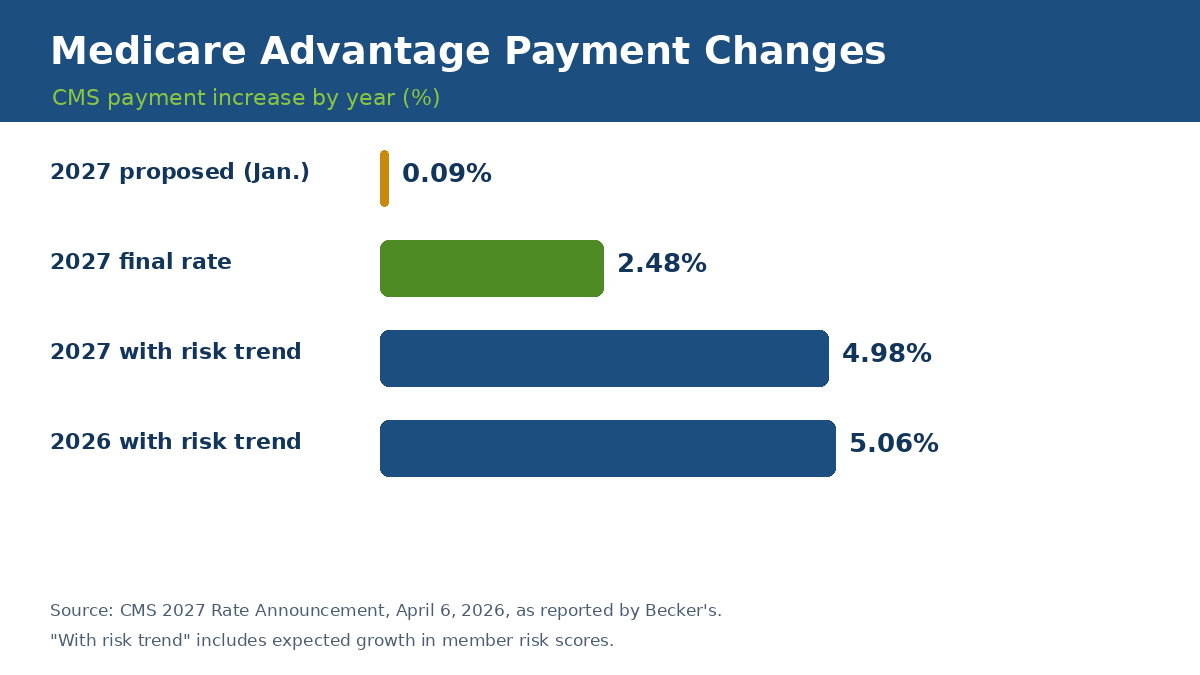
Medicare Advantage payment increase: 0.09% proposed for 2027, 2.48% final, 4.98% with risk trend, 5.06% for 2026

What Changed in Plan Payments for 2027

CMS finalized its 2027 payment rules in April 2026. The main changes:

✔

A 2.48% payment increase, or more than $13 billion, up from a nearly flat 0.09% proposed in January. Counting expected growth in risk scores, plans get about 4.98% more on average.

✔

No new risk model. CMS dropped a proposed new risk adjustment model and kept the current one.

✔

Fewer diagnoses count. Diagnoses found only in chart reviews that aren’t linked to a medical visit will no longer count toward risk scores.

✔

Coding adjustment held. CMS kept its 5.9% coding pattern adjustment, the minimum the law allows.

Even with higher payments, many insurers trimmed their 2027 lineups. CMS counts 5,532 Medicare Advantage plans for 2027, down from 5,553, and some carriers left whole counties. See the full list in Medicare Advantage plans ending in 2027.

What This Means When You Shop

✔

A $0 premium is not free. You still pay your Part B premium, plus copays, deductibles and drug costs up to your plan’s limits.

✔

Extras can change every year. Dental, vision and other benefits are paid for with rebates, which shift with each year’s bids and star ratings.

✔

Networks and prior authorization are cost controls. Check that your doctors are in network and how the plan handles approvals.

✔

Agents are paid by the plans. Licensed agents are paid by insurers, with pay capped by Medicare, so you pay nothing extra for help comparing plans.

Weigh these trade-offs in our guide to the disadvantages of Medicare Advantage plans.

Before You Pick a 2027 Plan: Checklist

1

Compare the out-of-pocket maximum and hospital copays, not just the premium.

2

Check your doctors and hospitals in each plan’s 2027 network.

3

Run your prescriptions through each plan’s 2027 drug list.

4

Read your Annual Notice of Change to see which extras were cut or added.

5

Check the star rating, which affects how much plans can spend on extras.

6

Enroll on time. Medicare Open Enrollment 2027 runs October 15 to December 7, 2026.

Compare 2027 Medicare Advantage Plans in Your Area

Speak with a licensed insurance agent

1-855-454-9051TTY 711

Mon-Fri: 8am-9pm ET

Agent 08

How Medicare Advantage Plans Make Money — Frequently Asked Questions

➤ How do Medicare Advantage plans make money?

Medicare pays each plan a fixed monthly amount per member to cover Part A and Part B care, plus separate payments for drug coverage. The plan keeps what’s left after paying for care and expenses, and it loses money if care costs more than the payments.

➤ Who pays for Medicare Advantage plans?

Mostly the federal Medicare program, funded by taxes and the Part B premiums people pay. Members may also pay a plan premium, copays and other costs.

➤ How much does Medicare pay Medicare Advantage plans per person?

MedPAC estimates the average payment is $16,242 per enrollee in 2026, including an average rebate of $2,660.

➤ How can Medicare Advantage plans offer $0 premiums?

When a plan bids below Medicare’s benchmark for its area, it gets part of the difference as a rebate. Rebates must be used for members, often to lower or eliminate premiums and add extra benefits.

➤ Do Medicare Advantage plans get paid more for sicker members?

Yes. Medicare adjusts each plan’s payment by each member’s risk score, which is based on age, Medicaid status and diagnosed conditions.

➤ Does Medicare pay more for Medicare Advantage than traditional Medicare?

MedPAC estimates Medicare spends about 14% more on Medicare Advantage enrollees than it would in traditional Medicare, about $76 billion in 2026. Insurers dispute parts of that estimate.

➤ How much did Medicare Advantage payments go up for 2027?

CMS finalized a 2.48% increase for 2027, more than $13 billion. Counting expected growth in risk scores, the average increase is about 4.98%.

➤ Do star ratings affect how much Medicare Advantage plans are paid?

Yes. Plans with 4 or more stars generally get quality bonus payments, and higher-rated plans keep a larger share of their rebates for extra benefits.

➤ Does it cost more to use an agent to enroll in Medicare Advantage?

No. Licensed agents are paid by insurance companies, with pay capped by Medicare, so you pay the same plan price with or without an agent.

New to Medicare?

If you are new to Medicare, then you can enroll in a 2027 Medicare Advantage plan up to three months prior to your Medicare Part B effective date.

Call one of our licensed insurance agents to see what the best time frame is for you to enroll, based on your current situation. You can contact them at 1-855-454-9051 (TTY 711), Mon–Fri 8am–9pm EST.

Have Questions?

Speak with a licensed insurance agent

1-855-454-9051

TTY users 711

Mon-Fri: 8am-9pm ET

Compare plans & benefits in your area

Or speak with a licensed insurance agent

1-855-454-9051TTY 711

Mon-Fri: 8am-9pm ET

Agent 08