Speak with a licensed insurance agent

1-855-454-9051

TTY user 711 Mon-Fri : 8am-9pm EST

2027 Medicare Advantage Plans: Costs and Benefits Compared by Carrier

Reviewed by Russell Noga, Licensed Medicare Insurance Broker (all 50 states) — Last updated September 1, 2026

Most comparisons of 2027 Medicare Advantage plans stop at the premium line. That’s the least useful number on the page.

What actually determines your cost is the interaction between your plan’s out-of-pocket maximum, its drug formulary tiers, and the federal Part D parameters CMS finalized in April 2026 — figures that apply to every Medicare Advantage plan with drug coverage, regardless of carrier.

This page breaks down what’s confirmed for 2027, what each major carrier brings to the cost-and-benefit equation, and how to calculate what you’ll actually pay. For the broader overview, see our 2027 Medicare Advantage plans guide, or compare plans by ZIP code to see real options in your county.

What's Confirmed for 2027 — and What Isn't

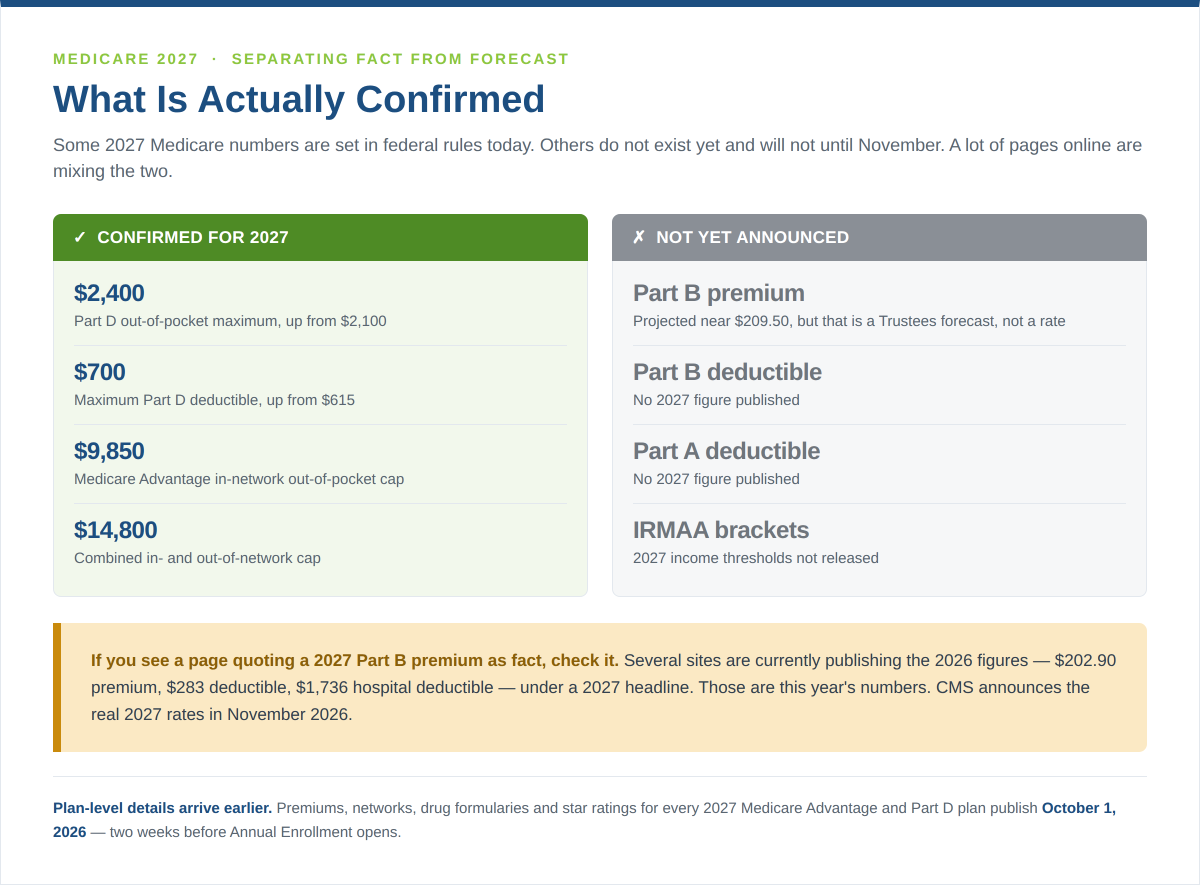
What is confirmed for 2027 Medicare vs not yet announced, Part D cap and out-of-pocket limits

Some 2027 numbers are locked in federal rules today. Others do not exist yet and will not until November 2026. There is a meaningful difference between the two, and most articles blur it.

Confirmed. CMS finalized the CY 2027 Medicare Advantage and Part D rule on April 2, 2026, along with the 2027 Part D standard benefit parameters. The out-of-pocket drug cap rises to $2,400 from $2,100, the maximum standard deductible to $700 from $615, and Medicare Advantage out-of-pocket caps are set at $9,850 in-network and $14,800 combined in- and out-of-network. The star ratings methodology changes are locked in as well. All of these are ceilings written into federal rules — individual plans can and often do come in below them.

Not confirmed. Individual plan premiums, county-level availability, specific supplemental benefits, and the 2027 star ratings themselves. Separately, the federal figures most people ask about — the standard Part B premium, the Part B deductible, the Part A hospital deductible and coinsurance, and the IRMAA income brackets — are not published either. The 2026 Medicare Trustees Report projects a Part B premium near $209.50, but a projection is not a rate and the final number can move in either direction depending on program spending through the rest of the year.

A warning worth taking seriously. Several sites are currently publishing a 2027 Part B premium of $202.90, a Part B deductible of $283 or a hospital deductible of $1,736. Those are the 2026 amounts — correct numbers attached to the wrong year. If a page quotes a 2027 Part A or Part B figure as fact right now, check it against the source. CMS publishes the real 2027 rates in November 2026, and we will update this page the day they land.

Plan-level detail arrives earlier than the federal figures. Premiums, provider networks, drug formularies, supplemental benefits and the 2027 star ratings for every county publish October 1, 2026 — two full weeks before Annual Enrollment opens on October 15.

Carriers including Devoted Health, Humana and HealthSpring have been reducing supplemental benefits across recent plan years, so treat any 2027 dental, vision or over-the-counter allowance as unconfirmed until it appears in that plan’s official Summary of Benefits.

Compare 2027 Medicare Advantage Plans and enroll online

The 2027 Part D Changes That Hit Every Plan

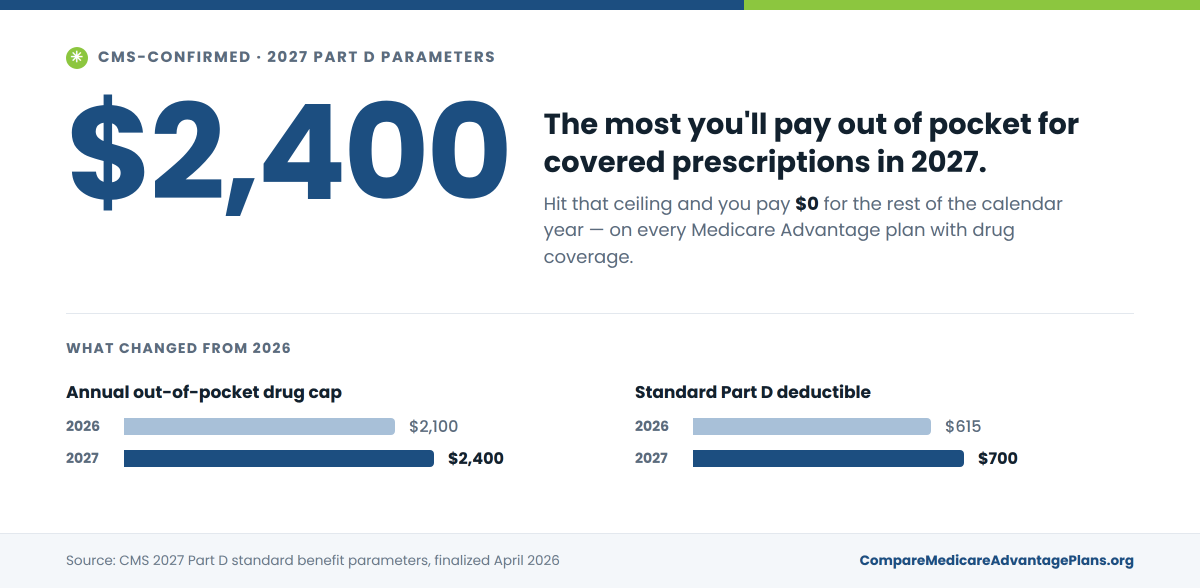
If your Medicare Advantage plan includes prescription drug coverage — most do — these federal parameters apply to it. They are the single biggest confirmed cost change for 2027:


Part D Parameter 2026 2027 Change
Annual out-of-pocket cap $2,100 $2,400 +$300
Standard deductible $615 $700 +$85
Coverage gap (“donut hole”) Eliminated Eliminated No change
Catastrophic phase cost sharing $0 $0 No change


What this means in practice: once you’ve spent $2,400 out of pocket on covered prescriptions in 2027, you pay nothing more for formulary drugs for the rest of the calendar year.

The cap rose $300 from 2026, so people with high drug costs will spend somewhat more before hitting zero cost-sharing — but the ceiling still exists, which it did not before 2025.

The $700 standard deductible is the maximum a plan may charge. Many Medicare Advantage plans set a lower drug deductible, or none at all, so this is a ceiling rather than a prediction of what you’ll pay.

How 2027 Medicare Advantage Costs Actually Break Down

Medicare Part D annual cap maximum

Five numbers determine your total cost. Premium is the one people fixate on and the one that matters least:

Your Part B premium. You pay this regardless of which Medicare Advantage plan you choose, or whether you choose one at all. Some plans offer a Part B giveback, but that’s a plan-specific feature, not a rule.

The plan premium. Often $0. A $0 premium does not mean a low-cost plan — it means the carrier is funded through Medicare payments rather than your monthly check.

Copays and coinsurance. What you pay per visit, per specialist, per hospital stay. This varies enormously between plans in the same county.

The medical out-of-pocket maximum. Every Medicare Advantage plan caps annual in-network medical spending. This is your worst-case number in a bad health year, and the spread between plans is often several thousand dollars.

Drug costs up to the $2,400 cap. Determined by your plan’s formulary tiers, not the plan premium. A drug on tier 4 versus tier 2 can swing your annual cost by thousands.

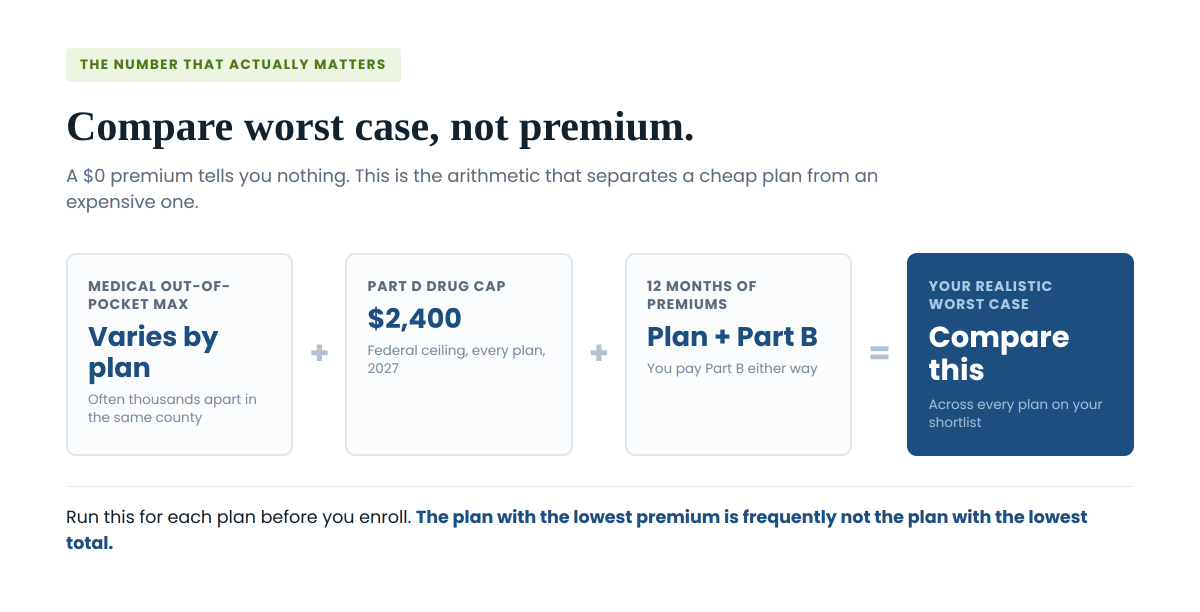
compare-total-cost-2027

A useful exercise: take the plan’s medical out-of-pocket maximum, add $2,400, and add twelve months of premiums. That’s your realistic worst case for the year. Compare that number across plans, not the premium.

Find & Compare Plans Online

Speak with a licensed insurance agent

1-855-454-9051TTY 711

Mon-Fri: 8am-9pm ET

2027 Medicare Advantage Plans Compared by Carrier

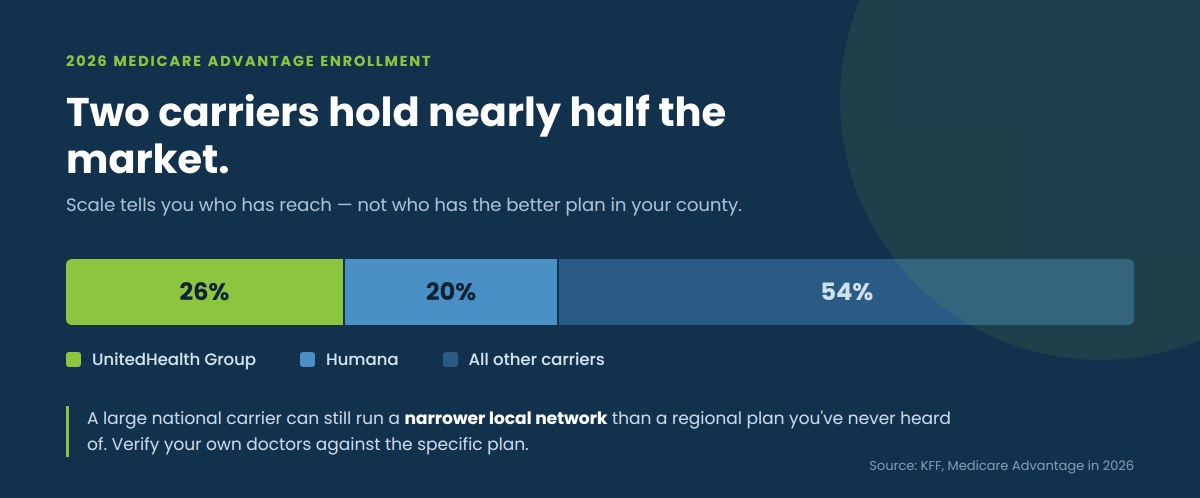
market-concentration-2026

The rankings below reflect what each carrier structurally brings to cost and benefit decisions, based on the most recent finalized data — 2026 enrollment figures and 2026 CMS star ratings.

Carrier-level strengths are real, but they do not guarantee a good plan in your specific county. Verify locally before enrolling.

Carrier Best for 2026 MA market share Quality signal (2026 ratings)
1. UnitedHealthcare Network size and nationwide availability ~26% 78% of members in 4+ star plans
2. Humana Supplemental benefit breadth ~20% Broad national footprint
3. Aetna (CVS Health) Pharmacy integration and drug costs Top-five national 81%+ of members in 4+ star plans
4. Kaiser Permanente Quality ratings, where available Regional 100% of contracts at 4+ stars
5. Blue Cross Blue Shield Regional networks and local provider depth Varies by state Varies by licensee
6. HealthSpring Cigna legacy markets in transition Regional (former Cigna) Varies by regional contract
7. Devoted Health Stability in a contracting market Regional, expanding Strong ratings for its size
8. Wellcare Low premiums and dual-eligible plans Multi-state 18% of members in 4+ star plans

1. UnitedHealthcare — best for network size and nationwide availability

UnitedHealth Group covered roughly 26% of all Medicare Advantage enrollees in 2026, the largest share of any carrier. For cost purposes, the practical implication is provider access: a large network reduces the chance that a specialist you need falls out of network, which is where unplanned costs come from. In 2026, 78% of its members were in plans rated 4 stars or higher.

Where it can cost you: breadth is a national average, not a local guarantee. In some counties, UnitedHealthcare offers narrow HMO products with tighter networks than the national picture suggests. Verify your specific doctors against the specific plan.

2. Humana — best for supplemental benefit breadth

Humana held roughly 20% of Medicare Advantage enrollment in 2026, making it and UnitedHealth Group together responsible for about 46% of the entire market. Humana has historically competed on supplemental benefits — dental, vision, hearing, OTC allowances, and fitness programs.

Where it can cost you: supplemental benefits are the most volatile part of any Medicare Advantage plan and the first thing carriers trim when margins compress. Benefit reductions have been widely reported across recent plan years. Confirm each benefit you’re counting on for 2027 in writing rather than assuming it carries over.

3. Aetna (CVS Health) — best for pharmacy integration and drug costs

Aetna’s CVS ownership creates a tighter link between the plan and the pharmacy counter, which matters more in 2027 than it used to — with the drug cap at $2,400 and the standard deductible at $700, formulary placement is a larger share of your total spend. In 2026, more than 81% of Aetna’s Medicare Advantage members were in plans rated 4 stars or higher, the strongest figure among the large national carriers.

Where it can cost you: preferred pharmacy networks cut both ways. If your regular pharmacy isn’t preferred under the plan, your copays rise.

Aetna’s 2027 story is more complicated than its ratings suggest — the full breakdown is in our guide to Aetna Medicare Advantage plans 2027.

4. Kaiser Permanente — best for quality ratings, where available

Kaiser had 100% of its Medicare Advantage contracts rated 4 stars or higher for 2026 — the strongest quality profile of any carrier at scale. Its integrated model, where the insurer and the provider system are the same organization, tends to produce consistent cost and care coordination.

Where it can cost you: availability. Kaiser operates in a limited set of regions, and the model requires you to use Kaiser facilities and physicians. If you’re attached to an outside doctor, this is the wrong fit regardless of ratings.

5. Blue Cross Blue Shield — best regional networks and local provider depth

Blue Cross Blue Shield operates as independent licensees by state, so there is no single national plan or rating. In many markets the local Blue plan has the deepest relationships with regional hospital systems, which can mean better in-network access than a national carrier offers in that same county.

Where it can cost you: the variation between licensees is large. A strong Blue plan in one state tells you nothing about the plan next door. Evaluate the specific state licensee, not the brand.

6. HealthSpring — best for Cigna legacy markets in transition

HealthSpring is the former Cigna Medicare Advantage business, acquired by HCSC in March 2025 and rebranded for the 2026 plan year. If you were a Cigna Medicare member, this is where your plan went. The networks and much of the plan design carried over, but ownership changed and the brand on your card did not, which is why searches for both names still lead to the same plans. Our HealthSpring 2027 breakdown covers the transition and what stayed the same.

Note the name before you compare: Cigna Medicare is now HealthSpring, following the HCSC acquisition that closed in March 2025. Same plans, new company behind them.

7. Devoted Health — best for stability in a contracting market

Devoted is one of the few carriers moving in the opposite direction to the rest of the market. While the majors are exiting counties for 2027, Devoted has been entering them, and it carries strong star ratings for a company its size. The trade-off is footprint: it operates in a limited set of states, so for most of the country it is simply not an option. Where it does sell, it deserves a look ahead of larger carriers with weaker ratings. Its state list and ratings are on our Devoted 2027 page.

8. Wellcare — best for low premiums and dual-eligible plans

Wellcare, part of Centene, competes on price and has a substantial dual-eligible special needs footprint for people who qualify for both Medicare and Medicaid. It is worth being straight about the trade: Centene has the lowest measured plan quality of the carriers on this page, with roughly 18% of members in 4-star-or-better plans — though that is a sharp improvement from 1% the prior year. If premium is the binding constraint, or you are dual-eligible, it belongs on your shortlist. If measured quality is your priority, it does not.

View 2027 Medicare Advantage Plans in your area

What Star Ratings Tell You About Cost Stability

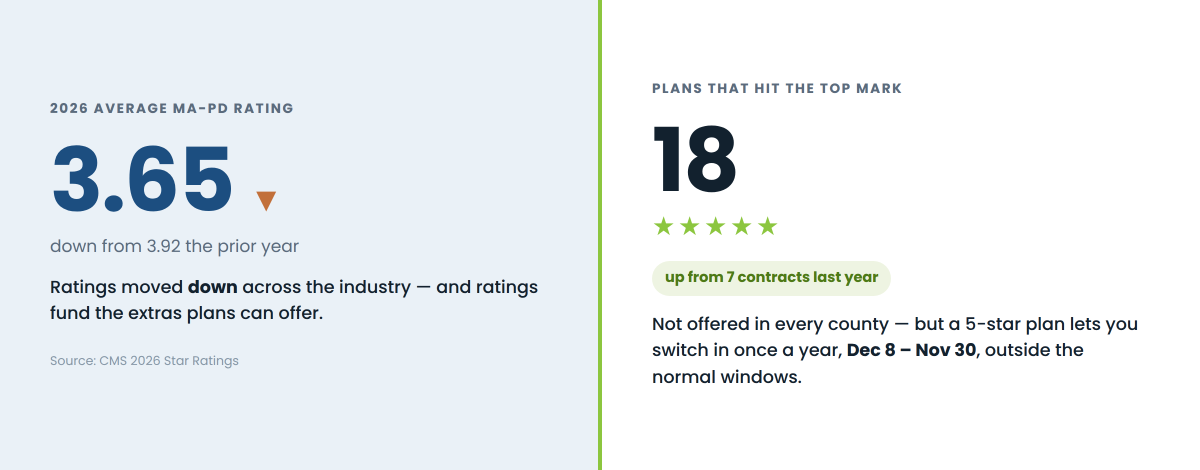
Star ratings aren’t just a quality score — they affect the bonus payments carriers receive, which in turn funds the supplemental benefits and low premiums plans can offer. A plan whose rating drops often has less room to fund extras the following year.

Two 2026 figures worth carrying into your 2027 decision:

  • The average MA-PD rating fell to 3.65 stars for 2026, down from 3.92. Ratings across the industry moved down, not up.
  • Eighteen contracts earned 5 stars for 2026, up from seven the prior year — but they are not offered in every county.

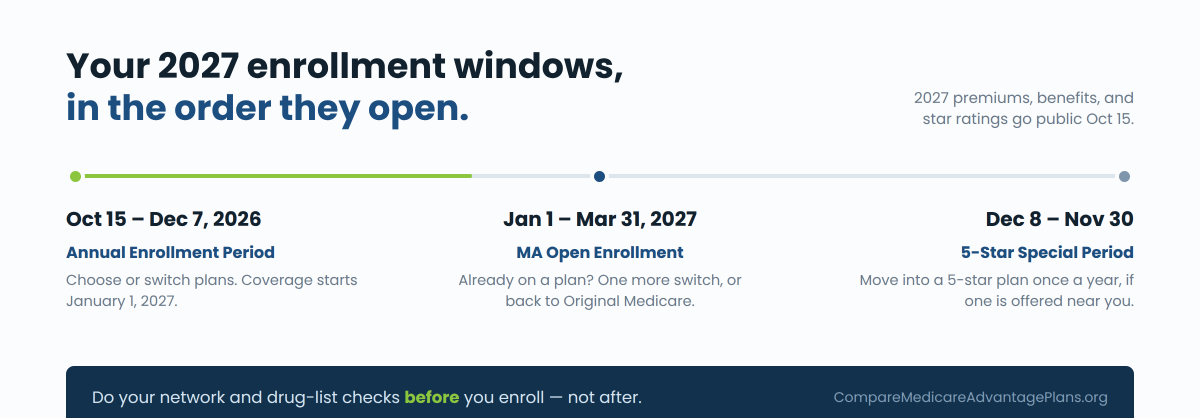
If a 5-star plan is available where you live, it carries a scheduling advantage: the 5-Star Special Enrollment Period lets you switch into it once per year outside the standard windows, between December 8 and November 30.

Medicare advantage star ratings for 2027

What's Changing in Star Ratings for 2027

The CY 2027 final rule modified how ratings are calculated. The changes that matter to you as a consumer:

  • Eleven measures were removed — administrative process measures where nearly all plans performed identically, so they weren’t distinguishing anything.
  • The Excellent Health Outcomes for All reward was discontinued, while the historical reward for consistently high performance continues.
  • A new Part C depression screening and follow-up measure was added, phasing in for the 2029 Star Ratings.

Practical effect: 2027 ratings are built on a slightly different measure set than prior years, so comparing a plan’s 2027 star rating directly against its 2025 rating isn’t quite apples to apples.

Supplemental Benefit Rules That Change in 2027

Three finalized changes affect how extra benefits work:

  • Plans must publicly post their eligibility criteria for Special Supplemental Benefits for the Chronically Ill. Previously these criteria were often opaque — now you can check before enrolling whether you’d actually qualify.
  • Benefit debit cards require real-time eligibility verification, which reduces declined transactions at the register but means the card checks your eligibility at point of sale.
  • Mid-year unused-benefit notices are no longer required. Your plan is no longer obligated to remind you about allowances you haven’t spent — track them yourself.

The Five Checks Before You Enroll

Run all five before you enroll, not after. Four of the five can only be verified against that plan’s own 2027 documents — the Summary of Benefits, the provider directory and the formulary — and those do not publish until CMS releases plan data on October 1, 2026. Annual Enrollment runs October 15 through December 7, which gives you two weeks to check before the window even opens. Once you enroll, you are generally locked in until the following January unless you qualify for a Special Enrollment Period.

When You Can Enroll for 2027

Medicare advantage enrollment period windows

The Annual Enrollment Period runs October 15 through December 7, 2026, for coverage effective January 1, 2027. This is when 2027 plan details, premiums, and star ratings become public.

If you’re already enrolled in a Medicare Advantage plan, the Medicare Advantage Open Enrollment Period from January 1 to March 31, 2027 gives you one additional switch, or the option to return to Original Medicare.

If you’re new to Medicare, your Initial Enrollment Period runs from three months before through three months after the month you turn 65.

Ready to see what’s available where you live? Compare 2027 Medicare Advantage plans by ZIP code.

View plans, benefits, and costs in your zip code

2027 Medicare Advantage Plans Costs and Benefits — Frequently Asked Questions

What will happen to Medicare Advantage in 2027?

Medicare Advantage is contracting for 2027 rather than expanding. Several carriers have announced they are reducing plan offerings or exiting counties entirely, and roughly one in ten current members is expected to see their plan go away. At the same time, federal rules finalized on April 2, 2026 improve the drug benefit: the Part D out-of-pocket cap rises to $2,400 and the maximum standard deductible to $700, with Medicare Advantage out-of-pocket limits set at $9,850 in-network and $14,800 combined. Supplemental benefits such as dental, vision and over-the-counter allowances are expected to keep shrinking. If your plan is not renewed for 2027, your carrier must notify you by October 1, 2026, and you qualify for a Special Enrollment Period to choose new coverage.

What is the Medicare Part D out-of-pocket cap for 2027?

The 2027 annual out-of-pocket cap for prescription drugs is $2,400, up from $2,100 in 2026. Once you reach it, you pay nothing more for covered formulary drugs for the rest of the calendar year. The standard Part D deductible for 2027 is $700, up from $615 — though many Medicare Advantage plans set a lower drug deductible or none at all.

How much do Medicare Advantage plans cost in 2027?

Plan premiums vary by ZIP code and many plans carry a $0 monthly premium, but premium is only one of five cost components. You’ll also pay your Medicare Part B premium regardless, plus copays, drug costs up to the $2,400 cap, and potentially up to your plan’s medical out-of-pocket maximum. Specific 2027 premiums become public when CMS releases plan data on October 1, 2026, two weeks before the Annual Enrollment Period opens on October 15.

Which carrier has the best Medicare Advantage plans for 2027?

It depends on what you’re optimizing for. UnitedHealthcare leads on network size and national availability at roughly 26% market share. Humana competes on supplemental benefit breadth at roughly 20%. Aetna’s CVS integration helps on pharmacy costs, and it had over 81% of members in 4-star-or-better plans for 2026. Kaiser Permanente had 100% of contracts at 4+ stars but operates only in limited regions. Carrier strength is a national average — verify plan quality in your own county.

What company has the highest rated Medicare Advantage plan?

By star ratings, Kaiser Permanente is the highest rated Medicare Advantage carrier, with 100% of its contracts rated 4 stars or higher for 2026 — though it operates in only a limited set of regions. Among the large national carriers available in most of the country, Aetna places the greatest share of members in 4-star-or-better plans at over 81%. Star ratings for 2027 plans have not been released and will not be published until CMS releases plan data on October 1, 2026, so any “highest rated 2027 plan” claim you see before that date is based on 2026 ratings. Ratings apply to a contract rather than to a county, so the highest rated carrier nationally is not automatically the highest rated plan available where you live.

Are Medicare Advantage benefits being cut in 2027?

Specific 2027 benefits aren’t public until the Annual Enrollment Period, so nothing is confirmed. Supplemental benefit reductions have been widely reported across recent plan years as carriers respond to margin pressure, so it’s reasonable to expect variation. Confirm every benefit you’re relying on in the plan’s official 2027 Summary of Benefits before enrolling rather than assuming it carries over from 2026.

Is a $0 premium Medicare Advantage plan actually free?

No. You still pay your Medicare Part B premium, and a $0-premium plan can carry copays, a drug deductible up to $700, and a higher medical out-of-pocket maximum than a plan charging a monthly premium. Compare total expected annual cost — premium plus copays plus drug spend — rather than the premium line alone.

What is changing with Medicare Advantage star ratings in 2027?

CMS removed 11 administrative process measures where plan performance barely varied, discontinued the Excellent Health Outcomes for All reward, and added a Part C depression screening measure phasing in for the 2029 ratings. Because the measure set changed, a plan’s 2027 rating isn’t a direct like-for-like comparison against its rating from two years earlier.

Are there any 5-star Medicare Advantage plans?

Yes. Eighteen Medicare Advantage contracts earned 5 stars for 2026, up from seven the prior year, though they aren’t offered in every county. Five-star plans carry an enrollment advantage: the 5-Star Special Enrollment Period lets you switch into one once per year between December 8 and November 30, outside the standard windows. Check whether your doctors participate before assuming a 5-star plan is the right fit.

Do I still have to pay the Part B premium with a Medicare Advantage plan?

Yes. Medicare Advantage replaces how your Part A and Part B benefits are delivered, but you remain enrolled in Medicare and continue paying the Part B premium. Some plans offer a Part B premium giveback that reduces this amount, but that’s a specific plan feature and not a general rule.

What is the out-of-pocket maximum on a Medicare Advantage plan?

Every Medicare Advantage plan caps your annual in-network medical spending — this is one of the structural advantages over Original Medicare, which has no cap. The specific amount varies substantially between plans, sometimes by several thousand dollars in the same county. It’s separate from the $2,400 prescription drug cap, so budget for both.

When can I enroll in a 2027 Medicare Advantage plan?

The Annual Enrollment Period runs October 15 through December 7, 2026, for coverage effective January 1, 2027. If you’re already in a Medicare Advantage plan, the Medicare Advantage Open Enrollment Period from January 1 to March 31, 2027 allows one additional switch. If you’re new to Medicare, your Initial Enrollment Period runs three months before through three months after your 65th birthday month.

Have Questions?

Speak with a licensed insurance agent

1-855-454-9051

TTY users 711

Mon-Fri: 8am-9pm ET

Find & Compare Plans Online

Speak with a licensed insurance agent

1-855-454-9051TTY 711

Mon-Fri: 8am-9pm ET

ZRN Health & Financial Services, LLC, a Texas limited liability company