





Speak with a licensed insurance agent

1-855-454-9051

TTY user 711 Mon-Fri : 8am-9pm EST

Medicare Advantage OTC Benefits and Flex Cards in 2027: Who Gets One and What Changed

Reviewed by Russell Noga, Licensed Medicare Insurance Broker (all 50 states) — Last updated October 31, 2026

An over-the-counter (OTC) allowance is still one of the most common extras in Medicare Advantage, but fewer 2027 plans offer one than in 2026, and the grocery and utility money that ads talk about is mostly limited to special needs plans. We went through CMS’s 2027 plan benefit files to count which plans include OTC, food and utility benefits, and how that differs by insurer.

Annual Enrollment runs October 15 to December 7, 2026, for coverage that starts January 1, 2027. If an OTC card is part of why you picked your plan, check the 2027 Evidence of Coverage before you renew: the allowance, how often it resets, and what it can be used for can all change from year to year.

✔ Licensed across all 50 states✔ Built on CMS 2027 data✔ No-cost plan comparison

Compare 2027 Medicare Advantage Plans With OTC Benefits

Speak with a licensed insurance agent

1-855-454-9051TTY 711

Mon-Fri: 8am-9pm ET

Agent 08
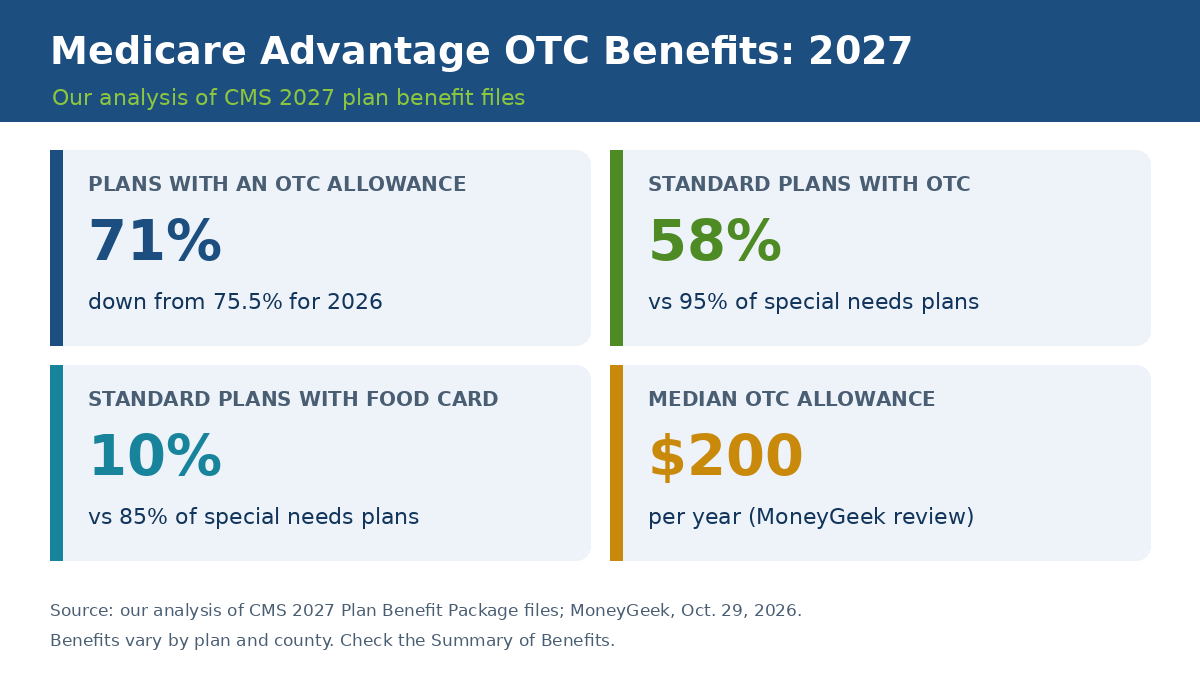
Medicare Advantage OTC benefits 2027: 71% of plans include an OTC allowance, 58% of standard plans vs 95% of special needs plans, 10% of standard plans include a food card, median OTC allowance $200 a year

The Short Answer for 2027

Our analysis of CMS 2027 plan data

✔

71% of individual Medicare Advantage plans (3,928 of 5,520 plan segments) include an OTC allowance for 2027, down from 75.5% for 2026.

✔

Standard plans vs special needs plans: 58% of standard plans include OTC, compared with 95% of special needs plans (SNPs).

✔

Grocery money is mostly an SNP benefit: 85% of SNPs include a food or grocery benefit, but only 10% of standard plans do.

✔

Utility help is rarer still: 70% of SNPs and 7% of standard plans include help with utility bills.

MoneyGeek’s separate review of the same CMS filings, published October 29, 2026, found the share of standard plans offering OTC to every member fell from 66.3% to 58.0%, the biggest drop of any extra benefit it tracked, and put the median separate OTC allowance at $200 a year. Plans also cut back in other areas, but OTC moved the most.

OTC Allowance vs Flex Card vs Grocery Card

Plans and ads use these names loosely, which is where much of the confusion comes from. In the plan documents they are usually different benefits with different rules:

What it is called Who can usually get it What it typically covers
OTC allowance Anyone enrolled in a plan that includes it Over-the-counter health items such as pain relievers, cold medicine, first-aid supplies and vitamins, from a catalog, approved stores or online
Flex card / benefit card Depends on the plan; often a single card that holds several benefits May hold OTC money plus other allowances such as dental, vision or hearing; each pot has its own limit
Grocery or food card Mostly members of chronic-condition or dual-eligible special needs plans who meet the plan’s criteria Healthy food and produce at approved stores
Utility help Mostly SNP members who meet the plan’s criteria Help with bills such as electric, gas or water, up to a set amount

Source: CMS plan benefit categories; plan Evidence of Coverage documents. Benefits vary by plan and county.

Food and utility benefits are usually offered as Special Supplemental Benefits for the Chronically Ill (SSBCI). The plan has to confirm that you have a qualifying chronic condition before it can give them to you. UnitedHealthcare, for example, told providers that starting January 1, 2026, its C-SNP members need a documented qualifying condition to use the healthy food or utility benefits, and that cardiovascular disorders, chronic heart failure and diabetes qualify members for the food benefit but not the utility benefit.

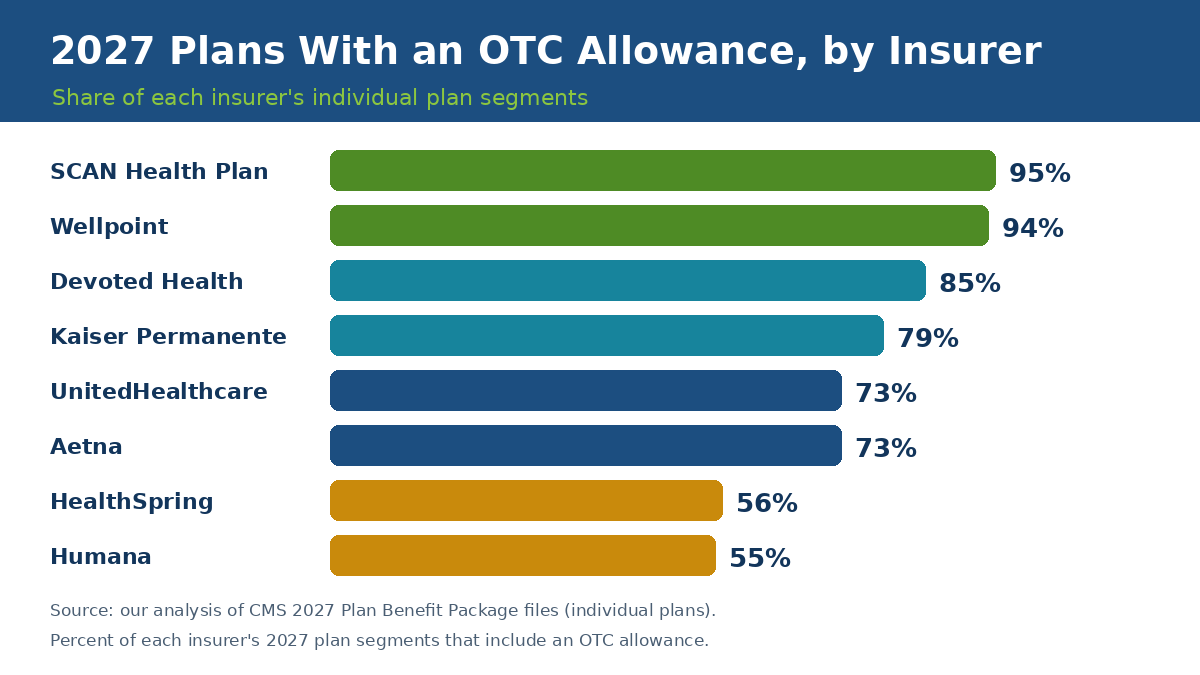
2027 Medicare Advantage plans with an OTC allowance by insurer: SCAN 95%, Wellpoint 94%, Devoted 85%, Kaiser 79%, UnitedHealthcare 73%, Aetna 73%, HealthSpring 56%, Humana 55%

Our Analysis: OTC, Food and Utility Benefits by Insurer

This side-by-side count comes from CMS’s 2027 plan benefit files. It shows how many of each insurer’s 2027 individual plan segments include each benefit. Insurers that file a separate plan for many counties, such as Devoted Health, show higher counts.

Insurer 2027 plans With OTC With food With utilities
UnitedHealthcare 822 599 (73%) 322 212
Humana 793 433 (55%) 218 235
Devoted Health 740 629 (85%) 286 286
Aetna 651 473 (73%) 275 275
Wellcare 210 146 (70%) 92 92
HealthSpring 195 110 (56%) 47 0
Kaiser Permanente 117 92 (79%) 18 0
SCAN Health Plan 83 79 (95%) 42 8
Alignment Health Plan 77 56 (73%) 46 41
Wellpoint 63 59 (94%) 45 40

Source: our analysis of CMS 2027 Plan Benefit Package files (individual plans; plan segments). Benefit amounts and eligibility vary by plan.

Two things stand out. Humana includes OTC in just over half of its 2027 plans, the lowest share of the large national insurers in this table. HealthSpring and Kaiser Permanente file no plans with a utility benefit. If OTC matters to you, compare the specific plans in your county instead of assuming one insurer always includes it. Our 2027 costs and benefits by carrier guide covers the other extras.

Compare 2027 Medicare Advantage Plans With OTC Benefits

Speak with a licensed insurance agent

1-855-454-9051TTY 711

Mon-Fri: 8am-9pm ET

Agent 08

Rules That Affect Your Card in 2027

1

No more mid-year reminder. A 2024 CMS rule would have made plans mail each member a personal notice of supplemental benefits they had not used in the first half of the year. CMS scrapped that requirement in its 2027 Medicare Advantage and Part D final rule before the first notices went out. CMS cited a survey of 1,846 enrollees in which 70% said they had used at least one supplemental benefit in the prior year. You will need to track your own balance.

2

The card checks what you buy. CMS requires benefit debit cards to be tied electronically to the items and services the plan covers, so an item the plan doesn’t cover can be declined at the register. Plans must also have another way to get a covered benefit if the card does not work.

3

Unused money usually doesn’t carry over. Allowances are tied to the plan year, and many reset monthly or quarterly. Check whether unused amounts roll forward within the year.

4

SSBCI rules must be public. Plans offering benefits for the chronically ill have to publish who qualifies, so you can check before you enroll.

Ads that promise every person on Medicare a large grocery or flex card do not match the plan data. In our count, only 10% of standard Medicare Advantage plans include a food benefit, and most of the plans that do are special needs plans that only people with Medicaid or a qualifying chronic condition can join. There is no government card that every person on Medicare gets.

Before you call an ad

Ask the agent for the plan name, its contract and plan number (for example H1234-001), and the exact OTC, food and utility amounts in the plan’s Summary of Benefits. Then look up the same plan on Medicare.gov Plan Finder. If the agent can’t name a plan, keep shopping.

If you have both Medicare and Medicaid, a dual-eligible plan is often where the biggest allowances are. Our guide to Medicare Advantage for people under 65 with disabilities explains special needs plan eligibility.

How to Compare OTC Benefits Between Plans

1

Find the dollar amount and period. $50 a month and $150 a quarter are about the same yearly value, but monthly money is easier to lose if you don’t use it.

2

Check where you can shop. Some plans limit you to a mail-order catalog; others work at specific store chains.

3

See whether the card is shared. If OTC and other benefits share one balance, spending on one leaves less for the other.

4

Read the eligibility line for food and utilities. If it says “for members who qualify” or names chronic conditions, not every member gets it.

5

Weigh the whole plan. An OTC allowance is small next to the out-of-pocket maximum, drug costs and whether your doctors are in network.

Compare 2027 Medicare Advantage Plans With OTC Benefits

Speak with a licensed insurance agent

1-855-454-9051TTY 711

Mon-Fri: 8am-9pm ET

Agent 08

Medicare Advantage OTC Benefits and Flex Cards — Frequently Asked Questions

➤ How many 2027 Medicare Advantage plans include an OTC allowance?

Our analysis of CMS 2027 plan benefit files found that 71% of individual Medicare Advantage plan segments include an OTC allowance, down from 75.5% for 2026.

➤ Do standard Medicare Advantage plans include a grocery card in 2027?

Rarely. Only about 10% of standard plans include a food or grocery benefit, compared with 85% of special needs plans.

➤ What is the median OTC allowance for 2027?

MoneyGeek’s review of CMS filings put the median separate OTC allowance at $200 a year. Many plans offer more or less, so check the Summary of Benefits.

➤ Will my plan remind me about unused OTC money in 2027?

Not because of a CMS rule. CMS dropped the planned mid-year notice of unused supplemental benefits in its 2027 final rule, so check your balance yourself.

➤ Can my flex card be declined at the store?

Yes. Benefit cards are tied to the items the plan covers, so an item the plan doesn’t cover can be declined at checkout.

➤ Which insurer includes OTC in the most 2027 plans?

By share of plans in our count, SCAN Health Plan (95%) and Wellpoint (94%) were highest. Devoted Health had the most plans with OTC, 629.

➤ Is there a government flex card for everyone on Medicare?

No. Flex cards and allowances come from individual Medicare Advantage plans, and food and utility money is mostly limited to special needs plan members who qualify.

➤ Does unused OTC money roll over to the next year?

Usually not. Allowances are tied to the plan year, and many reset monthly or quarterly. Check your plan’s Evidence of Coverage.

New to Medicare?

If you are new to Medicare, then you can enroll in a 2027 Medicare Advantage plan up to three months prior to your Medicare Part B effective date.

Call one of our licensed insurance agents to see what the best time frame is for you to enroll, based on your current situation. You can contact them at 1-855-454-9051 (TTY 711), Mon–Fri 8am–9pm EST.

Have Questions?

Speak with a licensed insurance agent

1-855-454-9051

TTY users 711

Mon-Fri: 8am-9pm ET

Compare plans & benefits in your area

Or speak with a licensed insurance agent

1-855-454-9051TTY 711

Mon-Fri: 8am-9pm ET

Agent 08