





Speak with a licensed insurance agent

1-855-454-9051

TTY user 711 Mon-Fri : 8am-9pm EST

Institutional Special Needs Plans 2027: I-SNPs for Nursing Home Residents, Who Sells Them and How to Join

Reviewed by Russell Noga, Licensed Medicare Insurance Broker (all 50 states) — Last updated November 20, 2026

Short answer: An institutional special needs plan (I-SNP) is a Medicare Advantage plan only for people who live, or are expected to live, 90 days or longer in a nursing home or similar long-term care facility, or who live at home but need that level of care. Our count of CMS’s 2027 plan files finds 163 I-SNPs sold in 42 states and Washington, D.C., all with Part D drug coverage. The median U.S. county has 2 to choose from, and 1,052 counties have none.

I-SNPs are the smallest of the three special needs plan types, but they work very differently from a regular Medicare Advantage plan: many are run by or with nursing home operators and put a nurse practitioner or care team inside the facility. Below: who qualifies, the three kinds of I-SNP, which insurers sell the most for 2027, what the plans do and do not pay for, and the enrollment rules that apply to nursing home residents.

✔ Licensed across all 50 states✔ Built on CMS 2027 data✔ No-cost plan comparison

See 2027 Nursing Home Plans in Your ZIP Code

Speak with a licensed insurance agent

1-855-454-9051TTY 711

Mon-Fri: 8am-9pm ET

Agent 08
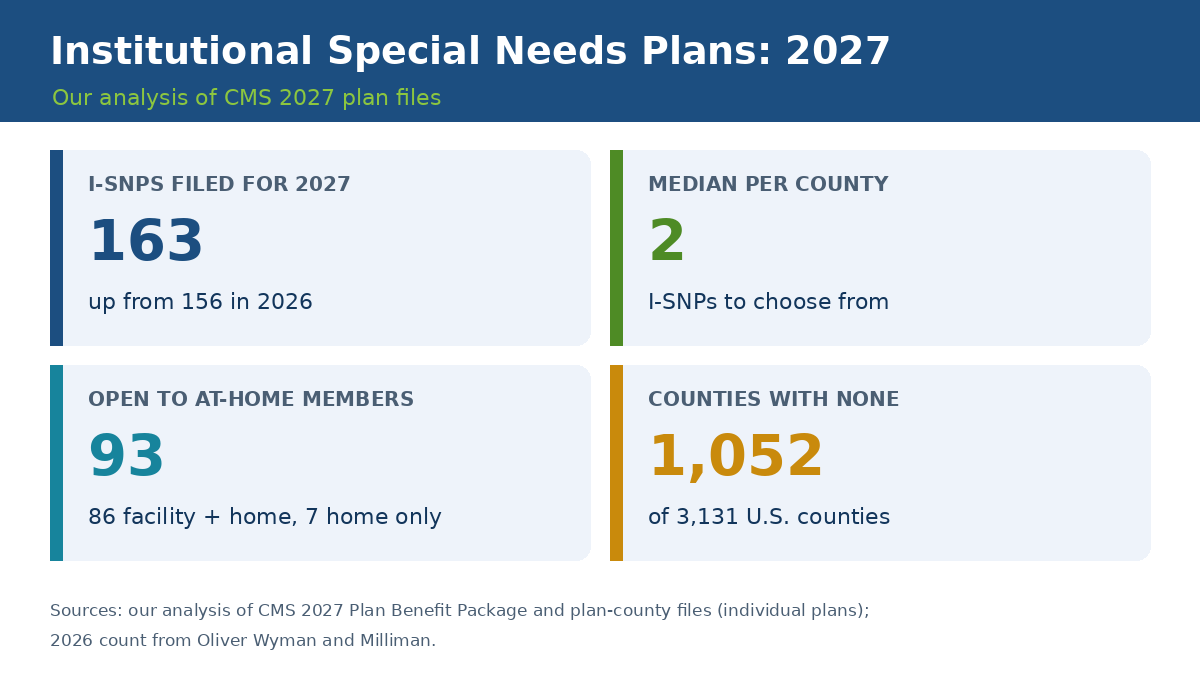
Institutional special needs plans 2027: 163 I-SNPs filed with CMS, up from 156, a median 2 per county, 93 open to members living at home, 1,052 counties with none

I-SNPs in 2027: Our Count of CMS Plan Files

Our analysis of CMS 2027 plan data

✔

163 I-SNPs are filed for 2027: 3% of the 5,481 individual Medicare Advantage plans, next to 1,050 dual plans and 752 chronic-condition plans.

✔

Who they enroll: 70 plans take facility residents only, 86 take both facility residents and people living at home who need nursing-home-level care, and 7 are for at-home members only.

✔

Plan types: 95 HMOs, 51 PPOs and 17 HMO-POS plans. All 163 include Part D.

✔

Where: 2,079 of 3,131 counties have at least one I-SNP and 289 have exactly one. Pasco County, Florida, has the most (10).

✔

No I-SNP is filed in Hawaii, Massachusetts, Minnesota, Montana, New Mexico, Vermont, Wyoming or Puerto Rico for 2027.

Two industry counts point the same way. Oliver Wyman (Nov. 4, 2026) counts I-SNP bids rising from 156 to 163 for 2027, with the average county going from 1.8 to 2.3 plans. Milliman (March 2026) counted 156 I-SNPs for 2026 and found enrollment growing nearly 7% a year from 2023 to 2026, faster in rural areas (about 13%) than urban ones (about 4%).

Who Qualifies for an Institutional Special Needs Plan

You need Medicare Part A and Part B and you must live in the plan’s service area. Then you must meet one of two CMS tests:

Test What CMS requires Typical plan wording
Institutional You have needed, or are expected to need, long-term care for 90 days or longer in a long-term care skilled nursing facility, a nursing facility, an intermediate care facility for people with intellectual disabilities, or an inpatient psychiatric facility “Nursing home plan” or “facility” I-SNP; you must live in a facility the plan contracts with
Institutional-equivalent You live in the community (your home or often assisted living) but a state assessment finds you need an institutional level of care “Community” or “home care” I-SNP

Source: CMS Institutional Special Needs Plans page. The full list of facility types is in CMS’s Medicare Advantage enrollment and disenrollment guidance.

For the at-home test, the level-of-care assessment must use the same state tool used for nursing home residents, and it must be done by an independent party that the I-SNP does not own or control. If you move to a different facility, the plan has to show it can still deliver its care model there or at another contracted setting, or you may need to change plans.

The 90-day rule is about expected need

You do not have to wait 90 days after admission. If your care team expects you to need long-term care for at least 90 days, you can generally qualify from the start. A short rehab stay after a hospital discharge usually does not count.

Three Kinds of I-SNP, and How Common Each Is

Kind of I-SNP 2027 plans (our count) Who it is for Example plan names in the CMS file
Facility-based (institutional) 70 Residents of a contracted nursing home or long-term care facility UHC Nursing Home Plan, Longevity Health Plan, Aetna Medicare Longevity
Facility and community 86 Facility residents plus people at home who need nursing-home-level care SCAN Embrace, AgeRight Advantage, CareMore Home Care plans
Community only (institutional-equivalent) 7 People at home or in assisted living with a state level-of-care finding UHC Care Advantage, Abilis Health Community, Provider Partners Indiana Essential Plan

Source: our analysis of CMS 2027 Plan Benefit Package files (institutional SNP type field), individual plans only. Plan names as filed with CMS; availability varies by county.

The practical difference: a facility-based plan only works if your nursing home has a contract with it. Ask the facility’s admissions or business office which I-SNPs it works with before you look at anything else.

See 2027 Nursing Home Plans in Your ZIP Code

Speak with a licensed insurance agent

1-855-454-9051TTY 711

Mon-Fri: 8am-9pm ET

Agent 08
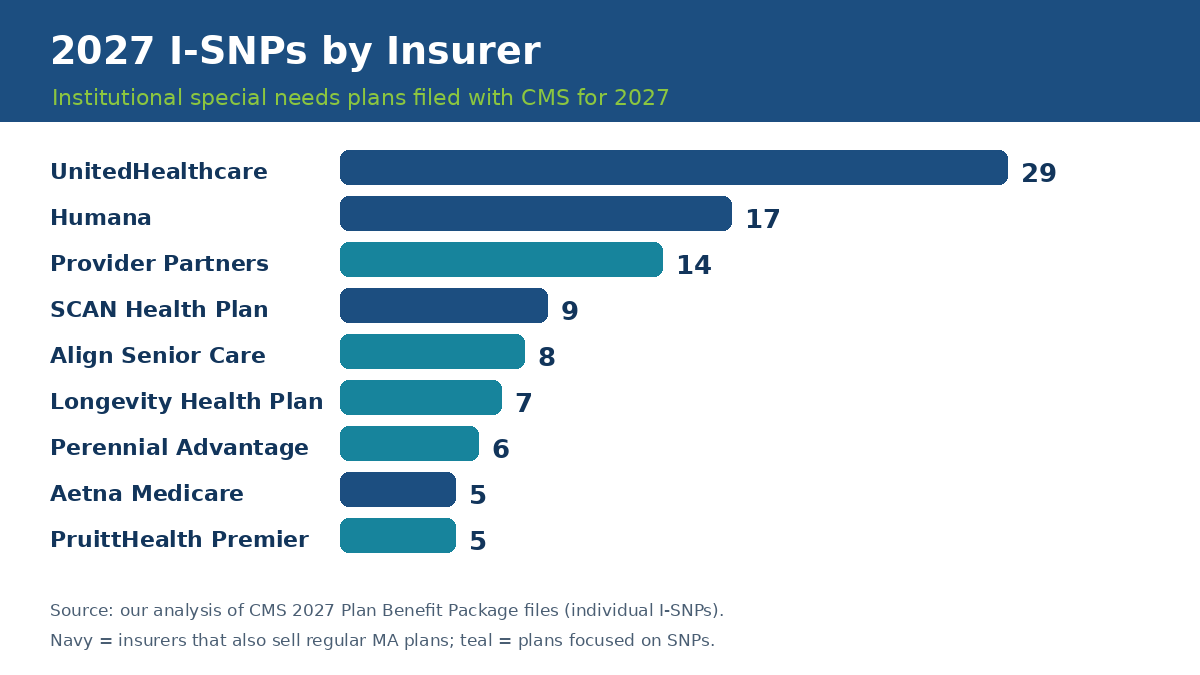
2027 I-SNPs by insurer: UnitedHealthcare 29, Humana 17, Provider Partners 14, SCAN Health Plan 9, Align Senior Care 8, Longevity Health Plan 7, Perennial Advantage 6, Aetna Medicare 5, PruittHealth Premier 5

Who Sells the Most I-SNPs for 2027

Insurer brand 2027 I-SNPs (our count)
UnitedHealthcare 29
Humana 17
Provider Partners Health Plans 14
SCAN Health Plan 9
Align Senior Care 8
Longevity Health Plan 7
Perennial Advantage 6
Aetna Medicare 5
PruittHealth Premier 5
Great Plains Medicare Advantage 4

Source: our analysis of CMS 2027 Plan Benefit Package files, individual I-SNPs. 47 insurer brands file at least one I-SNP.

Most of the smaller names are regional plans that sell only, or mainly, special needs plans, and some are tied to long-term care operators (PruittHealth runs nursing homes in the Southeast), so where they are sold follows the facilities they work with. UnitedHealth Group is still the largest, but Milliman found its share of I-SNP enrollment fell from 57% in 2023 to 46% in 2026. By state, Florida has the most I-SNPs for 2027 (12), followed by Ohio (11), North Carolina (10), and Indiana, Missouri and New York (9 each). Carrier guides: Provider Partners Health Plans and Perennial Advantage.

What an I-SNP Pays For, and What It Does Not

Cost or service In an I-SNP Notes
Doctor, hospital and skilled nursing care Covered as Medicare Advantage benefits Plans must cover everything Original Medicare covers
Prescription drugs Included in all 163 plans $2,400 Part D out-of-pocket cap in 2027
On-site care team Usually a nurse practitioner or care coordinator who sees you in the facility Each I-SNP runs a CMS-approved model of care
Long-term custodial care (room and board, help with daily activities) Not paid by Medicare or the I-SNP Paid by you, Medicaid or long-term care insurance
Dental and other extras Vary by plan; may include dental or other supplemental benefits Milliman found comprehensive dental in national I-SNPs fell from 98% (2025) to 56% (2026)
Your out-of-pocket maximum Set by the plan, up to the $9,850 in-network cap for 2027 People with Medicaid often owe less

Sources: CMS I-SNP page; CMS 2027 MOOP and Part D parameters; Milliman, Medicare Advantage institutional special needs plans: 2026 market landscape (March 19, 2026). 2027 benefits vary by plan and county.

The biggest misunderstanding: an I-SNP does not pay the nursing home bill. It covers Medicare services for someone who lives there. If the cost of the stay is the problem, look at Medicaid eligibility in your state. More on how Medicare Advantage handles skilled nursing, hospice and home health in our nursing home, hospice and home health guide.

When Nursing Home Residents Can Join or Switch

1

Special enrollment period for institutional residents: if you move into, live in, or move out of a qualifying facility, Medicare lets you join, switch or drop a Medicare Advantage plan, including an I-SNP, outside the usual dates. It lasts while you live there and for two months after you move out.

2

Medicare and Medicaid together: people with both have their own monthly options; see our guide to dual eligible special needs plans 2027.

3

Annual Enrollment, October 15 to December 7: any change, effective January 1, 2027.

4

Medicare Advantage Open Enrollment, January 1 to March 31: one switch if you are already in a plan; see the Medicare Advantage Open Enrollment Period 2027.

5

If you stop qualifying, for example after moving home without an institutional level of care, the plan can disenroll you and you get a special enrollment period to choose other coverage.

Coverage generally starts the first day of the month after the plan gets your application. Before enrolling, confirm three things: the facility contracts with the plan, your current doctors or the plan’s facility clinicians will manage your care, and your drugs are on the plan’s 2027 formulary. Compare with the other special needs plan types in our Medicare Advantage special needs plans guide and our C-SNP guide.

See 2027 Nursing Home Plans in Your ZIP Code

Speak with a licensed insurance agent

1-855-454-9051TTY 711

Mon-Fri: 8am-9pm ET

Agent 08

Institutional Special Needs Plans — Frequently Asked Questions

➤ How many institutional special needs plans are there for 2027?

Our count of CMS 2027 plan files finds 163 individual I-SNPs in 42 states and Washington, D.C. Oliver Wyman also counts 163 I-SNP bids, up from 156 in 2026.

➤ Do I have to live in a nursing home to join an I-SNP?

No. 93 of the 163 plans in our count accept people living at home or in assisted living who have a state assessment showing they need a nursing-home level of care. The other 70 are for facility residents only.

➤ Does an I-SNP pay for nursing home room and board?

No. An I-SNP covers Medicare services such as doctor visits, hospital care, skilled nursing and drugs. Long-term custodial care is paid by you, Medicaid or long-term care insurance.

➤ Can I keep my own doctor in an I-SNP?

Only if the doctor is in the plan’s network. Many I-SNPs use their own nurse practitioners and physicians who visit the facility, so ask the plan who will be your main clinician.

➤ Which states have no I-SNPs in 2027?

Hawaii, Massachusetts, Minnesota, Montana, New Mexico, Vermont and Wyoming have none in our count, and neither does Puerto Rico. Nationally, 1,052 counties have no I-SNP.

➤ Is an I-SNP the same as a D-SNP?

No. A D-SNP is for people with Medicare and Medicaid; an I-SNP is for people who need long-term care in a facility or at that level at home. Many nursing home residents have Medicaid, so they may qualify for both and should compare.

➤ Can I leave an I-SNP during the year?

Usually yes. People who live in a qualifying facility, or left one within the last two months, can change plans outside the normal enrollment dates.

➤ Who sells the most I-SNPs for 2027?

UnitedHealthcare (29), Humana (17), Provider Partners Health Plans (14), SCAN Health Plan (9) and Align Senior Care (8) in our count of CMS plan files.

New to Medicare?

If you are new to Medicare, then you can enroll in a 2027 Medicare Advantage plan up to three months prior to your Medicare Part B effective date.

Call one of our licensed insurance agents to see what the best time frame is for you to enroll, based on your current situation. You can contact them at 1-855-454-9051 (TTY 711), Mon–Fri 8am–9pm EST.

Have Questions?

Speak with a licensed insurance agent

1-855-454-9051

TTY users 711

Mon-Fri: 8am-9pm ET

Compare plans & benefits in your area

Or speak with a licensed insurance agent

1-855-454-9051TTY 711

Mon-Fri: 8am-9pm ET

Agent 08