





Speak with a licensed insurance agent

1-855-454-9051

TTY user 711 Mon-Fri : 8am-9pm EST

Chronic Condition Special Needs Plans (C-SNPs) in 2027: Who Qualifies and Where They're Sold

Reviewed by Russell Noga, Licensed Medicare Insurance Broker (all 50 states) — Last updated October 31, 2026

A chronic condition special needs plan (C-SNP) is a Medicare Advantage plan that only people with certain long-term illnesses can join, most often diabetes, chronic heart failure or cardiovascular disease. In exchange for that limit, the plan builds its doctors, drug list and care management around the condition, and many C-SNPs add extras that standard plans don’t.

C-SNPs are the fastest-growing kind of special needs plan. KFF reported that C-SNP enrollment rose 71% from 2024 to 2025, the first year C-SNP growth outpaced plans for people with Medicaid. Below is what our count of CMS’s 2027 plan files shows about where these plans are sold and who offers them, plus how the enrollment rules differ from a regular plan.

✔ Licensed across all 50 states✔ Built on CMS 2027 data✔ No-cost plan comparison

See 2027 Chronic Condition Plans in Your ZIP Code

Speak with a licensed insurance agent

1-855-454-9051TTY 711

Mon-Fri: 8am-9pm ET

Agent 08
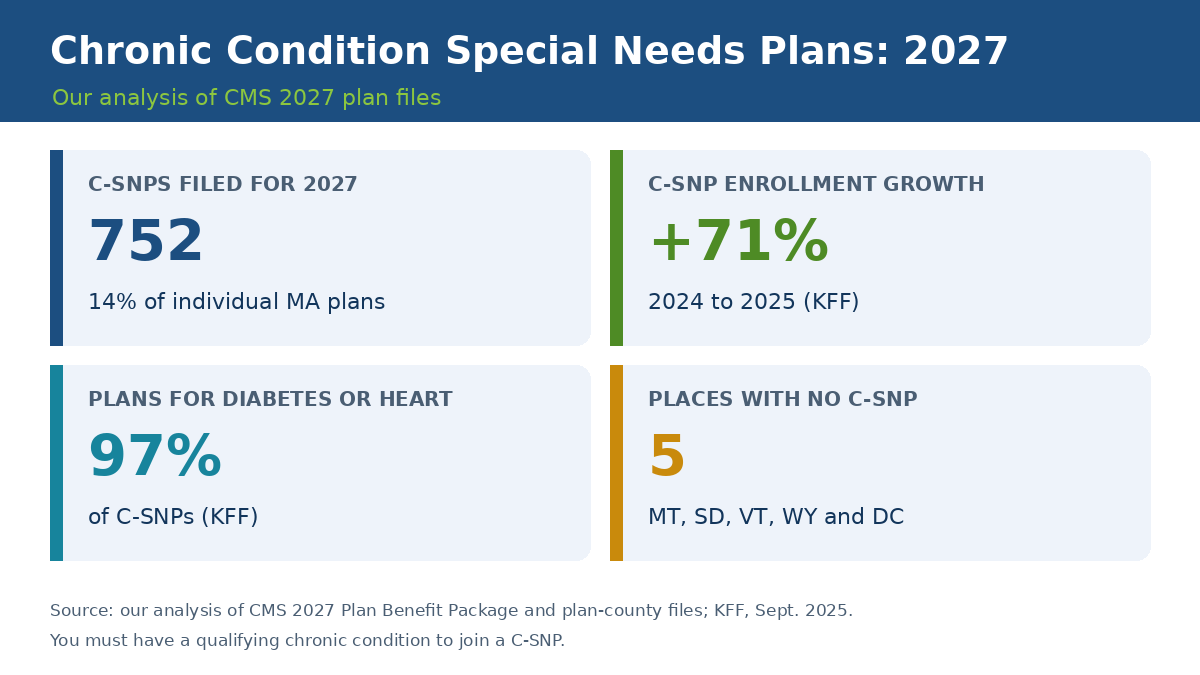
Chronic condition special needs plans 2027: 752 C-SNPs filed, enrollment up 71% from 2024 to 2025, 97% for diabetes or heart conditions, no C-SNPs in Montana, South Dakota, Vermont, Wyoming or DC

C-SNPs in 2027 by the Numbers

Our analysis of CMS 2027 plan data

✔

752 C-SNPs are filed for 2027, about 14% of the 5,481 individual Medicare Advantage plans and 38% of all special needs plans.

✔

54 insurer brands offer at least one. Devoted Health files the most (255), followed by UnitedHealthcare (103), Humana (73) and Aetna (73).

✔

Plan types: 433 HMOs, 145 HMO-POS plans and 174 PPOs. Most C-SNP members will need to use the plan’s network.

✔

Not everywhere: C-SNPs are sold in 2,433 counties, but none are filed for Montana, South Dakota, Vermont, Wyoming or Washington, D.C.

✔

94 C-SNPs have “Giveback” in the name, meaning they may lower your Part B premium.

Plan names give a rough sense of focus: 108 C-SNP names mention diabetes, 107 mention heart or cardiovascular conditions, 26 mention kidney disease and 22 mention lung disease or COPD. Many others, such as “Chronic Care” or “Complete Care” plans, cover a group of conditions without naming them. KFF found that 97% of C-SNPs are for people with diabetes or cardiovascular conditions.

Which Conditions Qualify?

CMS keeps a list of severe or disabling chronic conditions that a C-SNP can be built around, and each plan chooses one condition or a group of related conditions from that list. Milliman counts 24 chronic conditions that plans can name when they file with CMS. In practice, the 2027 plans cluster around a few:

Condition focus How common in 2027 Example of who offers it
Diabetes, often paired with heart conditions Most common Humana “Diabetes and Heart” HMO and PPO plans; many UnitedHealthcare and Devoted plans
Chronic heart failure and cardiovascular disorders Most common Often bundled with diabetes in the same plan
End-stage renal disease or chronic kidney disease Uncommon (26 plan names) Gold Kidney Health Plan (15 C-SNPs), Humana, Anthem and Wellpoint
Chronic lung disorders such as COPD Uncommon (22 plan names) Humana, Wellpoint and Anthem

Source: our analysis of CMS 2027 Plan Benefit Package files (plan names); KFF; Milliman. A plan’s qualifying conditions are listed in its enrollment materials.

You don’t need to have every condition a plan lists. If a plan is for “diabetes, chronic heart failure and cardiovascular disorders,” having one of them is usually enough. Ask the plan which diagnoses it accepts before you apply.

How Enrollment and Verification Work

1

You can join outside Open Enrollment. People with a qualifying condition who live where a C-SNP serves that condition have a special enrollment period that can be used at any time of year. It is generally tied to each condition, so it can’t be reused for the same diagnosis after you leave the plan.

2

Your doctor confirms the diagnosis. The plan sends a chronic condition verification form to your provider, or confirms the condition with the provider directly.

3

If it isn’t confirmed, you’re moved out. A plan that can’t verify your condition disenrolls you, and you return to Original Medicare unless you choose another plan.

4

Extra benefits need proof too. Healthy food and utility benefits for the chronically ill require a documented qualifying condition. UnitedHealthcare told providers this applies to its C-SNP members from January 1, 2026, and that cardiovascular disorders, heart failure and diabetes qualify members for food help but not utility help.

Ask for the verification status

After you enroll, call the plan within the first few weeks and ask whether your condition has been verified. A missing form is one of the easiest ways to lose a C-SNP you wanted.

See 2027 Chronic Condition Plans in Your ZIP Code

Speak with a licensed insurance agent

1-855-454-9051TTY 711

Mon-Fri: 8am-9pm ET

Agent 08
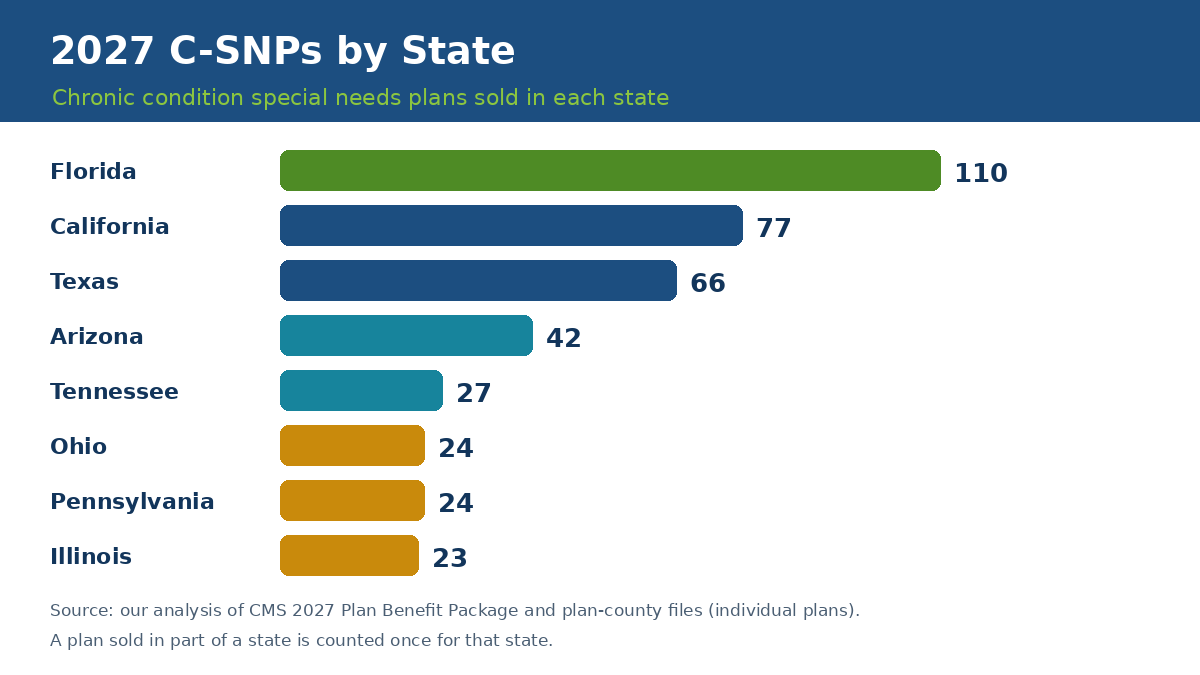
2027 C-SNPs by state: Florida 110, California 77, Texas 66, Arizona 42, Tennessee 27, Ohio 24, Pennsylvania 24, Illinois 23

Where C-SNPs Are Concentrated

C-SNPs follow the big Medicare Advantage markets. Florida has the most 2027 C-SNPs of any state in our count, 110, followed by California (77), Texas (66) and Arizona (42). Tennessee, Ohio, Pennsylvania and Illinois each have more than 20.

In rural states the choice is much thinner, and in five places there are none at all. If you live in Montana, South Dakota, Vermont, Wyoming or Washington, D.C., the closest options are standard Medicare Advantage plans, a dual special needs plan if you also have Medicaid, or Original Medicare. Check your state’s guide, such as Medicare Advantage plans in Florida or Medicare Advantage plans in Texas, for the local carriers.

C-SNP vs a Standard Medicare Advantage Plan

C-SNP Standard Medicare Advantage
Who can join Only people with a qualifying chronic condition Anyone with Parts A and B in the service area
When you can join Any time the special enrollment period applies, plus normal enrollment periods Annual Enrollment, Open Enrollment and other qualifying events
Drug coverage Required; formulary often built around the condition Usually included
Care coordination Required model of care for the condition Varies by plan
Grocery and utility help Common, for members who qualify Uncommon
Out-of-pocket maximum Same federal limits apply Same federal limits apply

Source: CMS special needs plan requirements; plan materials.

A C-SNP is not automatically better. Compare the network, the drug list and the out-of-pocket maximum the same way you would for any plan, and see our overview of Medicare Part C for how all Medicare Advantage plans work.

Questions to Ask Before You Enroll

✔

Which of my diagnoses qualify me for this plan, and how will you verify it?

✔

Are my endocrinologist, cardiologist or nephrologist in network for 2027?

✔

What tier are my diabetes or heart medicines on, and is insulin capped at $35 a month?

✔

Does the plan include a care manager, and how do I reach them?

✔

Is the food or utility allowance available to me, and how much is it?

✔

What happens to my coverage if my condition improves or can’t be confirmed?

See 2027 Chronic Condition Plans in Your ZIP Code

Speak with a licensed insurance agent

1-855-454-9051TTY 711

Mon-Fri: 8am-9pm ET

Agent 08

Medicare Advantage C-SNP Plans — Frequently Asked Questions

➤ How many C-SNPs are available for 2027?

Our analysis of CMS 2027 plan files counts 752 individual chronic condition special needs plans, about 14% of all individual Medicare Advantage plans.

➤ Which insurer offers the most C-SNPs in 2027?

Devoted Health files the most, 255, followed by UnitedHealthcare with 103 and Humana and Aetna with 73 each.

➤ Can I join a C-SNP outside Annual Enrollment?

Usually yes. People with a qualifying condition have a special enrollment period to join a C-SNP that serves that condition, which can be used during the year.

➤ What happens if my doctor doesn’t verify my condition?

The plan disenrolls you, and you go back to Original Medicare unless you pick another plan.

➤ Are there C-SNPs in every state?

No. Our count found no 2027 C-SNPs filed for Montana, South Dakota, Vermont, Wyoming or Washington, D.C.

➤ Which state has the most C-SNPs for 2027?

Florida, with 110 in our count of CMS plan files, followed by California with 77 and Texas with 66.

➤ Do C-SNPs include grocery cards?

Many do, but food and utility help usually requires a documented qualifying condition, and the amounts vary by plan.

➤ Is there a C-SNP for kidney disease?

A small number. Plan names mention kidney disease in 26 C-SNPs for 2027, including plans from Gold Kidney Health Plan, Humana, Anthem and Wellpoint.

New to Medicare?

If you are new to Medicare, then you can enroll in a 2027 Medicare Advantage plan up to three months prior to your Medicare Part B effective date.

Call one of our licensed insurance agents to see what the best time frame is for you to enroll, based on your current situation. You can contact them at 1-855-454-9051 (TTY 711), Mon–Fri 8am–9pm EST.

Have Questions?

Speak with a licensed insurance agent

1-855-454-9051

TTY users 711

Mon-Fri: 8am-9pm ET

Compare plans & benefits in your area

Or speak with a licensed insurance agent

1-855-454-9051TTY 711

Mon-Fri: 8am-9pm ET

Agent 08